|
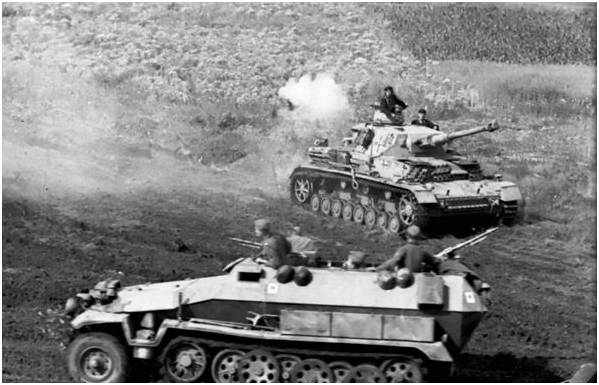
| Panzerkampfwagen IV Ausf F2 in Russia. |
The Panzerkampfwagen IV (Pz.Kpfw. IV), commonly known as the
Panzer IV, was a German medium tank developed in the late 1930s and used
extensively during the Second World War. Its ordnance inventory designation was
Sd.Kfz. 161.
Designed as an infantry-support tank, the Panzer IV was not
intended to engage enemy armor—that role being allocated to the Panzer III.
However, with the flaws of pre-war doctrine becoming apparent and in the face
of Soviet T-34 tanks, the Panzer IV soon assumed the original role of its
increasingly vulnerable cousin. The most widely manufactured and deployed
German tank of the Second World War, the Panzer IV was used as the base for
many other fighting vehicles, including the Sturmgeschütz IV assault gun,
Jagdpanzer IV tank destroyer, the Wirbelwind self-propelled anti-aircraft gun,
and the Brummbär self-propelled gun.
Robust and reliable, the Panzer IV saw service in all combat
theaters involving Germany and was notable for being the only German tank to
remain in continuous production throughout the war, with over 8800 produced
between 1936 and 1945. Upgrades and design modifications intended to counter
new threats, extended its service life. Generally, these involved increasing
the Panzer IV's armor protection or upgrading its weapons, although during the
last months of the war, with Germany's pressing need for rapid replacement of
losses, design changes also included simplifications to speed up the
manufacturing process.
The Panzer IV was generally succeeded by the Panther medium
tank introduced to counter the T-34. The Panzer IV was the most widely exported
tank in German service, with around 300 sold to Finland, Romania, Spain and
Bulgaria. After the war, Syria procured Panzer IVs from France and
Czechoslovakia, which were to see combat in the 1967 Six-Day War. Some 8,553
Panzer IVs of all versions were built during World War II, with only the StuG
III assault-gun/tank destroyer's production number of 10,086 vehicles exceeding
the Panzer IV's production total for Germany's and other Axis armored forces.
The Panzer IV was the brainchild of German general and
innovative armored warfare theorist General Heinz Guderian. In concept, it was
intended to be a support tank for use against enemy anti-tank guns and
fortifications. Ideally, each tank battalion in a panzer division was to have
three medium companies of Panzer IIIs and one heavy company of Panzer IVs. On
11 January 1934, the German army wrote the specifications for a "medium
tractor," and issued them to a number of defense companies. To support the
Panzer III, which would be armed with a 37-millimeter (1.46 in) anti-tank gun,
the new vehicle would have a short-barreled 75-millimeter (2.95 in) howitzer as
its main gun, and was allotted a weight limit of 24 tons (26.46 short tons).
Development was carried out under the name Begleitwagen ("accompanying
vehicle"), or BW, to disguise its actual purpose, given that Germany was
still theoretically bound by the Treaty of Versailles ban on tanks. MAN, Krupp,
and Rheinmetall-Borsig each developed prototypes, with Krupp's being selected
for further development.
The chassis had originally been designed with a six-wheeled
interleaved suspension, but the German Army amended this to a torsion bar
system. Permitting greater vertical deflection of the roadwheels, this was
intended to improve performance and crew comfort both on- and off-road.
However, due to the urgent requirement for the new tank, neither proposal was
adopted, and Krupp instead equipped it with a simple leaf spring double-bogie
suspension.
The prototype required a crew of five men; the hull contained
the engine bay to the rear, with the driver and radio operator, who doubled as
the hull machine gunner, seated at the front-left and front-right,
respectively. In the turret, the tank commander sat beneath his roof hatch,
while the gunner was situated to the left of the gun breech and the loader to
the right. The turret was offset 66.5 mm (2.62 in) to the left of the chassis
center line, while the engine was moved 152.4 mm (6.00 in) to the right. This
allowed the torque shaft to clear the rotary base junction, which provided
electrical power to turn the turret, while connecting to the transmission box
mounted in the hull between the driver and radio operator. Due to the
asymmetric layout, the right side of the tank contained the bulk of its stowage
volume, which was taken up by ready-use ammunition lockers.
Accepted into service as the Versuchskraftfahrzeug 622
(Vs.Kfz. 622), production began in 1936 at Fried. Krupp Grusonwerk AG factory
at Magdeburg.
The first mass-produced version of the Panzer IV was the
Ausführung A (abbreviated to Ausf. A, meaning "Variant A"), in 1936.
It was powered by Maybach's HL 108TR, producing 250 PS (183.87 kW), and used
the SGR 75 transmission with five forward gears and one reverse, achieving a
maximum road speed of 31 kilometers per hour (19.26 mph). As main armament, the
vehicle mounted the Kampfwagenkanone 37 L/24 (KwK 37 L/24) 75 mm (2.95 in) tank
gun, which was a low-velocity gun mainly designed to fire high-explosive
shells. Against armored targets, firing the Panzergranate (armor-piercing
shell) at 430 meters per second (1,410 ft/s) the KwK 37 could penetrate 43
millimeters (1.69 in), inclined at 30 degrees, at ranges of up to 700 meters
(2,300 ft). A 7.92 mm (0.31 in) MG 34 machine gun was mounted coaxially with
the main gun in the turret, while a second machine gun of the same type was
mounted in the front plate of the hull. The Ausf. A was protected by 14.5 mm
(0.57 in) of steel armor on the front plate of the chassis, and 20 mm (0.79 in)
on the turret. This was only capable of stopping artillery fragments, small-arms
fire, and light anti-tank projectiles.
After manufacturing 35 tanks of the A version, in 1937
production moved to the Ausf. B. Improvements included the replacement of the
original engine with the more powerful 300 PS (220.65 kW) Maybach HL 120TR, and
the transmission with the new SSG 75 transmission, with six forward gears and
one reverse gear. Despite a weight increase to 16 t (18 short tons), this
improved the tank's speed to 39 kilometers per hour (24 mph). The glacis plate
was augmented to a maximum thickness of 30 millimeters (1.18 in), and the
hull-mounted machine gun was replaced by a covered pistol port. Forty-two
Panzer IV Ausf. Bs were manufactured before the introduction of the Ausf. C in
1938. This saw the turret armor increased to 30 mm (1.18 in), which brought the
tank's weight to 18.14 t (20.00 short tons). After assembling 40 Ausf. Cs,
starting with chassis number 80341, the engine was replaced with the improved
HL 120TRM. The last of the 140 Ausf. Cs was produced in August 1939, and production
changed to the Ausf. D; this variant, of which 248 vehicles were produced,
reintroduced the hull machine gun and changed the turret's internal gun mantlet
to an external one. Again, protection was upgraded, this time by increasing
side armor to 20 mm (0.79 in). As the German invasion of Poland in September
1939 came to an end, it was decided to scale up production of the Panzer IV,
which was adopted for general use on 27 September 1939 as the
Sonderkraftfahrzeug 161 (Sd.Kfz. 161).
In response to the difficulty of penetrating the armor of
British infantry tanks (Matilda and Matilda II) during the Battle of France,
the Germans had tested a 50 mm (1.97 in) gun—based on the 5 cm Pak 38 anti-tank
gun—on a Panzer IV Ausf. D. However, with the rapid German victory in France,
the original order of 80 tanks was canceled before they entered production.
In October 1940, the Ausf. E was introduced. This had 50
millimeters (1.97 in) of armor on the bow plate, while a 30-millimeter (1.18
in) appliqué steel plate was added to the glacis as an interim measure.
Finally, the commander's cupola was moved forward into the turret. Older model
Panzer IV tanks were retrofitted with these features when returned to the
manufacturer for servicing. 206 Ausf. Es were produced between October 1940 and
April 1941.
In April 1941, production of the Panzer IV Ausf. F started.
It featured 50 mm (1.97 in) single-plate armor on the turret and hull, as
opposed to the appliqué armor added to the Ausf. E, and a further increase in
side armor to 30 mm (1.18 in). The weight of the vehicle was now 22.3 tons
(24.6 short tons), which required a corresponding modification of track width
from 380 to 400 mm (14.96 to 15.75 in) to reduce ground pressure. The wider
tracks also facilitated the fitting of ice sprags, and the rear idler wheel and
front sprocket were modified. The designation Ausf. F was changed in the
meantime to Ausf. F1, after the distinct new model, the Ausf. F2, appeared. A
total of 471 Ausf. F (later temporarily called F1) tanks were produced from
April 1941 to March 1942.
On 26 May 1941, mere weeks before Operation Barbarossa,
during a conference with Hitler, it was decided to improve the Panzer IV's main
armament. Krupp was awarded the contract to integrate again the 50 mm (1.97 in)
Pak 38 L/60 gun into the turret. The first prototype was to be delivered by 15
November 1941. Within months, the shock of encountering the Soviet T-34 medium
and KV-1 heavy tanks necessitated a new, much more powerful tank gun. In
November 1941, the decision to up-gun the Panzer IV to the 50-millimeter (1.97
in) gun was dropped, and instead Krupp was contracted in a joint development to
modify Rheinmetall's pending 75 mm (2.95 in) anti-tank gun design, later known
as 7.5 cm Pak 40 L/46. Because the recoil length was too great for the tank's
turret, the recoil mechanism and chamber were shortened. This resulted in the
75-millimeter (2.95 in) KwK 40 L/43. When firing an armor-piercing shell, the
gun's muzzle velocity was increased from 430 m/s (1,410 ft/s) to 990 m/s (3,250
ft/s). Initially, the gun was mounted with a single-chamber, ball-shaped muzzle
brake, which provided just under 50% of the recoil system's braking ability.
Firing the Panzergranate 39, the KwK 40 L/43 could penetrate 77 mm (3.03 in) of
steel armor at a range of 1,830 m (6,000 ft).
The longer 7.5 cm guns were a mixed blessing. In spite of the
designers' efforts to conserve weight, the new weapon made the vehicle
nose-heavy to such an extent that the forward suspension springs were under
constant compression. This resulted in the tank tending to sway even when no
steering was being applied, an effect compounded by the introduction of the
Ausführung H in March 1943.
The Ausf. F tanks that received the new, longer, KwK 40 L/43
gun were temporary named Ausf. F2 (with the designation Sd.Kfz. 161/1). The
tank increased in weight to 23.6 tons (26.0 short tons). Three months after
beginning production, the Panzer IV Ausf. F2 was renamed Ausf. G.
During its production run from March 1942 to June 1943, the Panzer
IV Ausf. G went through further modifications, including another armor upgrade.
Given that the tank was reaching its viable limit, to avoid a corresponding
weight increase, the appliqué 20-millimeter (0.79 in) steel plates were removed
from its side armor, which instead had its base thickness increased to 30
millimeters (1.18 in). The weight saved was transferred to the front, which had
a 30-millimeter (1.18 in) face-hardened appliqué steel plate welded (later
bolted) to the glacis—in total, frontal armor was now 80 mm (3.15 in) thick.
This decision to increase frontal armor was favorably received according to
troop reports on 8 November 1942, despite technical problems of the driving
system due to added weight. At this point, it was decided that 50% of Panzer IV
productions would be fitted with 30 mm thick additional armor plates.
Subsequently on 5 January 1943, Hitler decided to that all Panzer IV should
have 80 mm frontal armor. To simplify production, the vision ports on either
side of the turret and on the right turret front were removed, while a rack for
two spare road wheels was installed on the track guard on the left side of the
hull. Complementing this, brackets for seven spare track links were added to
the glacis plate. For operation in high temperatures, the engine's ventilation
was improved by creating slits over the engine deck to the rear of the chassis,
and cold weather performance was boosted by adding a device to heat the
engine's coolant, as well as a starter fluid injector. A new light replaced the
original headlight, and the signal port on the turret was removed. On 19 March
1943, the first Panzer IV with Schürzen skirts on its sides and turret was
exhibited. The double hatch for the commander's cupola was replaced by a single
round hatch from very late model Ausf. G. and the cupola was up-armored as
well. In April 1943, the KwK 40 L/43 was replaced by the longer 75-millimeter
(2.95 in) KwK 40 L/48 gun, with a redesigned multi-baffle muzzle brake with
improved recoil efficiency.
The next version, the Ausf. H, began production in June 1943
and received the designation Sd. Kfz. 161/2. The integrity of the glacis armor
was improved by manufacturing it as a single 80-millimeter (3.15 in) plate. To
prevent adhesion of magnetic anti-tank mines, which the Germans feared would be
used in large numbers by the Allies, Zimmerit paste was added to all the
vertical surfaces of the tank's armor. The vehicle's side and turret were
further protected by the addition of 5-millimeter (0.20 in) side-skirts and
8-millimeter (0.31 in) turret skirts. During the Ausf. H's production run its
rubber-tired return rollers were replaced with cast steel, the hull was fitted
with triangular supports for the easily damaged side-skirts and the hole in the
roof, designed for the Nahverteidigungswaffe, was plugged by a circular armored
plate due to shortages of the weapon.
These modifications meant, that the tank's weight increased
to 25 tons (27.56 short tons). In spite of a new six-speed SSG 77 transmission
borrowed from the Panzer III, cross country speed dropped to as low as 16 km/h
(10 mph) on anything but hard, level surfaces. An experimental version of the
Ausf H was fitted with a hydrostatic transmission but was not put into
production.
Despite addressing the mobility problems introduced by the
previous model, the final production version of the Panzer IV—the Ausf. J—was
considered a retrograde from the Ausf. H. Born of German necessity to replace
heavy losses, it was greatly simplified to speed production. The electric
generator that powered the tank's turret traverse was removed, so the turret
had to be rotated manually. The space was later used for the installation of an
auxiliary 200-liter (44 imp gal) fuel tank; road range was thereby increased to
320 km (200 mi), The pistol and vision ports in the turret were removed, and
the engine's radiator housing was simplified by changing the slanted sides to
straight sides. In addition, the cylindrical muffler was replaced by two
flame-suppressing mufflers. By late 1944, Zimmerit was no longer being applied
to German armored vehicles, and the Panzer IV's side-skirts had been replaced
by wire mesh, while the number of return rollers was reduced from four to three
to further speed-up production.
In a bid to augment the Panzer IV's firepower, an attempt was
made to mate a Schmalturm turret—carrying the longer 75 mm (2.95 in) L/70 tank
gun—to a Panzer IV hull. This was unsuccessful, and confirmed that the chassis
had, by this time, reached the limits of its adaptability in both weight and
available volume.
The Panzer IV was originally intended to be used only on a
limited scale, so initially Krupp was its sole manufacturer. Prior to the
Polish campaign, only 217 Panzer IVs were produced: 35 Ausf. A; 42 Ausf. B; and
140 Ausf. C; in 1941 production was extended to Vomag (located in the city of
Plauen) and the Nibelungenwerke in the Austrian city of St. Valentin.
In 1941, an average of 39 tanks per month were built; this
rose to 83 in 1942, 252 in 1943, and 300 in 1944. However, in December 1943,
Krupp's factory was diverted to manufacture the Sturmgeschütz IV and, in the
spring of 1944, the Vomag factory began production of the Jagdpanzer IV,
leaving the Nibelungenwerke as the only plant still assembling the Panzer IV.
With the slow collapse of German industry under pressure from Allied air and
ground offensives—in October 1944 the Nibelungenwerke factory was severely
damaged during a bombing raid—by March and April 1945, production had fallen to
pre-1942 levels, with only around 55 tanks per month coming off the assembly
lines.
|
Panzer IV Production by Year
|
|
Date
|
Number of
vehicles
|
Variant (Ausf.)
|
|
1937–1939
|
262
|
A – D
|
|
1940
|
290 (-24)
|
D, E
|
|
1941
|
480 (+17)
|
E, F
|
|
1942
|
994
|
F, G
|
|
1943
|
2,983
|
G, H
|
|
1944
|
3,125
|
H, J
|
|
1945
|
~435
|
J
|
|
Total
|
~8,569
|
all
|
The Panzer IV was the most exported German tank of the Second
World War. In 1942, Germany delivered 11 tanks to Romania and 32 to Hungary,
many of which were lost on the Eastern Front between the final months of 1942
and the beginning of 1943. Romania received approximately 120 Panzer IV tanks
of different models throughout the entire war. To arm Bulgaria, Germany
supplied 46 or 91 Panzer IVs, and offered Italy 12 tanks to form the nucleus of
a new armored division. These were used to train Italian crews while Italian
dictator Benito Mussolini was deposed, but were retaken by Germany during its
occupation of Italy in mid-1943. The Spanish government petitioned for 100
Panzer IVs in March 1943, but only 20 were ever delivered, by December. Finland
bought 30, but only received 15 in 1944, and the same year a second batch of 62
or 72 was sent to Hungary (although 20 of these were diverted to replace German
losses). In total, some 297 Panzer IVs of all models were delivered to
Germany's allies.
The Panzer IV was the only German tank to remain in both
production and combat throughout World War II, and measured over the entire war
it comprised 30% of the Wehrmacht's total tank strength. Although in service by
early 1939, in time for the occupation of Czechoslovakia, at the start of the
war the majority of German armor was made up of obsolete Panzer Is and Panzer
IIs. The Panzer I in particular had already proved inferior to Soviet tanks,
such as the T-26, during the Spanish Civil War.
|
Percentage of Late War Panzer Models Operational
|
|
Date
|
Western
front
|
Eastern
front
|
|
Pz IV
|
Panther
|
Tiger
|
Pz IV
|
Panther
|
Tiger
|
|
31 May 44
|
88
|
82
|
87
|
84
|
77
|
79
|
|
14 Sep 44
|
80
|
74
|
98
|
65
|
72
|
70
|
|
30 Sep 44
|
50
|
57
|
67
|
65
|
60
|
81
|
|
31 Oct 44
|
74
|
85
|
88
|
52
|
53
|
54
|
|
15 Nov 44
|
78
|
71
|
81
|
72
|
66
|
61
|
|
30 Nov 44
|
76
|
71
|
45
|
78
|
67
|
72
|
|
15 Dec 44
|
78
|
71
|
64
|
79
|
69
|
79
|
|
30 Dec 44
|
63
|
53
|
50
|
72
|
61
|
80
|
|
15 Jan 45
|
56
|
45
|
58
|
71
|
60
|
73
|
|
15 Mar 45
|
44
|
32
|
36
|
54
|
49
|
53
|
|
Average
|
71
|
65
|
65
|
68
|
62
|
70
|
When Germany invaded Poland on 1 September 1939, its armored
corps was composed of 1,445 Panzer Is, 1,223 Panzer IIs, 98 Panzer IIIs and 211
Panzer IVs; the more modern vehicles amounted to less than 10% of Germany's
armored strength. The 1st Panzer Division had a roughly equal balance of types,
with 17 Panzer Is, 18 Panzer IIs, 28 Panzer IIIs, and 14 Panzer IVs per
battalion. The remaining panzer divisions were heavy with obsolete models,
equipped as they were with 34 Panzer Is, 33 Panzer IIs, 5 Panzer IIIs, and 6
Panzer IVs per battalion. Although the Polish army possessed less than 200
tanks capable of penetrating the German light tanks, Polish anti-tank guns
proved more of a threat, reinforcing German faith in the value of the
close-support Panzer IV.
Despite increasing production of the medium Panzer IIIs and
IVs prior to the German invasion of France on 10 May 1940, the majority of
German tanks were still light types. According to Heinz Guderian, the Wehrmacht
invaded France with 523 Panzer Is, 955 Panzer IIs, 349 Panzer IIIs, 278 Panzer
IVs, 106 Panzer 35(t)s and 228 Panzer 38(t)s. Through the use of tactical
radios and superior tactics, the Germans were able to outmaneuver and defeat
French and British armor. However, Panzer IVs armed with the KwK 37 L/24
75-millimeter (2.95 in) tank gun found it difficult to engage French tanks such
as Somua S35 and Char B1. The Somua S35 had a maximum armor thickness of 55 mm
(2.17 in), while the KwK 37 L/24 could only penetrate 43 mm (1.69 in) at a
range of 700 m (2,296.59 ft). The British Matilda II was also heavily armored,
with at least 70 mm (2.76 in) of steel on the front and turret, and a minimum
of 65 mm on the sides, but were few in number.
Although the Panzer IV was deployed to North African campaign
with the German Afrika Korps, until the longer gun variant began production,
the tank was outperformed by the Panzer III with respect to armor penetration.
Both the Panzer III and IV had difficulty in penetrating the British Matilda
II's thick armor, while the Matilda's 40-mm QF 2 pounder gun could knock out
either German tank; its major disadvantage was its low speed. By August 1942,
Rommel had only received 27 Panzer IV Ausf. F2s, armed with the L/43 gun, which
he deployed to spearhead his armored offensives. The longer gun could penetrate
all American and British tanks in theater at ranges of up to 1,500 m (4,900
ft), by that time the most heavily armored of which was the M3 Grant. Although
more of these tanks arrived in North Africa between August and October 1942,
their numbers were insignificant compared to the amount of matériel shipped to
British forces.
The Panzer IV also took part in the invasion of Yugoslavia
and the invasion of Greece in early 1941.
With the launching of Operation Barbarossa on 22 June 1941,
the unanticipated appearance of the KV-1 and T-34 tanks prompted an upgrade of
the Panzer IV's 75 mm (2.95 in) gun to a longer, high-velocity 75 mm (2.95 in)
gun suitable for antitank use. This meant that it could now penetrate the T-34
at ranges of up to 1,200 m (3,900 ft) at any angle. The 75 mm (2.95 in) KwK 40
L/43 gun on the Panzer IV could penetrate a T-34 at a variety of impact angles
beyond 1,000 m (3,300 ft) range and up to 1,600 m (5,200 ft). Shipment of the
first model to mount the new gun, the Ausf. F2, began in spring 1942, and by
the summer offensive there were around 135 Panzer IVs with the L/43 tank gun
available. At the time, these were the only German tanks that could defeat T-34
or KV-1 with sheer firepower. They played a crucial role in the events that
unfolded between June 1942 and March 1943, and the Panzer IV became the mainstay
of the German panzer divisions. Although in service by late September 1942, the
Tiger I was not yet numerous enough to make an impact and suffered from serious
teething problems, while the Panther was not delivered to German units in the
Soviet Union until May 1943. The extent of German reliance on the Panzer IV
during this period is reflected by their losses; 502 were destroyed on the
Eastern Front in 1942.
The Panzer IV continued to play an important role during
operations in 1943, including at the Battle of Kursk. Newer types, such as the
Panther, were still experiencing crippling reliability problems that restricted
their combat efficiency, so much of the effort fell to the 841 Panzer IVs that
took part in the battle. Throughout 1943, the German army lost 2,352 Panzer IVs
on the Eastern Front; some divisions were reduced to 12–18 tanks by the end of
the year. In 1944, a further 2,643 Panzer IVs were destroyed, and such losses
were becoming increasingly difficult to replace. Nevertheless, due to a shortage
of replacement Panther tanks, the Panzer IV continued to form the core of
Germany's armored divisions, including elite units such as the II SS Panzer
Corps, through 1944.
In January 1945, 287 Panzer IVs were lost on the Eastern
Front. It is estimated that combat against Soviet forces accounted for 6,153
Panzer IVs, or about 75% of all Panzer IV losses during the war.
Panzer IVs comprised around half of the available German tank
strength on the Western Front prior to the Allied invasion of Normandy on 6
June 1944. Most of the 11 panzer divisions that saw action in Normandy
initially contained an armored regiment of one battalion of Panzer IVs and
another of Panthers, for a total of around 160 tanks, although Waffen-SS panzer
divisions were generally larger and better-equipped than their Heer
counterparts. Regular upgrades to the Panzer IV had helped to maintain its
reputation as a formidable opponent. The bocage countryside in Normandy favored
defense, and German tanks and anti-tank guns inflicted very heavy casualties on
Allied armor during the Normandy campaign, despite the overwhelming Allied air
superiority. German counter-attacks were blunted in the face of Allied
artillery, infantry-held anti-tank weapons, tank destroyers and anti-tank guns,
as well as the ubiquitous fighter bomber aircraft. The rugged terrain caused
the side-skirt armor used to pre-detonate shaped charge anti-tank weapons, such
as the British PIAT, to be pulled away. German tankers in all theaters were
"frustrated by the way these skirts were easily torn off when going
through dense brush.
The Allies had also been developing lethality improvement
programs of their own; the widely used American-designed M4 Sherman medium
tank, while mechanically reliable, suffered from thin armor and an inadequate
gun. Against earlier-model Panzer IVs, it could hold its own, but with its 75
mm M3 gun, struggled against the late-model Panzer IV (and was unable to
penetrate the frontal armor of Panther and Tiger tanks at virtually any range).
The late-model Panzer IV's 80 mm (3.15 in) frontal hull armor could easily
withstand hits from the 75 mm (2.95 in) weapon on the Sherman at normal combat
ranges, though the turret remained vulnerable.
The British up-gunned the Sherman with their highly effective
QF 17 pounder anti-tank gun, resulting in the Firefly; although this was the
only Allied tank capable of dealing with all current German tanks at normal
combat ranges, few (342) were available in time for the Normandy invasion. From
D-Day to the end of the Normandy campaign a further 550 Fireflys were built. A
second British tank equipped with the 17pdr gun, the Cruiser Mk VIII
Challenger, could not participate in the initial landings having to wait for
port facilities to be ready to land. It was not until July 1944 that American
Shermans, fitted with the 76-mm (3-inch) M1 tank gun, achieved a parity in
firepower with the Panzer IV; however, most Shermans were not upgraded with the
new gun.
However, despite the general superiority of its armored
vehicles, by 29 August 1944, as the last surviving German troops of Fifth
Panzer Army and Seventh Army began retreating towards Germany, the twin
cataclysms of the Falaise Pocket and the Seine crossing had cost the Wehrmacht
dearly. Of the 2,300 tanks and assault guns it had committed to Normandy
(including around 750 Panzer IVs), over 2,200 had been lost. Field Marshal
Walter Model reported to Hitler that his panzer divisions had remaining, on
average, five or six tanks each.
During the winter of 1944–45, the Panzer IV was one of the
most widely used tanks in the Ardennes offensive, where further heavy losses—as
often due to fuel shortages as to enemy action—impaired major German armored
operations in the West thereafter. The Panzer IVs that took part were survivors
of the battles in France between June and September 1944, with around 260
additional Panzer IV Ausf. Js issued as reinforcements.
The Finns bought 15 new Panzer IV Ausf J in 1944, for
5,000,000 Finnish markkas each (about twice the production price). The tanks arrived
too late to see action against the Soviets, but were instead used against the
Germans during their withdrawal through Lapland. After the war, they served as
training tanks, and one portrayed a Soviet KV-1 tank in the movie The Unknown
Soldier in 1955.
After 1945, Bulgaria incorporated its surviving Panzer IVs in
defensive bunkers as gunpoints on the border with Turkey, along with T-34
turrets. This defensive line known as the "Krali Marko Line,"
remained in use until the fall of communism in 1989.
Twenty Panzer IV Ausf Hs and ten StuG III Ausf Gs were
supplied to Spain in December 1943, a fraction of what Spain had originally
asked for. The Panzer IV represented the best tank in Spanish service between
1944 and 1954, and was deployed along with T-26s and Panzer Is. Spain sold 17
Panzer IVs to Syria in 1967; the remaining three are conserved. These can be
found at Madrid, Burgos and Santovenia de Pisuerga (Valladolid).
Most of the tanks Romania had received were lost in 1944 and
1945 in combat. These tanks, designated T4 in the army inventory, were used by
the 2nd Armored Regiment.
On 9 May 1945, only two Panzer IVs were left. Romania
received another 50 Panzer IV tanks from the Red Army after the end of the war.
These tanks were of different models and were in very poor shape—many of them
were missing parts and the side skirts. The T4 tanks remained in service until
1950, when the Army decided to use only Soviet equipment. By 1954, all German
tanks had been scrapped.
While their numbers remain uncertain, Syria received around
60 Panzers that were refurbished in France during 1950-1952, followed by 50
others purchased from Czechoslovakia in 1954. A Soviet DShK machine gun on an
anti-aircraft mount was retrofitted on the cupola. These were used to shell Israeli
settlements below the Golan Heights, and were fired upon in 1965 during the
Water War by Israeli Centurion tanks. Syria received 17 Panzer IVs from Spain;
these saw combat during the Six-Day War in 1967.
In addition, Turkey was a buyer, with 35 Panzer IV received
until 4 May 1944 in exchange for some chromium. Delivery was began with Ausf G
and probably went on with Ausf H versions.
The Soviet Army captured large numbers of German armored
vehicles, including Panzer IVs (Russian designation T-4). Some of them were
pressed into temporary service and some others were used for training.
Sometimes captured tanks were used in different temporary units or as single
tanks. While captured Tigers and Panthers were only permitted to be used until
they broke down (which would not take long), the simplicity of the Panzer IV
and the large number of captured parts allowed for repair and continued use.
At least one captured Panzer IV Ausf. H was used by the
Warsaw Tank Brigade of the Polish 2nd Corps in Italy during 1944.
The 1st GMR (Groupement Mobile de Reconnaissance) of the FFI
(French Forces of the Interior), later called 'escadron autonome de chars
Besnier,' was equipped in December 1944 with at least one Panzer IV.
Variants
In keeping with the wartime German design philosophy of
mounting an existing anti-tank gun on a convenient chassis to give mobility,
several tank destroyers and infantry support guns were built around the Panzer
IV hull. Both the Jagdpanzer IV, initially armed with the 75-millimeter (2.95
in) L/48 tank gun, and the Krupp-manufactured Sturmgeschütz IV, which was the
casemate of the Sturmgeschütz III mounted on the body of the Panzer IV, proved
highly effective in defense. Cheaper and faster to construct than tanks, but
with the disadvantage of a very limited gun traverse, around 1,980 Jagdpanzer
IVs and 1,140 Sturmgeschütz IVs were produced. Another tank destroyer, the
Panzer IV/70, used the same basic 75 millimeter L/70 gun that was mounted on
the Panther.
Another variant of the Panzer IV was the Panzerbefehlswagen
IV (Pz. Bef. Wg. IV) command tank. This conversion entailed the installation of
additional radio sets, mounting racks, transformers, junction boxes, wiring,
antennas and an auxiliary electrical generator. To make room for the new equipment,
ammunition stowage was reduced from 87 to 72 rounds. The vehicle could
coordinate with nearby armor, infantry or even aircraft. Seventeen
Panzerbefehlswagen were built on Ausf. J chassis in August and September 1944,
while another 88 were based on refurbished chassis.
The Panzerbeobachtungswagen IV (Pz. Beob. Wg. IV) was an
artillery observation vehicle built on the Panzer IV chassis. This, too,
received new radio equipment and an electrical generator, installed in the left
rear corner of the fighting compartment. Panzerbeobachtungswagens worked in
cooperation with Wespe and Hummel self-propelled artillery batteries.
Also based on the Panzer IV chassis was the Sturmpanzer IV
Brummbär 150-millimeter (5.91 in) infantry-support self-propelled gun. These vehicles
were primarily issued to four Sturmpanzer units (Numbers 216, 217, 218 and 219)
and used during the battle of Kursk and in Italy in 1943. Two separate versions
of the Sturmpanzer IV existed, one without a machine gun in the mantlet and one
with a machine gun mounted on the mantlet of the casemate. Furthermore, a
105-millimeter (4.13 in) artillery gun was mounted in an experimental
demountable turret on a Panzer IV chassis. This variant was called the
Heuschrecke ("Grasshopper"). Another 105 mm artillery/anti-tank
prototype was the 10.5 cm K (gp.Sfl.) nicknamed Dicker Max.
Four different self-propelled anti-aircraft vehicles were
built on the Panzer IV hull. The Flakpanzer IV Möbelwagen was armed with a
37-millimeter (1.46 in) anti-aircraft cannon; 240 were built between 1944 and
1945. In late 1944 a new Flakpanzer, the Wirbelwind ("Whirlwind"),
was designed, with enough armor to protect the gun's crew and a rotating
turret, armed with the quadruple 20 mm Flakvierling anti-aircraft cannon system;
at least 100 were manufactured. Sixty-five similar vehicles were built, named
Ostwind ("East wind"), but with a single 37-millimeter (1.46 in)
anti-aircraft cannon instead. This vehicle was designed to replace the
Wirbelwind. The final model was the Flakpanzer IV Kugelblitz, of which only
five pilot vehicles were built. This vehicle featured an enclosed turret armed
with twin 30-millimeter (1.18 in) anti-aircraft cannons.
Although not a direct modification of the Panzer IV, some of
its components, in conjunction with parts from the Panzer III, were utilized to
make one of the most widely used self-propelled artillery chassis of the
war—the Geschützwagen III/IV. This chassis was the basis of the Hummel
artillery piece, of which 666 were built, and also the 88 millimeters (3.46 in)
gun armed Nashorn tank destroyer, with 473 manufactured. To resupply
self-propelled howitzers in the field, 150 ammunition carriers were
manufactured on the Geschützwagen III/IV chassis.
Another rare variant was the Bergepanzer IV armored recovery
vehicle. Some were believed to have been converted locally, 21 were converted
from hulls returned for repair between October 1944 and January 1945. The
conversion involved removing the turret and adding a wooden plank cover with an
access hatch over the turret ring and the addition of a 2-ton jib crane and
rigid towing bars.
Details
Type: Medium tank
Place of origin: Nazi Germany
In service:
1939–1945 (Nazi Germany)
1954–1967 (Syria)
Used by:
Nazi Germany
Romania
Turkey
Hungary
Bulgaria
Italy
Finland
Spain
Croatia
Syria
Wars:
World War II
1948 Arab–Israeli War
Six-Day War
Designer: Krupp
Designed: 1936
Manufacturer:
Krupp
Vomag
Nibelungenwerk
Unit cost: ≈103,462 Reichsmark
Produced: 1936–1945
Number built: ≈8,553 of all variants
Variants:
StuG IV
Jagdpanzer IV
Wirbelwind
Brummbär
Nashorn
Production Models
Ausf. A, 1/BW (Sd.Kfz. 161): 35 produced by Krupp-Gruson, between November 1937 and June
1938.
Ausf. B, 2/BW: 42
produced by Krupp-Gruson, from May to October 1938.
Ausf. C, 3/BW: 140
produced by Krupp-Gruson, from October 1938 to August 1939.
Ausf. D, 4/BW + 5/BW: 200 + 48 produced by Krupp-Gruson, from October 1939 to
October 1940.
Ausf. E, 6/BW: 206
produced by Krupp-Gruson, from October 1940 to April 1941.
Ausf. F, 7/BW: 471
produced by Krupp-Gruson, Vomag and Nibelungenwerke from April 1941 to March
1942.
Ausf. F2, 7/BW Umbau (Sd.Kfz. 161/1): Temporary designation for Ausf F chassis built with
long 7.5cm KwK40 L/43 main gun, later renamed into Auf. G and 8/BW.
Ausf. G, 8/BW: 1,927
produced by Krupp-Gruson, Vomag and Nibelungenwerke from March 1942 to June
1943.
Ausf. H, 9/BW (Sd.Kfz. 161/2): ~2,324 produced by Krupp-Gruson, Vomag and Nibelungenwerke
from June 1943 to February 1944.
Weight: 25.0 tons (27.6 short tons; 24.6
long tons)
Length:
5.92 meters (19 ft 5 in)
7.02 meters (23 ft 0 in) gun forward
Width: 2.88 m (9 ft 5 in)
Height: 2.68 m (8 ft 10 in)
Crew: 5
(commander, gunner, loader, driver, radio operator/bow machine-gunner)
Armor:
Hull front: 80 mm (3.1 in)
Hull side (upper and lower): 30 mm (1.2 in)
Hull rear (upper and lower): 20 mm (0.79 in)
Hull roof and floor: 10 mm (0.39 in)
Schürzen: 5 mm (0.20 in) to 8 mm (0.31 in)
Turret front: 50 mm (2.0 in)
Turret side and rear: 30 mm (1.2 in)
Turret roof: 10 mm (0.39 in)
Main armament:
7.5 cm (2.95 in) KwK 40 L/48 main gun (87 rounds)
Secondary armament: 2 × 7.92 mm MG 34 machine guns (3,150 rounds)
Engine:
Maybach HL 120 TRM 12-cylinder gasoline engine, 300 PS (296 hp, 220 kW)
Power/weight:
12 PS (8.8 kW) / ton
Transmission:
(Synchromesh ZF SSG 77) 6 forward and 1 reverse ratios
Suspension:
Leaf spring
Fuel capacity:
470 l (120 US gal)
Operational range: 200 km (120 mi)
Speed:
38 km/h (24 mph) to 42 km/h (26 mph)
max speed
25 km/h (16 mph) maximum sustained
road speed
16 km/h (9.9 mph) off road
Ausf. J, 10/BW: ~3,160 produced by Vomag Nibelungenwerke from February 1944 to April
1945.
Variants Based on Chassis
Tauchpanzer IV: 42 converted from July 1940 as submersible medium support tanks
Panzerbefehlswagen: Command tank with additional radio equipment, 17 built on Ausf. J and
further 88 on rebuilt chassis
Panzerbeobachtungswagen IV: Artillery spotter tank with special radio equipment, 133
converted from Ausf. J
Sturmpanzer IV: Heavy Assault gun armed with 150 mm Infantry gun
Sturmgeschütz IV: Assault gun, similar to StuG III, armed with 7.5 cm gun
Jagdpanzer IV and Panzer IV/70: Tank destroyer armed with 7.5 cm gun
Nashorn: Heavy
Panzerjäger armed with 8.8 cm Anti-tank gun
Hummel: Self-propelled
artillery armed with 150 mm Howitzer
Flakpanzer IV: Multiple
variants of Panzer IV chassis armed with various Flak guns
Brückenleger IV b+c: 20+4 bridge layer tanks built by Krupp and Magirus, on Ausf.C and Ausf.D
chassis, from February to May 1940
Brückenleger IV s (Sturmstegpanzer): 4 assault bridge carriers converted from Ausf.C
chassis in 1940
Bergepanzer IV: 21 armored recovery vehicles converted from Pz IV chassis from October to
December 1944
Bibliography
Bird, Lorrin R.; Livingston, Robert
(2001). World War II Ballistics: Armor and Gunnery. Albany, NY: Overmatch
Press.
Caballero, Carlos; Molina, Lucas
(October 2006). Panzer IV: El puño de la Wehrmacht (in Spanish). Valladolid,
Spain: AFEditores.
Crawford, Steve (11 November 2000).
Tanks of World War II. Zenith Press.
de Mazarrasa, Javier (1994).
Blindados en España 2ª Parte: La Dificil Postguerra 1939-1960 (in Spanish).
Valladolid, Spain: Quiron Ediciones.
Doyle, Hilary; Jentz, Tom (2001).
Panzerkampfwagen IV Ausf. G, H and J 1942-45. New Vanguard 39. Oxford, United
Kingdom: Osprey.
Doyle, Hilary; Lukas Friedli (2016).
Panzer Tracts 4-3: Panzerkampfwagen IV Ausf. H - Ausf. J, 1943 to 1945. Boyds,
Maryland: Panzer Tracts.
Fletcher, David (2008). Sherman
Firefly. New Vanguard. Oxford, United Kingdom: Osprey.
Forty, George (2000). The Reich's
Last Gamble: The Ardennes Offensive, December 1944. London, United Kingdom:
Cassell & Co.
Guderian, Heinz Panzer Leader New
York Da Capo Press Reissue edition, 2001.
Hastings, Max (1999). Overlord: D-Day
and the Battle for Normandy 1944. London, United Kingdom: Pan Books.
Jentz, Thomas (1996). Panzertruppen:
The Complete Guide to the Creation & Combat Employment of Germany's Tank
Force 1933-1942. Atglen, PA: Schiffer Military History.
Jentz, Thomas; Doyle, Hilary (1997).
Panzer Tracts 4: Panzerkampfwagen IV - Grosstraktor to Panzerbefehlswagen IV.
Darlington, MD: Darlington Productions.
Jentz, Thomas; Doyle, Hilary (2001).
Germany's Panzers in World War II: From Pz.Kpfw. I to Tiger II. Atglen, PA:
Schiffer Military History..
Liddell Hart, B.H. The German
Generals Talk. New York, NY: Morrow, 1948.
McCarthy, Peter; Mike Syryon (2002).
Panzerkieg: The Rise and Fall of Hitler's Tank Divisions. New York City, NY:
Carroll & Graf.
Ormeño, Javier (1 January 2007).
"Panzerkampfwagen III: El pequeño veterano de la Wehrmacht". SERGA
(45).
Perrett, Bryan (1998). German Light
Panzers 1932-42. New Vanguard. Oxford, United Kingdom: Osprey.
Perrett, Bryan (1999).
Panzerkampfwagen IV Medium Tank : 1936 - 1945. New Vanguard. Oxford, United
Kingdom: Osprey.
Reynolds, Michael (2002). The Sons of
the Reich: II SS Panzer Corps. Havertown, PA: Casemate.
Scheibert, Horst (1991). The Panzer
IV Family. West Chester, PA: Schiffer Military History.
Simpkin, Richard E. (1979). Tank
Warfare: An analysis of Soviet and NATO tank philosophy. London, United
Kingdom: Brassey's.
Spielberger, Walter (April 1972).
Panzerkampfwagen IV. Berkshire, United Kingdom: Profile Publications Ltd.
Spielberger, Walter (1993). Panzer IV
and its variants. Atglen, PA, USA: Schiffer Military History.
Spielberger, Walter (2011).
Panzerkampfwagen IV and its variants 1935 - 1945 Book 2. Atglen, PA, USA:
Schiffer Military History.
Wilmot, Chester (1997). The Struggle
for Europe. Ware, Herts.: Wordsworth Editions Ltd.
Scafes, Cornel I; Scafes, Ioan I; Serbanescu, Horia Vl
(2005). Trupele Blindate din Armata Romana 1919-1947. Bucuresti: Editura Oscar
Print.
 |
| PzKpfw IV Ausf C, Panzergrenadier-Division "Großdeutschland," during training of Panzergrenadiers. The tank is rolling over a foxhole with a soldier, so they can become used to the tactic before they enter combat. 5 November 1943. |
 |
| PzKpfw IV Ausf D on a training exercise, 21 March 1940. |
 |
| The short-barreled PzKpfw IV Ausf F1. |
 |
| A captured PzKpfw IV Ausf F. Note that two roadwheels on the right side are missing. |
 |
| PzKpfw IV Ausf G. |
 |
| VK.2001 (Bataillonsführerwagen) Rheinmetall-Borsig PzKpfw IV prototype. |
 |
| PzKpfw IV Ausf A (SdKfz 161). |
 |
| PzKpfw IV Ausf B. |
 |
| PzKpfw IV Ausf D. |
 |
| PzKpfw IV Ausf F. |
 |
| PzKpfw IV Ausf F1/2. |
 |
| PzKpfw IV Ausf G. |
 |
| PzKpfw IV Ausf G with armored skirts. |
 |
| PzKpfw IV Ausf H. |
 |
| PzKpfw IV Ausf J with mesh side skirts. |
 |
| A PzKpfw IV Ausf E showing signs of multiple hits to the turret, including the gun barrel, April 1941. |
 |
| A PzKpfw IV Ausf H of the 12th Panzer Division operating on the Eastern Front in the USSR, July 1944. |
 |
| A Panzer IV pulling another one out of the mud in Greece. |
 |
| Early Panzer IVs and one Panzer II (second from right). |
 |
| A Panzer IV and its crew (as well as some infantrymen) in Northern Russia. |
 |
| An early Panzer IV that got entangled in barbed wire in Poland. |
 |
| Panzer IV during Operation Barbarossa. |
 |
| A Panzer IV (later model with long barrel, left) and a Panzer III (right) in combat, 1942. |
 |
| Panzer IV Ausf. G with widened "winter tracks". |
 |
| Panzer IV Ausf. G's in Africa, with jerrycans on top. |
 |
| Knocked-out Panzer IV Ausf. J, with the mesh side skirt visible. |
 |
| A PzKpfw IV Ausf G of the 1st SS Panzer Division "Leibstandarte Adolf Hitler" (LSSAH) near the Arc de Triomphe in Paris, July 1942. |
 |
| Panzer IV Ausf. F. |
 |
| The engine compartment received a new top cover which included two radiator ventilation grilles. |
 |
| The Panzer IV Ausf.F received a small auxiliary engine muffler which was added to the left of the shorter exhaust muffler. The box with the Balkenkreuz to the left of the engine compartment is actually a smoke grenade rack system (Nebelkerzenabwurfvorrichtung). |
 |
| On many occasions in the German Army (and in other armies as well), the crews would make additional modifications to suit their needs. For example, they added extra storage boxes where equipment could be stored. This Panzer IV had an unusual front-mounted storage box. |
 |
| The Panzer IV Ausf. F received a completely new ball mount for the machine gun and a thicker machine gun port cover. |
 |
| The difference in turret doors designs are quite obvious between the older (upper) and the newer (lower) version used on the Ausf. F. |
 |
| Difference between the older (left) and the new (right) idler design. The new idler was built using welded tubes. It was much simpler in construction, saving time and resources. |
 |
| Some Ausf. F tanks were equipped with 5 mm thick armor plates. These covered the turret and hull sides and their meaning was to provide protection against Soviet anti-tank rifle fire. |
 |
| A group of Ausf. F tanks with the added front-spaced armor. |
 |
| The crew of this vehicle added a huge number of track links on their vehicle. While most are Panzer IV track links, at least one (above the drive visor port) is from a Soviet T-34. Also note that the left turret Schürzen is missing. |
 |
| Panzer Ausf. F. The armament from the previous version was unchanged. |
 |
| While the short-barreled Panzer IV were used by the Germans in North Africa, their actual numbers were quite limited. This Panzer IV Ausf.F was destroyed probably by an external ammunition explosion, probably caused by an enemy hit. |
 |
| A Panzer IV Ausf. F from the 5th Panzer Division somewhere in the Soviet Union. |
 |
| A column of armored vehicles belonging to the German 13th Verstärkt Polizei Panzer Kompanie. In the background, three captured Italian tank destroyers can be seen. |
 |
| A Panzer IV Ausf. F captured by the Yugoslav Partisans near the end of the war. |
 |
| The Panzer IV Ausf.G, which was initially based on the Ausf. F. |
 |
| A Panzer IV Ausf. F armed with the longer 7.5 cm gun, possibly used as a training vehicle. |
 |
| The Germans paid great attention to Panzer crew training programs. This exercise served to help train the crew to abandon the vehicle in case of an outbreak of fire inside the vehicle. In this case, a smoke emitter serves to simulate fire in the vehicle. |
 |
| Panzer IV Ausf. F in Hungarian Service. |
 |
| A Panzer IV Ausf. F next to a Panzer III under Soviet use. |
 |
| PzKpfw IV Ausf A, Poland, September 1939. |
 |
| PzKpfw IV Ausf A crossing a stream over bundles of fascines, 1938. |
 |
| PzKpfw IV Ausf A, 1939. |
 |
| PzKpfw IV Ausf A undergoing maintenance, 1939. |
 |
| PzKpfw IV Ausf B, Poland, 7 September 1939. |
 |
| Wrecked PzKpfw Ausf A, Normandy. |
 |
| PzKpfw IV Ausf C, Western Front, 21 March 1940. |
 |
| PzKpfw IV Ausf C, Poland, 6 September 1939. |
 |
| PzKpfw IV Ausf C, Panzergrenadier-Division "Großdeutschland," during training of Panzergrenadiers to use a grenade on a moving tank. 5 November 1943. |
 |
| Knocked-out PzKpfw IV Ausf D, Normandy, 25 August 1944. |
 |
| PzKpfw IV Ausf D, France, May 1940. |
 |
| Feldwebel of a PzKpfw IV Ausf C, France, 21 June 1940. |
 |
| British Crusader tank passes a burning PzKpfw IV tank during Operation Crusader. |
 |
| A captured German PzKpfw IV tank which was used for anti-tank weapon tests at Eighth Army HQ near Lucera, Italy, 27 October 1943. |
 |
| American soldier inspecting wrecked PzKpfw IV with side skirts, called "Bazooka Pants" by GIs. 1944. |
 |
| PzKpfw IV Ausf D, Western Front, 21 March 1940. |
 |
| PzKpfw IV Ausf D, Russia, October 1941. |
 |
| PzKpfw IV Ausf F, Scandinavia, 1943. |
 |
| PzKpfw IV Ausf F, Russia, July 1942. |
 |
| PzKpfw IV Ausf F, Russia, July 1942. |
 |
| PzKpfw IV Ausf F, Russia, July 1942. On the hull side there is an 'X' on black square which is the sign for the 1st Panzer Division. |
 |
| PzKpfw IV Ausf F, Stalingrad, Russia, September 1942. |
 |
| PzKpfw IV Ausf F, Sixth Army, Stalingrad, September 1942. |
 |
| PzKpfw IV Ausf F, Ukraine, Russia, Summer 1942. |
 |
| PzKpfw IV Ausf F, Ukraine, Russia, 21 June 1941. |
 |
| PzKpfw IV Ausf F2, Ukraine, Russia, summer 1942. |
 |
| PzKpfw IV Ausf D early models advance through a valley, France, 1940. |
 |
| PzKpfw IV Ausf F1, 4th Company, 5th Panzer Regiment, 21st Panzer Division, Afrika Korps, '413,' with mottled sand over panzer gray scheme, passing British Bren Carrier, T33417. |
 |
| PzKpfw IV camouflaged with local branches and loaded with infantrymen. The soldier walking alongside the tank is carrying two Panzerfausts. |
 |
| PzKpfw IV, '801,' North Africa. |
 |
| PzKpfw IV Ausf D (7.5cm KwK 24) firing at a target in a wooded area, France, 1940. |
 |
| PzKpfw IV Ausf D medium tanks advance into a wooded area, France, 1940. |
 |
| PzKpfw IV moves over a repaired bridge over the Don in Russia, as other vehicles of the panzer unit wait their turn. |
 |
| PzKpfw IV Ausf F being guided into a concealed position in a Russian forest. |
 |
| Soviet painting of German Jagdpanthers, Ferdinands, PzKpfw IVs and other vehicles knocked out and burning after the battle of Kursk. |
 |
| PzKpfw IV, Panzer Lehr Division, Normandy, 1944. |
 |
| Driver of a PzKpfw IV Ausf D. |
 |
| PzKpfw IV Ausf H's, Panzer Lehr Division. |
 |
| PzKpfw IV Ausf H's, Panzer Lehr Division. |
 |
| PzKpfw IV Ausf D, 1st Panzer Division, 1940. Note 1st Panzer Division sign, 'x,' in yellow on hull side. 1941/42. |
 |
| PzKpfw IV Ausf E. |
 |
| PzKpfw IV Ausf G, Russia, 21 June 1943. |
 |
| PzKpfw IV. |
 |
| PzKpfw IV Ausf G, II SS Panzer Korps, port of Toulon, France, 27 November 1942. The warship burning in the background is one of the French naval vessels that was scuttled on this date. |
 |
| PzKpfw IV Ausf G with a SdKfz 251 half-track, Russia, June 1943. |
 |
| PzKpfw IV Ausf F, Russia, March 1942. |
 |
| Knocked out PzKpfw IV Ausf G. |
 |
| A destroyed PzKpfw IV Ausf F2, North Africa, 6 September 1942. |
 |
| PzKpfw IV Ausf F2, 1942. |
 |
| A captured PzKpfw IV 'Special' is the focus of interest at GHQ in Cairo, 29 December 1942. The tank was a present from Major General Briggs, GOC, 1st Armoured Division to the Director of Military Intelligence. |
 |
| PzKpfw IV Ausf H, Russia, August 1943. |
 |
| PzKpfw IV Ausf E (7.5cm KwK L/24). |
 |
| Guardsmen of the Scots Guards inspect a knocked-out PzKpfw IV Ausf G near Medenine, North Africa, 12 March 1943. |
 |
| A PzKpfw IV Ausf H at 27th Armoured Brigade workshops, 3 July 1944. This vehicle had the turret number '612.' |
 |
| PzKpfw IV Ausf C undergoing engine maintenance, France, 1940. |
 |
| Destroyed Panzer IV Ausf F2 or H in Africa, 1943. |
 |
| A captured PzKpfw IV Ausf H at 27th Armoured Brigade workshops, 3 July 1944. This vehicle had the turret number '612.' |
 |
| PzKpfw IV Ausf H, Russia, August 1943. |
 |
| PzKpfw IV Ausf G, Russia, June 1943. |
 |
| PzKpfw IV Ausf H, Russia, August 1943. |
 |
| PzKpfw IV Ausf H, "Grislybär," 3rd Panzer Division, Russia, August 1943. |
 |
| PzKpfw IV Ausf J, Znojmo, Czechoslovakia, May 1945. |
 |
| PzKpfw IV Ausf H, Russia, August 1943. |
 |
| PzKpfw IV Ausf H, Russia, August 1943. |
 |
| PzKpfw IV Ausf H, Greece, 1943. |
 |
| PzKpfw IV Ausf H, "Grislybär," 3rd Panzer Division, Russia, August 1943. |
 |
| British officer examines a knocked-out PzKpfw IV Ausf H, Italy, 18-19 September 1943. |
 |
| PzKpfw IV Ausf H slowly moves across a temporary wooden bridge, Russia, August 1943. |
 |
| PzKpfw IV Ausf H crossing stream, Russia, August 1943. |
 |
| PzKpfw IV Ausf H with side skirts, Russia, August 1943. |
 |
| Soviet T-34 medium tank advances past a destroyed PzKpfw IV, 1943. |
 |
| Various PzKpfw IV models, including Ausf B, C and E, France, 1941. |
 |
| PzKpfw IV slowly move across a temporary wooden bridge, Russia, August 1943. |
 |
| PzKpfw IV cross a stream bed, Russia, August 1943. |
 |
| SdKfz 251/6 with Luftwaffe Oberleutnant with flare pistol as observer for aerial operations, accompanied by PzKpfw IV, Russia, October 1943. |
 |
| PzKpfw IV accompanied by German infantry in winter camouflage suits, Russia, January 1944. |
 |
| PzKpfw IV Ausf H, Russia, January 1944. |
 |
| Armored column, including SdKfz 251 half-tracks and PzKpfw IV, Russia, 21 March 1944. |
 |
| PzKpfw IV, passing British and Greek POWs, Greece, April 1941. |
 |
| Infantrymen in winter camouflage suits on a PzKpfw IV, Russia, 21 March 1944. |
 |
| PzKpfw IV, 5th Panzer Division, Fourth Army, Russia, June 1944. The tank has been damaged by a penetration hit to the left front corner of the turret. |
 |
| Repairing the left track on a PzKpfw IV, with a SdKfz 9 half-track, Russia, June 1944. |
 |
| PzKpfw IV with mounted infantry, Russia, January 1944. |
 |
| Transporting PzKpfw IV Ausf G on rail cars, Greece, 1941/42. |
 |
| PzKpfw IV Ausf G, Greece, 1941. |
 |
| Armored column, including SdKfz 251 half-tracks and PzKpfw IV, Russia, 21 March 1944. |
 |
| Mr. John J. McCloy, U.S. Assistant Secretary of War inspecting a knocked out German PzKpfw. IV at Kasserine Pass, 3 March 1943. This PzKpfw. IV appears to be a late F2 model with the muzzle brake removed. Possibly the muzzle brake was of the double baffle variety and would therefore have been of great interest to the U.S. Ordnance men. Also of note is the "spade" marking on the turret side. Both black spades and red diamonds were used by the Germans on their tanks at this time, but no qualified information on their meaning or extent of usage has materialized to date. We might also assume that the "7" refers to Panzer Regiment 7 which was part of the 10th Panzer Division at this time. |
 |
| PzKpfw IV destroyed by Polish 7TP light tank. |
 |
| Infantrymen in winter camouflage suits climb aboard a PzKpfw IV, Russia, 21 March 1944. |
 |
| The crew of a shot-down Ju 87 Stuka was fortunate enough to be picked up by advancing PzKpfw IVs. Now, from the safety of a SdKfz 250 they are observing their fellow Stuka men in action. |
 |
| Destroyed PzKpfw IV tank, North Africa. A British Stuart speeds along in the background. |
 |
| Infantrymen in winter camouflage suits on a PzKpfw IV, Russia, 21 March 1944. |
 |
| Trucks and PzKpfw IV line a road in Normandy, 1944. |
 |
| PzKpfw IV getting ready to be extricated from a river it was trying to cross in Russia. |
 |
| PzKpfw IV, Greece, 1941. |
 |
| Fieseler Fi 156 Storch flies over a column of PzKpfw IV medium tanks, Russia. |
 |
| Destroyed PzKpfw IV. |
 |
| Winter camouflaged PzKpfw IV with the long 7.5 cm L43 gun, Russia. |
 |
| Polish TKS, named "Floh" (flea), in German service with 1939 markings. It was probably seized by some armored unit as booty (interesting comparison of its size with a PzKpfw IV). |
 |
| PzKpfw IV in the 12th SS Hitlerjugend Division possibly in Belgium or the Netherlands. |
 |
| PzKpfw IV Brückenleger, or bridgelayer, seen in Russia in the summer of 1941. |
 |
| Two PzKpfw IV Brückenleger, or bridgelayer, seen in Russia in the summer of 1941. |
 |
| PzKpfw IV in the 12th SS Hitlerjugend Division possibly in Belgium or the Netherlands. |
 |
| Scandinavian volunteer tank crewman, 5th SS Panzer Division "Wiking," Kowel sector, April 1944. |
 |
| PzKpfw IV with the Finnish 2nd Tank Battalion in the fall of 1944. |
 |
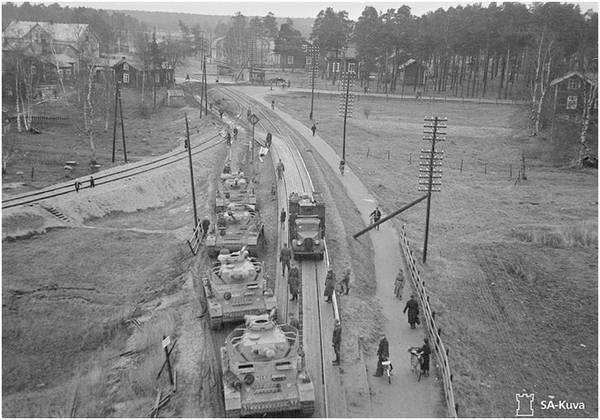
| Finnish Panzer IV Ausf J tanks entering the bridge over the river Oulujoki in Tuira, Oulu, Finland in November 1944. |
 |
| PzKpfw IV medium tank with the Romanian 2nd Tank Regiment at Nagykaroly, Hungary in 1944 after Romania joined the Allies. |
 |
| PzKpfw IV Ausf C during the German advance into Poland. |
 |
| PzKpfw IV Ausf E knocked out and captured in December 1941 near Sidi Rezegh. Note the extra armor on the superstructure front (30mm) and the sides (20mm) and the new lower cupola. The Afrika Korps badge is on a patch of Panzer Gray left when the tank was roughly camouflaged in desert yellow. |
 |
| By 1943-44 most PzKpfw IVs in action were fully equipped with long 75mm guns and Schürtzen plates, 8mm around the turret and 5mm on the sides. These new Ausf H vehicles (note the single cupola hatch) advancing through the outskirts of a Russian town have only the extra turret protection. |
 |
| A modified PzKpfw IV in Toulon, 27 November 1942. |
 |
| PzKpfw IV, Afrika Korps. |
 |
| PzKpfw IV (in distance) accompanied by four PzKpfw 38(t)s attacking a French pillbox, 1940. |
 |
| PzKpfw IV Ausf J, 111th Panzer Brigade, 2111th Panzer Abteilung, Staff Company, Lorraine, France, September 1944. |
 |
| PzKpfw IV Ausf D of 6th Panzer Division, 1941. |
 |
| Another view of the same PzKpfw IV Ausf D of 6th Panzer Division as in the previous photo. |
 |
| PzKpfw IV, Russia, 1943. |
 |
| PzKpfw IV, Russia. |
 |
| PzKpfw IV. |
 |
| PzKpfw IVs. |
 |
| PzKpfw IVs on the Polish border. |
 |
| PzKpfw IVs, Kursk. |
 |
| Destroyed PzKpfw IV. |
 |
| PzKpfw IV Ausf H, Panzer Lehr Division. |
 |
| PzKpfw IV medium tanks advance towards burning Russian village. |
 |
| PzKpfw IVs, Toulouse, France, 1942. |
 |
| PzKpfw IV. Note the "liberated" monkey statue on the front of the vehicle. |
 |
| PzKpfw IV medium tanks loaded on flatcars for transportation to the assembly area for the Ardennes Offensive. |
 |
| Dead German soldiers and burning PzKpfw IV, Operation Zitadelle, 1943. |
 |
| PzKpfw IVs of 1st SS Panzer Division, their crews taking some fresh air outside, clatter past several hundred American prisoners during the Ardennes Offensive, December 1944. |
 |
| A PzKpfw IV of 6th Kompanie, SS Panzer Regiment 1, in Stoumont during the Ardennes Offensive. A panzergrenadier runs for better cover, as dark smoke from a burning Panther drifts upwards at right. |
 |
| Members of the U.S. Navy's 4th Beach Battalion alongside a PzKpfw IV, one of the German tanks that nearly succeeded in sweeping the American forces from the beach at Salerno. |
 |
| PzKpfw IV medium tank after a head on collision with a Char B1 on 16 May 1940. |
 |
| The 1942 PzKpfw IV Ausf F2 was an upgrade of the Ausf F, fitted with the KwK 40 L/43 anti-tank gun to counter Soviet T-34 and KV tanks. Vehicle on display at the United States Army Ordnance Museum, Aberdeen Proving Ground, Maryland, 2007. |
 |
| PzKpfw IV Ausf H on display at the Musée des Blindés in Saumur, 2006. |
 |
| PzKpfw IV Ausf J, in Finnish markings, displayed in Finnish Tank Museum (Panssarimuseo) in Parola, 2006. |
 |
| PzKpfw IV in Belgrade Military Museum, Serbia, 2008. |
 |
| PzKpfw IV Ausf D, Imperial War Museum, Duxford, 2011. |
 |
| The 300 horsepower Maybach HL 120TRM engine used in most Panzer IV production models. |
 |
| PzKpfw IV Ausf D with additional bolted-on armor plates on display at the U.S. Army Ordnance Museum in Aberdeen. The tank bears the sign of the Afrika Korps. 2007. |
 |
| PzKpfw IV Ausf D, Bovington Tank Museum, 2010. |
 |
| PzKpfw IV Ausf A turret with 75mm L/24 cannon, in the Militärhistorischen Museum der Bundeswehr in Dresden, 2005. |
 |
| PzKpfw IV Ausf D, Bovington Tank Museum, 2010. |
 |
| PzKpfw IV Ausf J, captured from the Syrian Army in the Six Day War, in Yad la-Shiryon Museum, Israel. 2005, with a Sturmgeschutz III in the background. |
 |
| PzKpfw IV Ausf G, captured from the Syrian Army in the Six Day War, in Yad la-Shiryon Museum, Israel. 2005. |
 |
| PzKpfw IV Ausf G, captured from the Syrian Army in the Six Day War, in Yad la-Shiryon Museum, Israel. 2005. |
 |
| PzKpfw IV Ausf G, captured from the Syrian Army in the Six Day War, in Yad la-Shiryon Museum, Israel. 2006. |
 |
| PzKpfw IV Ausf F2 with 7.5 cm KwK 40 L/48 gun at the Auto & Technik Museum, Sinsheim, 2011. Known by the British as the Mk. IV "Special." |
 |
| PzKpfw IV Ausf F2 with 7.5 cm KwK 40 L/48 gun at the Auto & Technik Museum, Sinsheim, 2004. Known by the British as the Mk. IV "Special." |
 |
| PzKpfw IV Ausf F2 or "Mk. IV Special," showing a penetration by a British anti-tank shell; at the Auto & Technik Museum, Sinsheim, 2011. |
 |
| PzKpfw IV Ausf G in the Deutsches Panzermuseum Munster in Munster, Germany. 2010. |
 |
| PzKpfw IV Ausf G in the Deutsches Panzermuseum Munster in Munster, Germany. 2010. |
 |
| PzKpfw IV Ausf G in the Deutsches Panzermuseum Munster in Munster, Germany. 2010. |
 |
| PzKpfw IV Ausf G, Aberdeen Proving Ground, 2008. |
 |
| PzKpfw IV Ausf J of the Rex & Rod Cadman collection. 2010. |
 |
| Panzer IV with hydraulic transmission, Aberdeen Proving Ground, 2008. |
 |
| Panzerkampfwagen IV Ausf A. |
 |
| Panzerkampfwagen IV Ausf B. |
 |
| Panzerkampfwagen IV Ausf C. |
 |
| Panzerkampfwagen IV Ausf D. |
 |
| PzKpfw. IV Ausf. D |
 |
| Panzerkampfwagen IV Ausf E. |
 |
| Panzerkampfwagen IV Ausf F1. |
 |
| Panzerkampfwagen IV Ausf F2. |
 |
| Panzerkampfwagen IV Ausf G. |
 |
| Panzerkampfwagen IV Ausf H. |
 |
| Panzerkampfwagen IV Ausf J. |
 |
| Panzerkampfwagen IV prototype VK. 2002 MAN. |