|
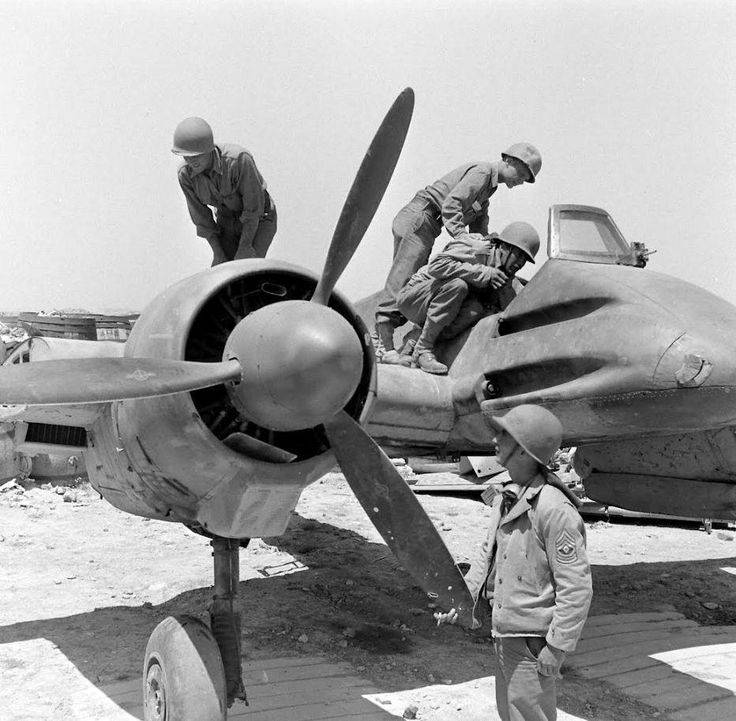
| Often claimed to have been captured by the British at El Aouina in Tunisia, this Hs 129B-2 displays the elaborate upper surface camouflage worn by some Henschels during the closing stages of the war in North Africa. Note bent propellers from a landing accident. |
The Henschel Hs 129
was a ground-attack aircraft designed and produced by the German aircraft
manufacturer Henschel Flugzeugwerke AG. Fielded by the Luftwaffe during the
Second World War, it saw combat in Tunisia and on the Eastern Front.
During the latter
half of 1930s, influenced by the experiences of German Condor Legion during the
Spanish Civil War, the Reichsluftfahrtministerium (RLM; "Reich Aviation
Ministry") sought a new ground-attack aircraft. The specification required
protection from ground-based small arms fire, for which Henschel's design
(which was initially designated at the P 46) incorporated a steel
"bathtub" with angled fuselage sides and a compact canopy that was
fitted with tiny windows. A further requirement of the specification was that
the aircraft be powered by engines that were not in demand for other types;
accordingly, the Hs 129 was designed to be equipped with low-power German Argus
As 410 engines, which were only capable of 465 PS (459 hp; 342 kW).
On 29 May 1939, the
prototype Hs 129 performed its maiden flight. Early flight testing was largely
unsatisfactory, the aircraft proving to be both underpowered and overweight as
well as offering poor visibility to the pilot. These criticisms were addressed
via the adoption of a revised canopy with greater glazing along with a more
powerful replacement engine in the form of the French Gnome-Rhône 14M engine,
which was capable of producing up to 700 PS (690 hp; 515 kW). As such, the Hs
129 A-0 was promptly succeeded by the Hs 129 A-1 and Hs 129 B-1. While Henschel
faced competition to fulfill the requirement in the form of the Focke-Wulf Fw
189, the Hs 129 was both smaller and cheaper, and thus continued to hold the
RLM's favor. Quantity production of the type was achieved during early 1942.
Introduced to
Luftwaffe service in April 1942, the Hs 129 was relatively effective during its
early years. It saw service on the Eastern Front in a variety of frontline
roles. As the conflict progressed, an increased emphasis on anti-tank support
led to the aircraft being continually up-gunned, eventually mounting a 75 mm
anti-tank cannon. Only a small number of thus-armed Hs 129 B-3 aircraft were
produced and saw action relatively late in the war. Production of the type
peaked in 1943 and was terminated entirely in September 1944 in response to
Nazi Germany's declining military position, although use of the HS 129
continued into the closing months of the conflict.
By the mid-1930s, the
German military, as well as its counterparts in other countries, had identified
the importance of ground-attack aircraft for the interdiction of logistics and
materiel, a task in which targets were often poorly protected and less likely
to have strong or well-coordinated defenses. For high-value, well-protected
tactical targets, the dive bomber was becoming the conventional solution.
The experience of the
German Condor Legion during the Spanish Civil War (1936–39) refuted this
concept. Even though it was equipped with types unsuited to the role, such as
the Henschel Hs 123 and cannon-armed versions of the Heinkel He 112, the Condor
Legion proved that ground-attack aircraft were effective in actual combat. This
determination led to support within the Luftwaffe for the creation of an aircraft
dedicated to this role, and the Reichsluftfahrtministerium (RLM; "Reich
Aviation Ministry") through its Technisches Amt (Technical office)
formulated a specification for a Schlachtflugzeug (ground-attack aircraft,
specifically intended for the direct support of ground forces.
It was anticipated
that the main source of damage to such an aircraft would be small arms fire
from the ground, meaning that the aircraft ought to be well-armored around key
areas, such as its cockpit and engines. Similar protection was also desirable
for the canopy, in the form of 75 mm (2.95 in) thick armored glass. The
aircraft was expected to be attacking in low-level, head-on strafing runs, so
the cockpit had to be located as close as possible to the nose, in order to
maximize the visibility of its targets. Another, non-operational, requirement
severely hampered the designs: the RLM insisted that the new design be powered
by engines that were not being used in existing aircraft, so that the type
would not interfere with the production of established types deemed essential
to the war effort.
During April 1937,
the newly-formulated specification was issued to four companies, Hamburger
Flugzeugbau GmbH (later renamed Blohm und Voss), Focke-Wulf Flugzeugbau GmbH,
Gothaer Waggonfabrik AG and the Henschel Flugzeug-Werke AG. Of these, Gotha
opted to not respond at all while the Hamburger Flugzeugbau offered their P-40
project, a development of their two seat Ha 141, however, the ground attack
version was considered to be too unconventional and was eliminated. On 1
October 1937, the RLM issued a pair of development contracts for the two other
submissions, which had been determined to superior: one was derived from an
existing Focke-Wulf reconnaissance type, the Fw 189, while the other was
produced by Henschel. Originally designated the P 46, Henschel’s aircraft was
later given the official designation of Hs 129 from the RLM in April 1938.
The Hs 129 was
designed by Henschel's chief designer, Dipl.-Ing. Friedrich Nicolaus; the
detailed design work was completed by mid 1938. The basic configuration was of
a compact low-wing monoplane with a triangular-section fuselage. It was
designed around a single large "bathtub" of steel sheeting that made
up the entire nose area of the aircraft, completely enclosing the pilot up to
head level. Even the canopy was steel, with only tiny windows on the side to
see out of and two angled blocks of glass for the windscreen. To improve the
armor's ability to deflect bullets, the fuselage sides were angled in, forming
a triangular shape, resulting in almost no room to move at shoulder level.
There was so little room in the cockpit that the instrument panel ended up
under the nose below the windscreen, where it was almost invisible; some of the
engine instruments were moved outside onto the engine nacelles' inboard-facing
surfaces and the gunsight was mounted outside on the nose.
During 29 May 1939,
the first prototype, designated Hs 129 V1, performed its maiden flight. It was
promptly joined by two more prototypes, the Hs 129 V2 and Hs 129 V3. These
early aircraft participated in competitive evaluations against the Fw 189.
Henschel's aircraft
came in 12 percent overweight while the engines produced eight percent less
power than had been anticipated; accordingly, it flew poorly. A further
complication was the poor external visibility available to the pilot from the
cramped cockpit. The controls proved to be almost inoperable as speed increased
and in testing, the V2 prototype flew into the ground from a short dive on 5
January 1940 because the stick forces were too high for the pilot to pull out.
The Focke-Wulf design proved to be no better. Both aircraft were underpowered
as a result of their air-cooled, inverted-V12 Argus As 410 engines as well as
being relatively difficult to fly.
Nevertheless, the RLM
felt they should continue with the concept. The only real deciding factor
between the two designs was that the Henschel was smaller and cheaper, thus a
further development contract was issued to Henschel for eight HS 129 A-0
pre-production aircraft while the FW 189 was positioned on low priority as a
backup while testing continued with the Hs 129 A-0.
Various improvements
were developed by Henschel which resulted in the Hs 129 A-1 series. This model
was armed with a pair of 20 mm MG 151/20 cannons and two 7.92 mm (.312 in) MG
17 machine guns, along with the ability to carry four 50 kg (110 lb) bombs
along the fuselage centerline. During late 1940, the A-1 was evaluated by
Luftwaffe pilots, the notable conclusion of which was that the service refused
to accept the aircraft in its current configuration.
Even prior to the
delivery of the first A-1s, the aircraft already being redesigned in response
to an instruction from the RLM to adopt French Gnome-Rhône 14M radial engines,
which were captured in some number when France fell and continued to be
produced under German occupation. This engine supplied 700 PS (690 hp; 515 kW)
for takeoff, compared with the Argus at 465 PS (459 hp; 342 kW). The
Gnome-Rhone radials were also made in versions with opposite rotation for the
propeller, and were installed on the Hs 129 with the port engine rotating
clockwise and the starboard rotating counterclockwise, as seen from nose-on,
thus eliminating engine torque problems.
Hs 129B-1
During early 1941, a
pair of HS 129 A-1s were refitted with the Gnome-Rhône radials and quickly
demonstrated that they possessed more satisfactory performance. Although
reviewing pilots were more satisfied with the aircraft's performance,
complaints continued to be files about the high stick forces as well as the
poor visibility from the canopy. Accordingly, new electronically-actuated trim
tabs and a redesign canopy with more extensive glazing was installed on the HS
129 B-0, along with a special Revi V12/C sight that was mounted externally just
forward of the windscreen. As a result, the aircraft possessed noticeably
superior vision. It is believed that all of the A-1s were converted into B-'s
(although it has been claimed that some A-1s were sold to Romania).
During December 1941,
the first of ten HS 129 B-0s was developed; in March 1942, the production
standard Hs 129 B-1 commenced manufacture. Initially, the two models were quite
similar, although some difference were apparent in terms of the positioning of
the radio apparatus and the presence of exposed blast troughs for the guns on
the B-1. Furthermore, the aircraft would receive adaptations to permit the
carriage of a wide variety of armaments.
In preparation for
the arrival of the B-1, I./SchlG 1 had been formed in January 1942 with Bf 109
E/Bs (fighter-bomber version of Bf 109 E) and Hs 123s and they delivered B-0s
and every B-1 that was completed. During April 1942, the first 12 B-1s were
delivered, enabling the 4th Staffel (squadron) to achieve operational
readiness. They were promptly assigned to the Eastern Front (to Crimea) in the
middle of May 1942 and in June they received a new weapon, the 30 mm (1.2 in)
MK 101 cannon with armor-piercing ammunition in a centerline pod. This would be
the B1/R2 Rüstsätze kit, the B1/R3 had the MK 101 replaced with a ventral tray
of four 7.92mm MG 17 machine guns. The B1/R4 had a larger bomb load and the
B1/R5 reconnaissance version had a camera.
Hs 129B-2
During May 1942,
deliveries of the new Hs 129 B-2 model commenced, side by side with the B-1 (of
which just 50 aircraft had been delivered at that point). By July 1943, (prior
to the launch of Operation Citadel, these were a total of five units of the
Luftwaffe equipped with HS 129s.
Initially, the only
difference between the B-1 and B-2 models were changes to the fuel system – a
host of other minor changes could be found almost at random on either model.
These changes accumulated in the B-2 production line until they could
eventually be told apart at a glance; the main differences being the removal of
the mast for the radio antenna, the addition of a direction-finding radio
antenna loop, and shorter exhaust stacks on the engines. In the field, the
differences became more pronounced. The Rüstsatz field refit kits were
renumbered and some were dropped, and in general, the Hs 129B-2/R2 aircraft in
service with 4./Schlachtgeschwader 1 received the upgraded cannon pack using a
30 mm MK 103 cannon instead of the earlier MK 101. The MK 103 was effectively
an upgraded MK 101 that was capable of increased muzzle velocity.
By late 1942, reports
were coming in about the ineffectiveness of the MK 101 against newer versions
of the Soviet T-34 tanks. One obvious solution would be to use the larger 3.7
cm (1.46 in) BK 3,7 (Bordkanone 3,7), recently adapted from the ground-based
3.7 cm Flak 18. These guns had already been converted into underwing
pod-mounted weapons for the Junkers Ju 87G and found to be an effective weapon,
despite the fact that only 12 shells per pod could be accommodated. When
mounted on the Hs 129, the empty area behind the cockpit could be used for
ammunition storage, greatly increasing the supply compared to the Ju. The
B-2/R3 package introduced the BK 3.7 cm (1.46 in) automatic cannon, but
relatively few aircraft were converted in favor of the B-2/R4 and B-3, mounting
the BK 7.5.
Hs 129B-3
It was decided that
the 7.5 cm (2.95 in) semi-automatic Rheinmetall PaK 40 anti-tank gun, which had
already been adapted for use in the Junkers Ju 88 P-1, would be further
modified for use in the Hs 129. This resulted in the BK 7,5 (Bordkanone 7,5),
which, even though it weighed 1,200 kg (2,600 lb), was lighter than the PaK 40.
Fully automatic, it featured a new, hydraulic recoil-dampening system and a
new, more aerodynamic muzzle brake. An autoloader system, with 12 rounds in a
rotary magazine, was fitted in the empty space behind the cockpit, within the
rear half of the wing root area. The gun and its recoil mechanism occupied a
substantial gun pod under the fuselage, and a circular port at the rear of the
pod allowed rearwards ejection of spent cartridges immediately after firing.
While this new variant, the Hs 129 B-3, was theoretically capable of destroying
any tank in the world, the added weight worsened the aircraft's general
performance and it was inferior to previous variants.
The Bordkanone 7,5
was the heaviest and most powerful forward-firing weapon fitted to a production
military aircraft during the Second World War. The only other ground-attack
aircraft to be factory-equipped with similar-caliber guns were the 1,420
examples of the North American B-25G and B-25H Mitchell, which mounted either a
75 mm (2.95 in) M4 cannon, or lightweight T13E1 or M5 versions of the same gun,
both of which required a crew member to manually reload after each shot. The
Japanese Mitsubishi Ki-109 Army Heavy Fighter Interceptor also carried a 75mm
gun, but only 24 were produced.
In May 1944, a Hs
129B-2, Werknummer 141258, was fitted with a mock-up of the BK 7.5 and
underwent aerodynamic testing at Travemünde. The gun fired a 12 kg shell and in
an emergency the entire installation could be jettisoned. During August of that
year, the first three HS 129 B-3s commenced trials. While deliveries commenced
to actual frontline units, around 25 B-3s are believed to have been completed
prior to the production line being permanently shut down in September (a small
number were reportedly also created by converting B-2 aircraft). In the field,
the B-3 proved to be effective even against members of the IS tank family,
however, its small numbers meant that it had little effect on the war effort.
Hs 129C
To address the poor
performance of the aircraft, plans had been under way for some time to fit the
aircraft with newer versions of the Italian Isotta-Fraschini Delta air-cooled
inverted V12 inline engine that delivered 850 hp (625 kW) and weighed some 510
kg (1,120 lb) apiece, providing more power than the Argus As 411 engine of
similar configuration and lighter (385 kg) weight. The engine installation ran
into a number of delays and was still not ready for production when Henschel's
plant was overrun by the Allies in 1945.
Hs 129D
Planned version of
the Hs 129. Powered by either two 809 kW (1,085 hp; 1,100 PS) Junkers Jumo 211
or two 1,148 kW (1,539 hp; 1,561 PS) BMW 801 to improve its performance. No
prototypes were made.
Bibliography
"Henschel Hs
129...der geflügelte Büchsenöffner". Air International (in German). 19
(6): 277–283, 303–304. December 1980.
Griehl, Manfred
(2012). X-Planes: German Luftwaffe Prototypes 1930-1945. Pen and Sword.
Munson, Kenneth
(1978). German Aircraft Of World War 2 in colour. Poole, Dorset, UK: Blandford
Press.
Pegg, Martin (2019).
Henschel Hs 129 Panzerjäger. Hull, East Yorkshire, UK: Chandos.
Smith, J. Richard;
Kay, Anthony (1972). German Aircraft of the Second World War (third impression
1978 ed.). London, UK: Putnam & Company Ltd.
Further Reading
Chorążykiewicz,
Przemysław (2008). Henschel Hs 129. Sandomierz, Poland/Redbourn, UK: Mushroom
Model Publications.
Green, William
(1970). Warplanes of the Third Reich (fourth impression 1979 ed.). London, UK:
Macdonald and Jane's Publishers Ltd.
Bernád, Dénes (2001).
Henschel Hs 129 in Action (Aircraft Number 176). Carrollton, US:
Squadron/Signal Publications, Inc.
Bernád, Dénes (2006).
Henschel Hs 129 (Military Aircraft in Detail). Hinckley, UK: Midland Publishing
Ltd.
Kempski, Benedykt
(2004). Samolot szturmowy Henschel Hs 129 (Typy Broni i Uzbrojenia No.214) (in
Polish). Warszawa, Poland.
Smith, J. Richard
(1966). The Henschel Hs 129 (Aircraft in Profile No.69). Leatherhead, Surrey,
UK: Profile Publications Ltd.
Pegg, Martin; Creek,
Eddie; Tullis, Thomas A. (1997). Hs 129: Panzerjäger! (Classic series, No. 2).
West Sussex, UK: Classic Publications.
Stachura, Petr;
Bernád, Dénes; Haladej, Dan (1993). Henschel Hs 129 (in Czech) (second edition
1996 bilingual Czech/English ed.). Prague, Czech Republic: MBI.
Wood, Tony; Gunston,
Bill (1977). Hitler's Luftwaffe: A pictorial history and technical encyclopedia
of Hitler's air power in World War II. London, UK: Salamander Books Ltd.
 |
| Hs 129B-2 ‘Red J’ served on the Russian Front with 8.(Pz)/SchG 1, during May 1943. It wore eight tank ‘kill’ markings on its rudder, and its Werk Nummer (WNr, factory serial number), 0364, on its lower fin. |
 |
| An Hs 129B-1 with early round intakes/filters beneath its engine cowlings displays the lower fuselage gun pod fairing for the Mk 101 30mm cannon, which could be swung down for maintenance/re-arming. The ammunition box sat inside the fuselage. |
 |
| Henschel Hs 129. |
 |
| Henschel Hs 129. |
 |
| Henschel Hs 129A-0. |
 |
| Henschel Hs 129. |
 |
| Henschel Hs 129. |
 |
| Henschel Hs 129. |
 |
| Henschel Hs 129. |
 |
| Henschel Hs 129. |
 |
| Henschel Hs 129. |
 |
| Henschel Hs 129. |
 |
| The much photographed ‘White K’ of 10.(Pz)/SG 9 during early 1944 on the Eastern Front. It was often flown by Lt Walter Krause and featured one of the unique color schemes employed by that unit’s Henschels. |
 |
| Henschel Hs 129. |
 |
| Henschel Hs 129. |
 |
Henschel Hs 129 of 11./SG 9, March 1944.
|
 |
| Henschel Hs 129 cockpit. |
 |
The BK 7,5 75mm gun and its associated fairing was mounted beneath the fuselage of the Hs 129B-3 in such a way that it could be jettisoned in an emergency, its fitment being shown in this drawing from the official manual on the Hs 129B-3.
|
 |
| Henschel Hs 129. |
 |
| Henschel Hs 129. |
 |
| Henschel Hs 129. |
 |
| Henschel Hs 129. |
 |
| Henschel Hs 129. |
 |
| Henschel Hs 129Bs. |
 |
| Henschel Hs 129. |
 |
| Henschel Hs 129. |
 |
| Henschel Hs 129. |
 |
| Henschel Hs 129. |
 |
| Henschel Hs 129. |
 |
| Captured Henschel Hs 129 being examined by American soldiers. |
 |
1946: A captured German Henschel Hs 129B wearing USAAF FE (Foreign Evaluation FE-4600) markings at Freeman Field, Indiana.
|
 |
| Henschel Hs 129B. |
 |
A captured German Henschel Hs 129B-2 (Wk.Nr. 0385) at Freeman Army Airfield, Indiana, in 1946. It was allotted for storage at Davis-Monthan AFB, Arizona but had to be force-landed at Gallatin, Tennessee, on 24 July 1946 while being ferried to Davis-Monthan. The aircraft ran out of fuel due to suspected tank leakage and was slightly damaged during the subsequent forced landing. It was taken to No. 803 Special Depot (Orchard Place) on 5 August 1946. When the storage depot was required for other purposes during the Korean War, FE-4600 was put up for disposal as scrap. Only the nose section was saved from a scrap yard.
This Hs 129 tankbuster was G blue with 8.(Pz.)/Schl.G.2. It was hit by AA fire and crash-landed at Toubakeur in Tunisia on 7 April 1943. With its outer wings removed it was brought to El Aouina where it was captured by the Allies. It was transported to the USA where it was repaired in a lengthy process. It is seen here with the Foreign Aircraft Evaluation Center at Freeman Army Airfield. On 24 July 1946 it crash-landed in a field at Gallatin, Tennessee, due to fuel leakage. Its front fuselage went to the Victory Air Museum at Mundelein, Illinois in 1951 and in 1986 to Martin Mednis of Sydney, Australia. Note the triangular fuselage and the tiny cockpit. FE-4600 is the Foreign Evaluation serial and EB105 its previous Evaluation Branch serial.
|
 |
Another view of Hs 129B-2 (Wk.Nr. 0385) Foreign Evaluation identification number FE-4600.
|
 |
| Another view of Hs 129B-2 (Wk.Nr. 0385) Foreign Evaluation identification number FE-4600. |
 |
| Wrecks of a German planes at El Aouiana airport, Tunis, Tunisia, May 1943. In front lies a propeller of a BMW 132 radial engine of a Junkers Ju 52. Behind it lies a water-cooled engine (probably DB 601 or Jumo 211), and the wings of a Messerschmitt Bf 109. A damaged Henschel Hs 129B is visible in the center, just before the burned out center section of a Messerschmitt Me 323 Gigant transport plane. In the right background is the fuselage of a Ju 52. |
 |
Damaged German Henschel Hs 129B of 5.(Pz)/Schlachtgeschwader 1 at El Aouiana airport, Tunis, Tunisia, in May 1943. In the background is a wreck of an Messerschmitt Me 323D-1/-2 Gigant transport. ‘Red K’ was one of the Hs 129B-2s left behind by 8.(Pz)/SchG 2 at Tunis-El Aouina during the final phase of the fighting in North Africa – and duly captured by the Allies. Here it is being examined by curious US personnel. El Aouina and its satellite strips were an eventual graveyard of different Luftwaffe types.
|
 |
| Henschel Hs 129 with wings removed outboard of engine nacelles, being towed by an Opel Blitz truck, circa 1939. |
 |
| Destroyed German aircraft at El Aouina airfield at Tunis, Tunisia, in May 1943. A Henschel Hs 129B of 5.(Pz)/Schlachtgeschwader 1 is visible in the foreground. |
 |
| A damaged Henschel Hs 129B of of 5.(Pz)/Schlachtgeschwader 1 at El Aouiana airport, Tunis, Tunisia, May 1943, behind the tail unit of an unknown German plane. |
 |
| Two damaged Henschel Hs 129B of of 5.(Pz)/Schlachtgeschwader 1 behind a pile of aircraft wheels at El Aouiana airport, Tunis, Tunisia, May 1943. In the left background is a damaged Junkers Ju 52, to the right are the remains of a Messerschmitt Me 323. |
 |
| A damaged Henschel Hs 129B of of 5.(Pz)/Schlachtgeschwader 1 at El Aouiana airport, Tunis, Tunisia, May 1943. |
 |
| The muzzle break of the MK 103 30mm cannon was rectangular, compared with the circular muzzle of the Mk 101. This MK 103 has been swung down from the lower fuselage of an Hs 129B-2 of 10.(Pz)/SG 9 on the Eastern Front, for re-arming. |
 |
Henschel Hs 129B-2.
|
 |
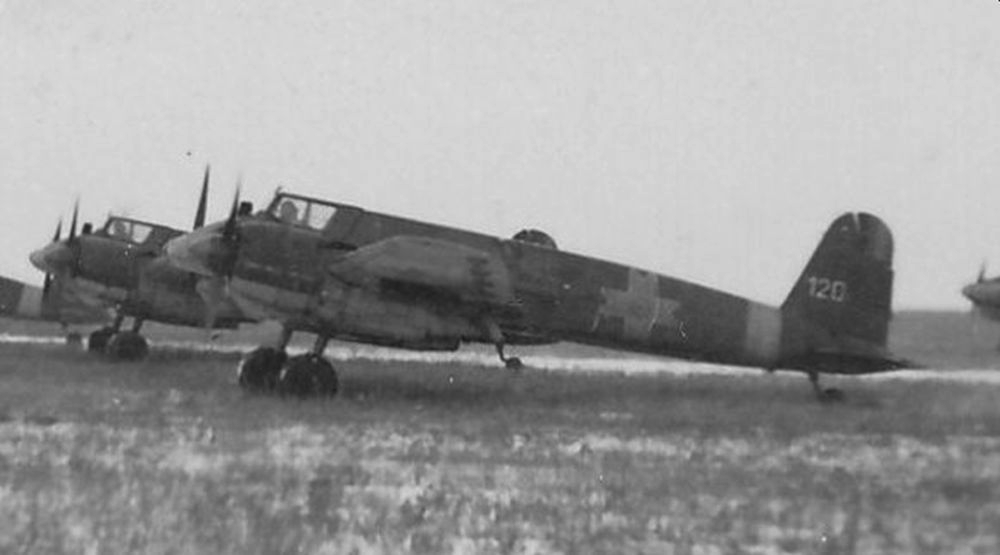
| A Soviet officer congratulates the commander of the anti-aircraft battery that shot down a German-made Romanian Hs 129B-2 attack aircraft No. 327 (W. No. 141263) piloted by Lieutenant Munteanu. In front of the "Mihai Cross" on the fuselage is the phrase "HAI FETITO" ("Come on, girl"). And below the tail number is probably Munteanu's personal emblem, a skull and a tilted bone. |
 |
| An Hs 129B-1 with early round intakes/filters beneath its engine cowlings displays the lower fuselage gun pod fairing for the Mk 101 30mm cannon, which could be swung down for maintenance/re-arming. The ammunition box sat inside the fuselage. |
 |
| Several Luftwaffe officers stand beside their Argus-powered Hs 129A-0, believed to have been assigned to Schlachtgeschwader 101. The very angular nose of these early Henschels encouraged the painting of the ‘Pike’s Head’ insignia. |
 |
| The extraordinary cockpit area of the Hs 129A-series aircraft, with the small, heavily armored vision panels including the V-shaped windscreen, which proved totally inadequate. The external structure ahead of the cockpit was intended to house the weapons sight. |
 |
| The Henschels of 10.(Pz)/SG 9 on the Eastern Front wore distinctive camouflage and this unit was often in front of propaganda photographers’ lenses during March 1944, when this image of the taxiing ‘White O’ was taken. |
 |
| RAF technicians work on damaged Hs 129B-2 WNr 0297, which was captured in North Africa having been ‘Blue C’ of 4.(Pz)/SchG 2. Transported to Britain, the aircraft was eventually made airworthy again. |
 |
| The Hs 129B-3 was armed with the BK 7,5 75mm gun (often also referred to as a cannon), but only 20 examples are recorded in official records as having been completed. This aircraft is believed to be a B-2 converted as a prototype/development airframe for the intended installation. |
 |
| The ZFR 3A weapons sight used in conjunction with the BK 7,5 75mm gun fitted to the Hs 129B-3, illustrated by a drawing from a company technical manual. |
 |
| The Rheinmetall-Borsig SG 113A Förstersonde comprised a battery of six downwards-firing anti-tank mortars housed in the Hs 129B mid-fuselage area, fired when the aircraft’s nose-mounted sensor detected a tank below. It was not used operationally. |
 |
Hs 129s of the Romanian air force.
|
 |
| Hs 129B-2 WkNr 140508 of 8.(Pz)/SchG 1. |
 |
| Hs 129B-2 of 4.(Pz)/SchG 2, Africa. |
 |
Hs 129 wreck, 1945.
|
 |
Hs 129 in winter on the Russian Front.
|
 |
Hs 129 with MK 101.
|
 |
Hs 129 wreck examined by American personnel, Africa.
|
 |
Another Hs 129 wreck, Africa.
|
 |
| Henschel Hs 129 WkNr 141859 “Red D” of SchG 1. |
 |
December 1942: One of the first five 8.(Pz)/Schl.G. 2 Hs 129B-1s being towed to Tunis el-Aouina airfield from where they operated until late April 1943.
|