 |
| National Revolutionary Army soldiers march to the front in 1939. |
The Second Sino-Japanese War was fought between the Republic of China and the Empire of Japan between 1937 and 1945, following a period of war localized to Manchuria that started in 1931. It is considered part of World War II, and often regarded as the beginning of World War II in Asia. It was the largest Asian war in the 20th century and has been described as "the Asian Holocaust", in reference to the scale of Japanese war crimes against Chinese civilians. It is known in China as the War of Resistance against Japanese Aggression.
On 18 September 1931, the Japanese staged the Mukden incident, a false flag event fabricated to justify their invasion of Manchuria and establishment of the puppet state of Manchukuo. This is sometimes marked as the beginning of the war. From 1931 to 1937, China and Japan engaged in skirmishes, including in Shanghai and in Northern China. Chinese Nationalist and Communist forces, respectively led by Chiang Kai-shek and Mao Zedong, had fought each other in the Chinese Civil War since 1927. In late 1933, Chiang Kai-shek encircled the Chinese Communists in an attempt to finally destroy them, forcing the Communists into the Long March, resulting in the Communists losing around 90% of their men. As a Japanese invasion became imminent, Chiang still refused to form a united front before he was placed under house arrest by his subordinates who forced him to form the Second United Front in late 1936 in order to resist the Japanese invasion together.
The full-scale war began on 7 July 1937 with the Marco Polo Bridge incident near Beijing, which prompted a full-scale Japanese invasion of the rest of China. The Japanese captured the capital of Nanjing in 1937 and perpetrated the Nanjing Massacre. After failing to stop the Japanese capture of Wuhan in 1938, then China's de facto capital at the time, the Nationalist government relocated to Chongqing in the Chinese interior. After the Sino-Soviet Non-Aggression Pact, Soviet aid bolstered the National Revolutionary Army and Air Force. By 1939, after Chinese victories at Changsha and with Japan's lines of communications stretched deep into the interior, the war reached a stalemate. The Japanese were unable to defeat Chinese Communist Party forces in Shaanxi, who waged a campaign of sabotage and guerrilla warfare. In November 1939, Chinese nationalist forces launched a large scale winter offensive, and in August 1940, communist forces launched the Hundred Regiments Offensive in central China.
In December 1941, Japan launched a surprise attack on Pearl Harbor and declared war on the United States. The US increased its aid to China under the Lend-Lease Act, becoming its main financial and military supporter. With Burma cut off, the United States Army Air Forces airlifted material over the Himalayas. In 1944, Japan launched Operation Ichi-Go, the invasion of Henan and Changsha. In 1945, the Chinese Expeditionary Force resumed its advance in Burma and completed the Ledo Road linking India to China. China launched large counteroffensives in South China and repulsed a failed Japanese invasion of West Hunan and recaptured Japanese occupied regions of Guangxi.
Japan formally surrendered on 2 September 1945, following the atomic bombings of Hiroshima and Nagasaki, Soviet declaration of war and subsequent invasions of Manchukuo and Korea. The war resulted in the deaths of around 20 million people, mostly Chinese civilians. China was recognized as one of the Four Policemen, regained all territories lost, and became one of the five permanent members of the United Nations Security Council. The Chinese Civil War resumed in 1946, ending with a communist victory and the Proclamation of the People's Republic of China in 1949.
Names
In China, the war is most commonly known as the "War of Resistance against Japanese Aggression", and shortened to "Resistance against Japanese Aggression" or the "War of Resistance". It was also called the "Eight Years' War of Resistance", but in 2017 the Chinese Ministry of Education issued a directive stating that textbooks were to refer to the war as the "Fourteen Years' War of Resistance", reflecting a focus on the broader conflict with Japan going back to the 1931 Japanese invasion of Manchuria. According to historian Rana Mitter, historians in China are unhappy with the blanket revision, and (despite sustained tensions) the Republic of China did not consider itself to be in an ongoing war with Japan over these six years. It is also referred to as part of the "Global Anti-Fascist War".
In contemporary Japan, the name "Japan–China War" is most commonly used because of its perceived objectivity. When the invasion of China proper began in earnest in July 1937 near Beijing, the government of Japan used "The North China Incident", and with the outbreak of the Battle of Shanghai the following month, it was changed to "The China Incident".
The word "incident" was used by Japan, as neither country had made a formal declaration of war. From the Japanese perspective, localizing these conflicts was beneficial in preventing intervention from other countries, particularly the United Kingdom and the United States, which were its primary source of petroleum and steel respectively. A formal expression of these conflicts would potentially lead to an American embargo in accordance with the Neutrality Acts of the 1930s. In addition, due to China's fractured political status, Japan often claimed that China was no longer a recognizable political entity on which war could be declared.
Other Names
In Japanese propaganda, the invasion of China became a crusade, the first step of the "eight corners of the world under one roof" slogan. In 1940, Japanese prime minister Fumimaro Konoe launched the Taisei Yokusankai. When both sides formally declared war in December 1941, the name was replaced by "Greater East Asia War".
Although the Japanese government still uses the term "China Incident" in formal documents, the word Shina is considered derogatory by China and therefore the media in Japan often paraphrase with other expressions like "The Japan–China Incident", which were used by media as early as the 1930s.
The name "Second Sino-Japanese War" is not commonly used in Japan as the China it fought a war against in 1894 to 1895 was led by the Qing dynasty, and thus is called the Qing-Japanese War, rather than the First Sino-Japanese War.
Another term for the second war between Japan and China is the "Japanese invasion of China", a term used mainly in foreign and Chinese narratives.
Background
The origins of the Second Sino-Japanese War can be traced to the First Sino-Japanese War (1894–1895), in which China, then under the rule of the Qing dynasty, was defeated by Japan and forced to cede Taiwan and recognize the full and complete independence of Korea in the Treaty of Shimonoseki. Japan also annexed the Senkaku Islands, which Japan claims were uninhabited, in early 1895 as a result of its victory at the end of the war. Japan had also attempted to annex the Liaodong Peninsula following the war, though was forced to return it to China following the Triple Intervention by France, Germany, and Russia. The Qing dynasty was on the brink of collapse due to internal revolts and the imposition of the unequal treaties, while Japan had emerged as a great power through its efforts to modernize. In 1905, Japan defeated the Russian Empire in the Russo-Japanese War, gaining Dalian and southern Sakhalin and establishing a protectorate over Korea.
Warlords in the Republic of China
In 1911, factions of the Qing Army uprose against the government, staging a revolution that swept across China's southern provinces. The Qing responded by appointing Yuan Shikai, commander of the loyalist Beiyang Army, as temporary prime minister in order to subdue the revolution. Yuan, wanting to remain in power, compromised with the revolutionaries, and agreed to abolish the monarchy and establish a new republican government, under the condition he be appointed president of China. The new Beiyang government of China was proclaimed in March 1912, after which Yuan Shikai began to amass power for himself. In 1913, the parliamentary political leader Song Jiaoren was assassinated; it is generally believed Yuan Shikai ordered the assassination. Yuan Shikai then forced the parliament to pass a bill to strengthen the power of the president and sought to restore the imperial system, becoming the new emperor of China.
However, there was little support for an imperial restoration among the general population, and protests and demonstrations soon broke out across the country. Yuan's attempts at restoring the monarchy triggered the National Protection War, and Yuan Shikai was overthrown after only a few months. In the aftermath of Shikai's death in June 1916, control of China fell into the hands of the Beiyang Army leadership. The Beiyang government was a civilian government in name, but in practice it was a military dictatorship with a different warlord controlling each province of the country. China was reduced to a fractured state. As a result, China's prosperity began to wither and its economy declined. This instability presented an opportunity for nationalistic politicians in Japan to press for territorial expansion.
Twenty-One Demands
In 1915, Japan issued the Twenty-One Demands to extort further political and commercial privilege from China, which was accepted by the regime of Yuan Shikai. Following World War I, Japan acquired the German Empire's sphere of influence in Shandong province, leading to nationwide anti-Japanese protests and mass demonstrations in China. The country remained fragmented under the Beiyang Government and was unable to resist foreign incursions. For the purpose of unifying China and defeating the regional warlords, the Kuomintang (KMT) in Guangzhou launched the Northern Expedition from 1926 to 1928 with limited assistance from the Soviet Union.
Jinan Incident
The National Revolutionary Army (NRA) formed by the Kuomintang swept through southern and central China until it was checked in Shandong, where confrontations with the Japanese garrison escalated into armed conflict. The conflicts were collectively known as the Jinan incident of 1928, during which time the Japanese military killed several Chinese officials and fired artillery shells into Jinan. According to the investigation results of the Association of the Families of the Victims of the Jinan massacre, it showed that 6,123 Chinese civilians were killed and 1,701 injured. Relations between the Chinese Nationalist government and Japan severely worsened as a result of the Jinan incident.
Reunification of China (1928)
As the National Revolutionary Army approached Beijing, Zhang Zuolin decided to retreat back to Manchuria, before he was assassinated by the Kwantung Army in 1928. His son, Zhang Xueliang, took over as the leader of the Fengtian clique in Manchuria. Later in the same year, Zhang declared his allegiance to the Nationalist government in Nanjing under Chiang Kai-shek, and consequently, China was nominally reunified under one government.
1929 Sino-Soviet war
The July–November 1929 conflict over the Chinese Eastern Railroad (CER) further increased the tensions in the Northeast that led to the Mukden Incident and eventually the Second Sino-Japanese War. The Soviet Red Army victory over Xueliang's forces not only reasserted Soviet control over the CER in Manchuria but revealed Chinese military weaknesses that Japanese Kwantung Army officers were quick to note.
The Soviet Red Army performance also stunned the Japanese. Manchuria was central to Japan's East Asia policy. Both the 1921 and 1927 Imperial Eastern Region Conferences reconfirmed Japan's commitment to be the dominant power in the Northeast. The 1929 Red Army victory shook that policy to the core and reopened the Manchurian problem. By 1930, the Kwantung Army realized they faced a Red Army that was only growing stronger. The time to act was drawing near and Japanese plans to conquer the Northeast were accelerated.
Chinese Communist Party
In 1930, the Central Plains War broke out across China, involving regional commanders who had fought in alliance with the Kuomintang during the Northern Expedition, and the Nanjing government under Chiang. The Chinese Communist Party (CCP) previously fought openly against the Nanjing government after the Shanghai massacre of 1927, and they continued to expand during this protracted civil war. The Kuomintang government in Nanjing decided to focus their efforts on suppressing the Chinese Communists through the Encirclement Campaigns, following the policy of "first internal pacification, then external resistance".
After the defeat of the Chinese Soviet Republic by the Nationalists, the Communists retreated on the Long March to Yan'an. The Nationalist government ordered local warlords to continue the campaign against the Communists rather than focus on the Japanese threat. A December 1936 coup by two Nationalist Generals, the Xi'an Incident, forced Chiang Kai-shek to accept a United Front with the Communists to oppose Japan.
Invasion of Manchuria and Northern China
The internecine warfare in China provided excellent opportunities for Japan, which saw Manchuria as a limitless supply of raw materials, a market for its manufactured goods (now excluded from the markets of many Western countries as a result of Depression-era tariffs), and a protective buffer state against the Soviet Union in Siberia. As a result, the Japanese Army was widely prevalent in Manchuria immediately following the Japanese victory in the Russo-Japanese War in 1905, where Japan gained significant territory in Manchuria. As a result of their strengthened position, by 1915 Japan had negotiated a significant amount of economic privilege in the region by pressuring Yuan Shikai, the president of the Republic of China at the time. With a widened range of economic privileges in Manchuria, Japan began focusing on developing and protecting matters of economic interests. This included railroads, businesses, natural resources, and a general control of the territory. With its influence growing, the Japanese Army began to justify its presence by stating that it was simply protecting its own economic interests. However militarists in the Japanese Army began pushing for an expansion of influence, leading to the Japanese Army assassinating the warlord of Manchuria, Zhang Zuolin. This was done with hopes that it would start a crisis that would allow Japan to expand their power and influence in the region. When this was not as successful as they desired, Japan then decided to invade Manchuria outright after the Mukden incident in September 1931. Japanese soldiers set off a bomb on the Southern Manchurian Railroad in order to provoke an opportunity to act in "self defense" and invade outright. Japan charged that its rights in Manchuria, which had been established as a result of its victory in 1905 at the end of the Russo-Japanese War, had been systematically violated and there were "more than 120 cases of infringement of rights and interests, interference with business, boycott of Japanese goods, unreasonable taxation, detention of individuals, confiscation of properties, eviction, demand for cessation of business, assault and battery, and the oppression of Korean residents".
After five months of fighting, Japan established the puppet state of Manchukuo in 1932, and installed the last Emperor of China, Puyi, as its puppet ruler. Militarily too weak to challenge Japan directly, China appealed to the League of Nations for help. The League's investigation led to the publication of the Lytton Report, condemning Japan for its incursion into Manchuria, causing Japan to withdraw from the League of Nations. No country took action against Japan beyond tepid censure. From 1931 until summer 1937, the Nationalist Army under Chiang Kai-shek did little to oppose Japanese encroachment into China.
Incessant fighting followed the Mukden Incident. In 1932, Chinese and Japanese troops fought the 28 January battle. This resulted in the demilitarization of Shanghai, which forbade the Chinese to deploy troops in their own city. In Manchukuo there was an ongoing campaign to pacify the Anti-Japanese Volunteer Armies that arose from widespread outrage over the policy of non-resistance to Japan. On 15 April 1932, the Chinese Soviet Republic led by the Communists declared war on Japan.
In 1933, the Japanese attacked the Great Wall region. The Tanggu Truce established in its aftermath, gave Japan control of Rehe Province, as well as a demilitarized zone between the Great Wall and Beijing-Tianjin region. Japan aimed to create another buffer zone between Manchukuo and the Chinese Nationalist government in Nanjing.
Japan increasingly exploited China's internal conflicts to reduce the strength of its fractious opponents. Even years after the Northern Expedition, the political power of the Nationalist government was limited to just the area of the Yangtze River Delta. Other sections of China were essentially in the hands of local Chinese warlords. Japan sought various Chinese collaborators and helped them establish governments friendly to Japan. This policy was called the Specialization of North China, more commonly known as the North China Autonomous Movement. The northern provinces affected by this policy were Chahar, Suiyuan, Hebei, Shanxi, and Shandong.
This Japanese policy was most effective in the area of what is now Inner Mongolia and Hebei. In 1935, under Japanese pressure, China signed the He–Umezu Agreement, which forbade the KMT to conduct party operations in Hebei. In the same year, the Chin–Doihara Agreement was signed expelling the KMT from Chahar. Thus, by the end of 1935 the Chinese government had essentially abandoned northern China. In its place, the Japanese-backed East Hebei Autonomous Council and the Hebei–Chahar Political Council were established. There in the empty space of Chahar the Mongol military government was formed on 12 May 1936. Japan provided all the necessary military and economic aid. Afterwards Chinese volunteer forces continued to resist Japanese aggression in Manchuria, and Chahar and Suiyuan.
Some Chinese historians believe the 18 September 1931 Japanese invasion of Manchuria marks the start of the War of Resistance. Although not the conventional Western view, British historian Rana Mitter describes this Chinese trend of historical analysis as "perfectly reasonable". In 2017, the Chinese government officially announced that it would adopt this view. Under this interpretation, the 1931–1937 period is viewed as the "partial" war, while 1937–1945 is a period of "total" war. This view of a fourteen-year war has political significance because it provides more recognition for the role of northeast China in the War of Resistance.
1937: Full-scale invasion of China
On the night of 7 July 1937, Chinese and Japanese troops exchanged fire in the vicinity of the Marco Polo (or Lugou) Bridge about 16 km from Beijing. The initial confused and sporadic skirmishing soon escalated into a full-scale battle.
Unlike Japan, China was unprepared for total war and had little military-industrial strength, no mechanized divisions, and few armored forces.
Within the first year of full-scale war, Japanese forces obtained victories in most major Chinese cities.
Battle of Beiping–Tianjin
On 11 July, in accordance with the Goso conference, the Imperial Japanese Army General Staff authorized the deployment of an infantry division from the Chōsen Army, two combined brigades from the Kwantung Army and an air regiment composed of 18 squadrons as reinforcements to Northern China. By 20 July, total Japanese military strength in the Beijing-Tianjin area exceeded 180,000 personnel.
The Japanese gave Sung and his troops "free passage" before moving in to pacify resistance in areas surrounding Beijing (then Beiping) and Tianjin. After 24 days of combat, the Chinese 29th Army was forced to withdraw. The Japanese captured Beijing and the Taku Forts at Tianjin on 29 and 30 July respectively, thus concluding the Beijing-Tianjin campaign. By August 1937, Japan had occupied Beijing and Tianjin.
However, the Japanese Army had been given orders not to advance further than the Yongding River. In a sudden volte-face, the Konoe government's foreign minister opened negotiations with Chiang Kai-shek's government in Nanjing and stated: "Japan wants Chinese cooperation, not Chinese land." Nevertheless, negotiations failed to move further. The Ōyama Incident on 9 August escalated the skirmishes and battles into full scale warfare.
The 29th Army's resistance (and poor equipment) inspired the 1937 "Sword March", which—with slightly reworked lyrics—became the National Revolutionary Army's standard marching cadence and popularized the racial epithet guizi to describe the Japanese invaders.
Battle of Shanghai
The Imperial General Headquarters (GHQ) in Tokyo, content with the gains acquired in northern China following the Marco Polo Bridge Incident, initially showed reluctance to escalate the conflict into a full-scale war. Following the shooting of two Japanese officers who were attempting to enter the Hongqiao military airport on 9 August 1937, the Japanese demanded that all Chinese forces withdraw from Shanghai; the Chinese outright refused to meet this demand. In response, both the Chinese and the Japanese marched reinforcements into the Shanghai area. Chiang concentrated his best troops north of Shanghai in an effort to impress the city's large foreign community and increase China's foreign support.
On 13 August 1937, Kuomintang soldiers attacked Japanese Marine positions in Shanghai, with Japanese army troops and marines in turn crossing into the city with naval gunfire support at Zhabei, leading to the Battle of Shanghai. On 14 August, Chinese forces under the command of Zhang Zhizhong were ordered to capture or destroy the Japanese strongholds in Shanghai, leading to bitter street fighting. In an attack on the Japanese cruiser Izumo, Kuomintang planes accidentally bombed the Shanghai International Settlement, which led to more than 3,000 civilian deaths.
In the three days from 14 to 16 August 1937, the Imperial Japanese Navy (IJN) sent many sorties of the then-advanced long-ranged G3M medium-heavy land-based bombers and assorted carrier-based aircraft with the expectation of destroying the Chinese Air Force. However, the Imperial Japanese Navy encountered unexpected resistance from the defending Chinese Curtiss Hawk II/Hawk III and P-26/281 Peashooter fighter squadrons; suffering heavy (50%) losses from the defending Chinese pilots (14 August was subsequently commemorated by the KMT as China's Air Force Day).
The skies of China had become a testing zone for advanced biplane and new-generation monoplane combat-aircraft designs. The introduction of the advanced A5M "Claude" fighters into the Shanghai-Nanjing theater of operations, beginning on 18 September 1937, helped the Japanese achieve a certain level of air superiority. However the few experienced Chinese veteran pilots, as well as several Chinese-American volunteer fighter pilots, including Maj. Art Chin, Maj. John Wong Pan-yang, and Capt. Chan Kee-Wong, even in their older and slower biplanes, proved more than able to hold their own against the sleek A5Ms in dogfights, and it also proved to be a battle of attrition against the Chinese Air Force. At the start of the battle, the local strength of the NRA was around five divisions, or about 70,000 troops, while local Japanese forces comprised about 6,300 marines. On 23 August, the Chinese Air Force attacked Japanese troop landings at Wusongkou in northern Shanghai with Hawk III fighter-attack planes and P-26/281 fighter escorts, and the Japanese intercepted most of the attack with A2N and A4N fighters from the aircraft carriers Hosho and Ryujo, shooting down several of the Chinese planes while losing a single A4N in the dogfight with Lt. Huang Xinrui in his P-26/281; the Japanese Army reinforcements succeeded in landing in northern Shanghai. The Imperial Japanese Army (IJA) ultimately committed over 300,000 troops, along with numerous naval vessels and aircraft, to capture the city. After more than three months of intense fighting, their casualties far exceeded initial expectations. On 26 October, the IJA captured Dachang, a key strong-point within Shanghai, and on 5 November, additional reinforcements from Japan landed in Hangzhou Bay. Finally, on 9 November, the NRA began a general retreat.
Japan did not immediately occupy the Shanghai International Settlement or the Shanghai French Concession, areas which were outside of China's control due to the treaty port system. Japan moved into these areas after its 1941 declaration of war against the United States and the United Kingdom.
Battle of Nanjing and Massacre
In November 1937, the Japanese concentrated 220,000 soldiers and began a campaign against Nanjing. Building on the hard-won victory in Shanghai, the IJA advanced on and captured the KMT capital city of Nanjing (December 1937) and Northern Shanxi (September – November 1937).
Japanese forces inflicted heavy casualties on the Chinese soldiers defending the city, killing approximately 50,000 of them including 17 Chinese generals. Upon the capture of Nanjing, Japanese committed massive war atrocities including mass murder and rape of Chinese civilians after 13 December 1937, which has been referred to as the Nanjing Massacre. Over the next several weeks, Japanese troops perpetrated numerous mass executions and tens of thousands of rapes. The army looted and burned the surrounding towns and the city, destroying more than a third of the buildings.
The number of Chinese killed in the massacre has been subject to much debate, with estimates ranging from 100,000 to more than 300,000. The numbers agreed upon by most scholars are provided by the International Military Tribunal for the Far East, which estimate at least 200,000 murders and 20,000 rapes.
The Japanese atrocities in Nanjing, especially following the Chinese defense of Shanghai, increased international goodwill for the Chinese people and the Chinese government.
The Nationalist government re-established itself in Chongqing, which became the wartime seat of government until 1945.
1938
By January 1938, most conventional Kuomintang forces had either been defeated or no longer offered major resistance to Japanese advances. KMT forces won a few victories in 1938 (the Battle of Taierzhuang and the Battle of Wanjialing) but were generally ineffective that year. By March 1938, the Japanese controlled almost all of North China. Communist-led rural resistance to the Japanese remained active, however.
Battles of Xuzhou and Taierzhuang
With many victories achieved, Japanese field generals escalated the war in Jiangsu in an attempt to wipe out the Chinese forces in the area. The Japanese managed to overcome Chinese resistance around Bengbu and the Teng xian, but were fought to a halt at Linyi.
The Japanese were then decisively defeated at the Battle of Taierzhuang (March–April 1938), where the Chinese used night attacks and close-quarters combat to overcome Japanese advantages in firepower. The Chinese also severed Japanese supply lines from the rear, forcing the Japanese to retreat in the first Chinese victory of the war.
The Japanese then attempted to surround and destroy the Chinese armies in the Xuzhou region with an enormous pincer movement. However the majority of the Chinese forces, some 200,000–300,000 troops in 40 divisions, managed to break out of the encirclement and retreat to defend Wuhan, the Japanese's next target.
Battle of Wuhan
Following Xuzhou, the IJA changed its strategy and deployed almost all of its existing armies in China to attack the city of Wuhan, which had become the political, economic and military center of China, in hopes of destroying the fighting strength of the NRA and forcing the KMT government to negotiate for peace. On 6 June, they captured Kaifeng, the capital of Henan, and threatened to take Zhengzhou, the junction of the Pinghan and Longhai railways.
The Japanese forces, numbering some 400,000 men, were faced by over 1 million NRA troops in the Central Yangtze region. Having learned from their defeats at Shanghai and Nanjing, the Chinese had adapted themselves to fight the Japanese and managed to check their forces on many fronts, slowing and sometimes reversing the Japanese advances, as in the case of Wanjialing.
To overcome Chinese resistance, Japanese forces frequently deployed poison gas and committed atrocities against civilians, such as a "mini-Nanjing Massacre" in the city of Jiujiang upon its capture. After four months of intense combat, the Nationalists were forced to abandon Wuhan by October, and its government and armies retreated to Chongqing. Both sides had suffered tremendous casualties in the battle, with the Chinese losing up to 500,000 soldiers killed or wounded, and the Japanese up to 200,000.
Communist Resistance
After their victory at Wuhan, Japan advanced deep into Communist territory and redeployed 50,000 troops to the Shanxi-Chahar-Hebei Border Region. Elements of the Eighth Route Army soon attacked the advancing Japanese, inflicting between 3,000 and 5,000 casualties and resulting in a Japanese retreat. The Eighth Route Army carried out guerilla operations and established military and political bases. As the Japanese military came to understand that the Communists avoided conventional attacks and defense, it altered its tactics. The Japanese military built more roads to quicken movement between strongpoints and cities, blockaded rivers and roads in an effort to disrupt Communists supply, sought to expand militia from its puppet regime to conserve manpower, and use systematic violence on civilians in the Border Region in an effort to destroy its economy. The Japanese military mandated confiscation of the Eighth Route Army's goods and used this directive as a pretext to confiscate goods, including engaging in grave robbery in the Border Region.
With Japanese casualties and costs mounting, the Imperial General Headquarters attempted to break Chinese resistance by ordering the Imperial Japanese Navy Air Service and Imperial Japanese Army Air Service to launch the war's first massive air raids on civilian targets. Japanese raiders hit the Kuomintang's newly established provisional capital of Chongqing and most other major cities in unoccupied China, leaving many people either dead, injured, or homeless.
Yellow River Flood
The 1938 Yellow River flood was a man-made flood from June 1938 to January 1947 created by the intentional destruction of levees on the Yellow River in Huayuankou, Henan by the National Revolutionary Army (NRA) during the Second Sino-Japanese War. The first wave of floods hit Zhongmu County on 13 June 1938.
NRA commanders intended the flood to act as a scorched earth defensive line against the Imperial Japanese Armed Forces. There were three long-term strategic intentions behind the decision to cause the flooding: firstly, the flood in Henan safeguarded the Guanzhong section of the Longhai railway, a major northwestern route used by the Soviet Union to send supplies to the NRA from August 1937 to March 1941. Secondly, the flooding of significant portions of land and railway sections made it difficult for the Japanese military to enter Shaanxi, thereby preventing them from invading the Sichuan basin, where the Chinese wartime capital of Chongqing and China's southwestern home front were located. Thirdly, the floods in Henan and Anhui destroyed much of the tracks and bridges of the Beijing–Wuhan railway, the Tianjin–Pukou railway and the Longhai railway, thereby preventing the Japanese from effectively moving their forces across Northern and Central China. In the short term, the NRA aimed to use the flood to halt the rapid transit of Japanese units from Northern China to areas near Wuhan.
1939–1943
By 1939, the Nationalist army had withdrawn to the southwest and northwest of China and the Japanese controlled the coastal cities that been centres of Nationalist power. From 1939 to 1945, China was divided into three regions: Japanese-occupied territories (Lunxianqu), the Nationalist-controlled region (Guotongqu), and the Communist-controlled regions (Jiefangqu, or liberated areas).
From the beginning of 1939, the war entered a new phase with the unprecedented defeat of the Japanese at Battle of Suixian–Zaoyang and First Battle of Changsha.
In 1939, Mao Zedong wrote The Greatest Crisis under Current Conditions, calling for more active resistance against Japan and for the strengthening of the Second United Front.
The Chinese launched their first large-scale counter-offensive against the IJA in December 1939; however, due to its low military-industrial capacity and limited experience in modern warfare, this offensive was defeated. Afterwards Chiang could not risk any more all-out offensive campaigns given the poorly trained, under-equipped, and disorganized state of his armies and opposition to his leadership both within the Kuomintang and in China in general. He had lost a substantial portion of his best trained and equipped troops in the Battle of Shanghai and was at times at the mercy of his generals, who maintained a high degree of autonomy from the central KMT government.
During the offensive, Hui forces in Suiyuan under generals Ma Hongbin and Ma Buqing routed the Imperial Japanese Army and their puppet Inner Mongol forces and prevented the planned Japanese advance into northwest China. Ma Hongbin's father Ma Fulu had fought against Japanese in the Boxer Rebellion. General Ma Biao led Hui, Salar and Dongxiang cavalry to defeat the Japanese at the Battle of Huaiyang. Ma Biao fought against the Japanese in the Boxer Rebellion.
After 1940, the Japanese encountered tremendous difficulties in administering and garrisoning the seized territories, and tried to solve their occupation problems by implementing a strategy of creating friendly puppet governments favorable to Japanese interests in the territories conquered. This included prominently the regime headed by Wang Jingwei, one of Chiang's rivals in the KMT. However, atrocities committed by the Imperial Japanese Army, as well as Japanese refusal to delegate any real power, left the puppets very unpopular and largely ineffective. The only success the Japanese had was to recruit a large Collaborationist Chinese Army to maintain public security in the occupied areas.
Japanese Expansion
By 1941, Japan held most of the eastern coastal areas of China and Vietnam, but guerrilla fighting continued in these occupied areas. Japan had suffered high casualties which resulted from unexpectedly stubborn Chinese resistance, and neither side could make any swift progress in the manner of Nazi Germany in Western Europe.
By 1943, Guangdong had experienced famine. As the situation worsened, New York Chinese compatriots received a letter stating that 600,000 people were killed in Siyi by starvation.
Second Phase: October 1938 – December 1941
During this period, the main Chinese objective was to drag out the war for as long as possible in a war of attrition, thereby exhausting Japanese resources while it was building up China's military capacity. American general Joseph Stilwell called this strategy "winning by outlasting". The NRA adopted the concept of "magnetic warfare" to attract advancing Japanese troops to definite points where they were subjected to ambush, flanking attacks, and encirclements in major engagements. The most prominent example of this tactic was the successful defense of Changsha in 1939, and again in the 1941 battle, in which heavy casualties were inflicted on the IJA.
Local Chinese resistance forces, organized separately by both the CCP and the KMT, continued their resistance in occupied areas to make Japanese administration over the vast land area of China difficult. In 1940, the Chinese Red Army launched a major offensive in north China, destroying railways and a major coal mine. These constant guerilla and sabotage operations deeply frustrated the Imperial Japanese Army and they led them to employ the Three Alls policy—kill all, loot all, burn all. It was during this period that the bulk of Japanese war crimes were committed.
By 1941, Japan had occupied much of north and coastal China, but the KMT central government and military had retreated to the western interior to continue their resistance, while the Chinese communists remained in control of base areas in Shaanxi. In the occupied areas, Japanese control was mainly limited to railroads and major cities ("points and lines"). They did not have a major military or administrative presence in the vast Chinese countryside, where Chinese guerrillas roamed freely.
From 1941 to 1942, Japan concentrated most of its forces in China in an effort to defeat the Communist bases behind Japan's lines. To decrease guerilla's human and material resources, the Japanese military implemented its Three Alls policy ("Kill all, loot all, burn all"). In response, the Communist armies increased their role in production activities, including farming, raising hogs, and cloth-making.
Relationship Between the Nationalists and the Communists
After the Mukden Incident in 1931, Chinese public opinion was strongly critical of Manchuria's leader, the "young marshal" Zhang Xueliang, for his non-resistance to the Japanese invasion, even though the Kuomintang central government was also responsible for this policy, giving Zhang an order to improvise while not offering support. After losing Manchuria to the Japanese, Zhang and his Northeast Army were given the duty of suppressing the Red Army in Shaanxi after their Long March. This resulted in great casualties for his Northeast Army, which received no support in manpower or weaponry from Chiang Kai-shek.
In the Xi'an Incident that took place on 12 December 1936, Zhang Xueliang kidnapped Chiang Kai-shek in Xi'an, hoping to force an end to KMT–CCP conflict. To secure the release of Chiang, the KMT agreed to a temporary ceasefire with the Communists. On 24 December, the two parties agreed to a United Front against Japan; this had salutary effects for the beleaguered Communists, who agreed to form the New Fourth Army and the 8th Route Army under the nominal control of the NRA. In addition, Shaan-Gan-Ning and Shanxi-Chahar-Hebei border regions were created, under the control of the CCP. In Shaan-Gan-Ning, Communists in the Shaan-Gan-Ning Base Area fostered opium production, taxed it, and engaged in its trade—including selling to Japanese-occupied and KMT-controlled provinces. The Red Army fought alongside KMT forces during the Battle of Taiyuan, and the high point of their cooperation came in 1938 during the Battle of Wuhan.
The formation of a united front added to the legality of the CCP, but what kind of support the central government would provide to the communists were not settled. When compromise with the CCP failed to incentivize the Soviet Union to engage in an open conflict against Japan, the KMT withheld further support for the Communists. To strengthen their legitimacy, Communist forces actively engaged the Japanese early on. These operations weakened Japanese forces in Shanxi and other areas in the North. Mao Zedong was distrustful of Chiang Kai-shek, however, and shifted strategy to guerrilla warfare in order to preserve the CCP's military strength.
Despite Japan's steady territorial gains in northern China, the coastal regions, and the rich Yangtze River Valley in central China, the distrust between the two antagonists was scarcely veiled. The uneasy alliance began to break down by late 1938, partially due to the Communists' aggressive efforts to expand their military strength by absorbing Chinese guerrilla forces behind Japanese lines. Chinese militia who refused to switch their allegiance were often labeled "collaborators" and attacked by CCP forces. For example, the Red Army led by He Long attacked and wiped out a brigade of Chinese militia led by Zhang Yin-wu in Hebei in June 1939. Starting in 1940, open conflict between Nationalists and Communists became more frequent in the occupied areas outside of Japanese control, culminating in the New Fourth Army Incident in January 1941.
Afterwards, the Second United Front completely broke down and Chinese Communists leader Mao Zedong outlined the preliminary plan for the CCP's eventual seizure of power from Chiang Kai-shek. Mao himself is quoted outlining the "721" policy, saying "We are fighting 70 percent for self development, 20 percent for compromise, and 10 percent against Japan". Mao began his final push for consolidation of CCP power under his authority, and his teachings became the central tenets of the CCP doctrine that came to be formalized as Mao Zedong Thought. The Communists also began to focus most of their energy on building up their sphere of influence wherever opportunities were presented, mainly through rural mass organizations, administrative, land and tax reform measures favoring poor peasants; while the Nationalists attempted to neutralize the spread of Communist influence by military blockade of areas controlled by CCP and fighting the Japanese at the same time.
Entrance of the Western Allies
Japan had expected to extract economic benefits of its invasions of China and elsewhere, including in the form of fuel and raw material resources. As Japanese aggression continued, however, the United States responded with trade embargoes on various goods, including oil and petroleum (beginning December 1939) and scrap iron and munitions (beginning July 1940). The United States demanded that Japan withdraw from China and also refused to recognize Japan's occupations of the Indochinese countries. In spring 1941, trade negotiations between the United States and Japan failed. In July 1941, the United States froze Japanese financial assets and obtained Dutch and British agreements to also cut those countries' oil exports to Japan. This in turn prompted the Japanese decision to attack Pearl Harbor.
Following the attack on Pearl Harbor, the United States declared war against Japan, and within days China joined the Allies in formal declaration of war against Japan, Germany and Italy. As the Western Allies entered the war against Japan, the Sino-Japanese War would become part of a greater conflict, the Pacific theatre of World War II. Japan's military action against the United States also restrained its capacity to conduct further offensive operations in China.
After the Lend-Lease Act was passed in 1941, American financial and military aid began to trickle in. Claire Lee Chennault commanded the 1st American Volunteer Group (nicknamed the Flying Tigers), with American pilots flying American warplanes which were painted with the Chinese flag to attack the Japanese. He headed both the volunteer group and the uniformed U.S. Army Air Forces units that replaced it in 1942. However, it was the Soviets that provided the greatest material help for China from 1937 into 1941, with fighter aircraft for the Nationalist Chinese Air Force and artillery and armor for the Chinese Army through the Sino-Soviet Treaty; Operation Zet also provided for a group of Soviet volunteer combat aviators to join the Chinese Air Force in the fight against the Japanese occupation from late 1937 through 1939. The United States embargoed Japan in 1941 depriving it of shipments of oil and various other resources necessary to continue the war in China. This pressure, which was intended to disparage a continuation of the war and bring Japan into negotiation, resulted in the Attack on Pearl Harbor and Japan's drive south to procure from the resource-rich European colonies in Southeast Asia by force the resources which the United States had denied to them.
Almost immediately, Chinese troops achieved another decisive victory in the Battle of Changsha, which earned the Chinese government much prestige from the Western Allies. President Franklin D. Roosevelt referred to the United States, United Kingdom, Soviet Union and China as the world's "Four Policemen"; his primary reason for elevating China to such a status was the belief that after the war it would serve as a bulwark against the Soviet Union.
Knowledge of Japanese naval movements in the Pacific was provided to the American Navy by the Sino-American Cooperative Organization (SACO) which was run by the Chinese intelligence head Dai Li. Philippine and Japanese ocean weather was affected by weather originating near northern China. The base of SACO was located in Yangjiashan.
Chiang Kai-shek continued to receive supplies from the United States. However, in contrast to the Arctic supply route to the Soviet Union which stayed open through most of the war, sea routes to China and the Yunnan–Vietnam Railway had been closed since 1940. Therefore, between the closing of the Burma Road in 1942 and its re-opening as the Ledo Road in 1945, foreign aid was largely limited to what could be flown in over "The Hump". In Burma, on 16 April 1942, 7,000 British soldiers were encircled by the Japanese 33rd Division during the Battle of Yenangyaung and rescued by the Chinese 38th Division. After the Doolittle Raid, the Imperial Japanese Army conducted a massive sweep through Zhejiang and Jiangxi, now known as the Zhejiang-Jiangxi Campaign, with the goal of finding the surviving American airmen, applying retribution on the Chinese who aided them and destroying air bases. The operation started 15 May 1942, with 40 infantry battalions and 15–16 artillery battalions but was repelled by Chinese forces in September. During this campaign, the Imperial Japanese Army left behind a trail of devastation and also spread cholera, typhoid, plague and dysentery pathogens. Chinese estimates allege that as many as 250,000 civilians, the vast majority of whom were destitute Tanka boat people and other pariah ethnicities unable to flee, may have died of disease. It caused more than 16 million civilians to evacuate far away deep inward China. 90% of Ningbo's population had already fled before battle started.
Most of China's industry had already been captured or destroyed by Japan, and the Soviet Union refused to allow the United States to supply China through the Kazakhstan into Xinjiang as the Xinjiang warlord Sheng Shicai had turned anti-Soviet in 1942 with Chiang's approval. For these reasons, the Chinese government never had the supplies and equipment needed to mount major counter-offensives. Despite the severe shortage of matériel, in 1943, the Chinese were successful in repelling major Japanese offensives in Hubei and Changde.
Chiang was named Allied commander-in-chief in the China theater in 1942. American general Joseph Stilwell served for a time as Chiang's chief of staff, while simultaneously commanding American forces in the China-Burma-India Theater. For many reasons, relations between Stilwell and Chiang soon broke down. Many historians (such as Barbara W. Tuchman) have suggested it was largely due to the corruption and inefficiency of the Kuomintang government, while others (such as Ray Huang and Hans van de Ven) have depicted it as a more complicated situation. Stilwell had a strong desire to assume total control of Chinese troops and pursue an aggressive strategy, while Chiang preferred a patient and less expensive strategy of out-waiting the Japanese. Chiang continued to maintain a defensive posture despite Allied pleas to actively break the Japanese blockade, because China had already suffered tens of millions of war casualties and believed that Japan would eventually capitulate in the face of America's overwhelming industrial output. For these reasons the other Allies gradually began to lose confidence in the Chinese ability to conduct offensive operations from the Asian mainland, and instead concentrated their efforts against the Japanese in the Pacific Ocean Areas and South West Pacific Area, employing an island hopping strategy.
Long-standing differences in national interest and political stance among China, the United States, and the United Kingdom remained in place. British Prime Minister Winston Churchill was reluctant to devote British troops, many of whom had been routed by the Japanese in earlier campaigns, to the reopening of the Burma Road; Stilwell, on the other hand, believed that reopening the road was vital, as all China's mainland ports were under Japanese control. The Allies' "Europe first" policy did not sit well with Chiang, while the later British insistence that China send more and more troops to Indochina for use in the Burma Campaign was seen by Chiang as an attempt to use Chinese manpower to defend British colonial possessions. Chiang also believed that China should divert its crack army divisions from Burma to eastern China to defend the airbases of the American bombers that he hoped would defeat Japan through bombing, a strategy that American general Claire Lee Chennault supported but which Stilwell strongly opposed. In addition, Chiang voiced his support of the Indian independence movement in a 1942 meeting with Mohandas Gandhi, which further soured the relationship between China and the United Kingdom.
American and Canadian-born Chinese were recruited to act as covert operatives in Japanese-occupied China. Employing their racial background as a disguise, their mandate was to blend in with local citizens and wage a campaign of sabotage. Activities focused on destruction of Japanese transportation of supplies (signaling bomber destruction of railroads, bridges). Chinese forces advanced to northern Burma in late 1943, besieged Japanese troops in Myitkyina, and captured Mount Song. The British and Commonwealth forces had their operation in Mission 204 which attempted to provide assistance to the Chinese Nationalist Army. The first phase in 1942 under command of SOE achieved very little, but lessons were learned and a second more successful phase, commenced in February 1943 under British Military command, was conducted before the Japanese Operation Ichi-Go offensive in 1944 compelled evacuation.
1944 and Operation Ichi-Go
In 1944, the Communists launched counteroffensives from the liberated areas against Japanese forces.
Japan's 1944 Operation Ichi-Go was the largest military campaign of the Second Sino-Japanese War. The campaign mobilized 500,000 Japanese troops, 100,000 horses, 1,500 artillery pieces, and 800 tanks. The 750,000 casualty figure for Nationalist Chinese forces are not all dead and captured, Cox included in the 750,000 casualties that China incurred in Ichigo soldiers who simply "melted away" and others who were rendered combat ineffective besides killed and captured soldiers.
In late November 1944, the Japanese advance slowed approximately 300 miles from Chongqing as it experienced shortages of trained soldiers and materiel. Although Operation Ichi-Go achieved its goals of seizing United States air bases and establishing a potential railway corridor from Manchukuo to Hanoi, it did so too late to impact the result of the broader war. American bombers in Chengdu were moved to the Mariana Islands where, along with bombers from bases in Saipan and Tinian, they could still bomb the Japanese home islands.
After Operation Ichigo, Chiang Kai-shek started a plan to withdraw Chinese troops from the Burma theatre against Japan in Southeast Asia for a counter offensive called "White Tower" and "Iceman" against Japanese soldiers in China in 1945.
The poor performance of Chiang Kai-shek's forces in opposing the Japanese advance during Operation Ichigo became widely viewed as demonstrating Chiang's incompetence. It irreparably damaged the Roosevelt administration's view of Chiang and the KMT. The campaign further weakened the Nationalist economy and government revenues. Because of the Nationalists' increasing inability to fund the military, Nationalist authorities overlooked military corruption and smuggling. The Nationalist army increasingly turned to raiding villages to press-gang peasants into service and force marching them to assigned units. Approximately 10% of these peasants died before reaching their units.
By the end of 1944, Chinese troops under the command of Sun Li-jen attacking from India, and those under Wei Lihuang attacking from Yunnan, joined forces in Mong-Yu, successfully driving the Japanese out of North Burma and securing the Ledo Road, China's vital supply artery. In Spring 1945 the Chinese launched offensives that retook Hunan and Guangxi. With the Chinese army progressing well in training and equipment, Wedemeyer planned to launch Operation Carbonado in summer 1945 to retake Guangdong, thus obtaining a coastal port, and from there drive northwards toward Shanghai. However, the atomic bombings of Hiroshima and Nagasaki and Soviet invasion of Manchuria hastened Japanese surrender and these plans were not put into action.
Foreign Aid
Before the start of full-scale warfare of the Second Sino-Japanese War, Germany had since the time of the Weimar Republic, provided much equipment and training to crack units of the National Revolutionary Army of China, including some aerial-combat training with the Luftwaffe to some pilots of the pre-Nationalist Air Force of China. A number of foreign powers, including the Americans, Italians and Japanese, provided training and equipment to different air force units of pre-war China. With the outbreak of full-scale war between China and the Empire of Japan, the Soviet Union became the primary supporter for China's war of resistance through the Sino-Soviet Non-Aggression Pact from 1937 to 1941. When the Imperial Japanese invaded French Indochina, the United States enacted the oil and steel embargo against Japan and froze all Japanese assets in 1941, and with it came the Lend-Lease Act of which China became a beneficiary on 6 May 1941; from there, China's main diplomatic, financial and military supporter came from the U.S., particularly following the attack on Pearl Harbor.
Overseas Chinese
Over 3,200 overseas Chinese drivers and motor vehicle mechanics embarked to wartime China to support military and logistics supply lines, especially through Indo-China, which became of absolute tantamount importance when the Japanese cut-off all ocean-access to China's interior with the capture of Nanning after the Battle of South Guangxi. Overseas Chinese communities in the U.S. raised money and nurtured talent in response to Imperial Japan's aggressions in China, which helped to fund an entire squadron of Boeing P-26 fighter planes purchased for the looming war situation between China and the Empire of Japan; over a dozen Chinese-American aviators, including John "Buffalo" Huang, Arthur Chin, Hazel Ying Lee, Chan Kee-Wong et al., formed the original contingent of foreign volunteer aviators to join the Chinese air forces (some provincial or warlord air forces, but ultimately all integrating into the centralized Chinese Air Force; often called the Nationalist Air Force of China) in the "patriotic call to duty for the motherland" to fight against the Imperial Japanese invasion. Several of the original Chinese-American volunteer pilots were sent to Lagerlechfeld Air Base in Germany for aerial-gunnery training by the Chinese Air Force in 1936.
German
Prior to the war, Germany and China were in close economic and military cooperation, with Germany helping China modernize its industry and military in exchange for raw materials. Germany sent military advisers such as Alexander von Falkenhausen to China to help the KMT government reform its armed forces. Some divisions began training to German standards and were to form a relatively small but well trained Chinese Central Army. By the mid-1930s about 80,000 soldiers had received German-style training. After the KMT lost Nanjing and retreated to Wuhan, Hitler's government decided to withdraw its support of China in 1938 in favour of an alliance with Japan as its main anti-Communist partner in East Asia.
Soviet
After Germany and Japan signed the anti-communist Anti-Comintern Pact, the Soviet Union hoped to keep China fighting, in order to deter a Japanese invasion of Siberia and save itself from a two-front war. In September 1937, they signed the Sino-Soviet Non-Aggression Pact and approved Operation Zet, the formation of a secret Soviet volunteer air force, in which Soviet technicians upgraded and ran some of China's transportation systems. Bombers, fighters, supplies and advisors arrived, headed by Aleksandr Cherepanov. Prior to the Western Allies, the Soviets provided the most foreign aid to China: some $250 million in credits for munitions and other supplies. The Soviet Union defeated Japan in the Battles of Khalkhin Gol in May – September 1939, leaving the Japanese reluctant to fight the Soviets again. In April 1941, Soviet aid to China ended with the Soviet–Japanese Neutrality Pact and the beginning of the Great Patriotic War. This pact enabled the Soviet Union to avoid fighting against Germany and Japan at the same time. In August 1945, the Soviet Union annulled the neutrality pact with Japan and invaded Manchuria, Inner Mongolia, the Kuril Islands, and northern Korea. The Soviets also continued to support the Chinese Communist Party. In total, 3,665 Soviet advisors and pilots served in China, and 227 of them died fighting there.
The Soviet Union provided financial aid to both the Communists and the Nationalists.
United States
The United States generally avoided taking sides between Japan and China until 1940, providing virtually no aid to China in this period. For instance, the 1934 Silver Purchase Act signed by President Roosevelt caused chaos in China's economy which helped the Japanese war effort. The 1933 Wheat and Cotton Loan mainly benefited American producers, while aiding to a smaller extent both Chinese and Japanese alike. This policy was due to US fear of breaking off profitable trade ties with Japan, in addition to US officials and businesses perception of China as a potential source of massive profit for the US by absorbing surplus American products, as William Appleman Williams states.
From December 1937, events such as the Japanese attack on USS Panay and the Nanjing Massacre swung public opinion in the West sharply against Japan and increased their fear of Japanese expansion, which prompted the United States, the United Kingdom, and France to provide loan assistance for war supply contracts to China. Australia also prevented a Japanese government-owned company from taking over an iron mine in Australia, and banned iron ore exports in 1938. However, in July 1939, negotiations between Japanese Foreign Minister Arita Khatira and the British Ambassador in Tokyo, Robert Craigie, led to an agreement by which the United Kingdom recognized Japanese conquests in China. At the same time, the US government extended a trade agreement with Japan for six months, then fully restored it. Under the agreement, Japan purchased trucks for the Kwantung Army, machine tools for aircraft factories, strategic materials (steel and scrap iron up to 16 October 1940, petrol and petroleum products up to 26 June 1941), and various other much-needed supplies.
In a hearing before the United States Congress House of Representatives Committee on Foreign Affairs on Wednesday, 19 April 1939, the acting chairman Sol Bloom and other Congressmen interviewed Maxwell S. Stewart, a former Foreign Policy Association research staff and economist who charged that America's Neutrality Act and its "neutrality policy" was a massive farce which only benefited Japan and that Japan did not have the capability nor could ever have invaded China without the massive amount of raw material America exported to Japan. America exported far more raw material to Japan than to China in the years 1937–1940. According to the United States Congress, the U.S.'s third largest export destination was Japan until 1940 when France overtook it due to France being at war too. Japan's military machine acquired war materials, automotive equipment, steel, scrap iron, copper, oil, that it wanted from the United States in 1937–1940 and was allowed to purchase aerial bombs, aircraft equipment, and aircraft from America up to the summer of 1938. A 1934 U.S. State Department memo even noted how Japan's business dealings with Standard Oil of New Jersey company, under the leadership of Walter Teagle, made United States oil the "major portion of the petroleum and petroleum products now imported into Japan." War essentials exports from the United States to Japan increased by 124% along with a general increase of 41% of all American exports from 1936 to 1937 when Japan invaded China. Japan's war economy was fueled by exports to the United States at over twice the rate immediately preceding the war. According to the U.S. Department of Commerce, Japan corresponded to the following share of American exports.
Japan invaded and occupied the northern part of French Indochina in September 1940 to prevent China from receiving the 10,000 tons of materials delivered monthly by the Allies via the Haiphong–Yunnan Fou Railway line.
On 22 June 1941, Germany attacked the Soviet Union. In spite of non-aggression pacts or trade connections, Hitler's assault threw the world into a frenzy of re-aligning political outlooks and strategic prospects.
On 21 July, Japan occupied the southern part of French Indochina (southern Vietnam and Cambodia), contravening a 1940 gentlemen's agreement not to move into southern French Indochina. From bases in Cambodia and southern Vietnam, Japanese planes could attack Malaya, Singapore, and the Dutch East Indies. As the Japanese occupation of northern French Indochina in 1940 had already cut off supplies from the West to China, the move into southern French Indochina was viewed as a direct threat to British and Dutch colonies. Many principal figures in the Japanese government and military (particularly the navy) were against the move, as they foresaw that it would invite retaliation from the West.
On 24 July 1941, Roosevelt requested Japan withdraw all its forces from Indochina. Two days later the US and the UK began an oil embargo; two days after that the Netherlands joined them. This was a decisive moment in the Second Sino-Japanese War. The loss of oil imports made it impossible for Japan to continue operations in China on a long-term basis. It set the stage for Japan to launch a series of military attacks against the Allies, including the attack on Pearl Harbor on 7 December 1941.
In mid-1941, the United States government financed the creation of the American Volunteer Groups (AVG), of which one the "Flying Tigers" reached China, to replace the withdrawn Soviet volunteers and aircraft. The Flying Tigers did not enter actual combat until after the United States had declared war on Japan. Led by Chennault, their early combat success of 300 kills against a loss of 12 of their newly introduced Curtiss P-40 Warhawk fighters heavily armed with six 0.50-inch caliber machine guns and very fast diving speeds earned them wide recognition at a time when the Chinese Air Force and Allies in the Pacific and SE Asia were suffering heavy losses, and soon afterwards their "boom and zoom" high-speed hit-and-run air combat tactics would be adopted by the United States Army Air Forces.
Disagreements existed both between the United States and the Nationalists, and within the United States military, about the form of aid. Chennault contended that aid should be in the form of building on the success of the Flying Tigers and go to the US Fourteenth Air Force in China. Lieutenant General Joseph Stilwell, who was in charge of training Nationalist divisions equipped by the United States, became increasingly frustrated by the Nationalists' refusal to use them to fight the Japanese in Burma or in southeastern China.
The Sino-American Cooperative Organization was an organization created by the SACO Treaty signed by the Republic of China and the United States of America in 1942 that established a mutual intelligence gathering entity in China between the respective nations against Japan. It operated in China jointly along with the Office of Strategic Services (OSS), America's first intelligence agency and forerunner of the CIA while also serving as joint training program between the two nations. Among all the wartime missions that Americans set up in China, SACO was the only one that adopted a policy of "total immersion" with the Chinese. The "Rice Paddy Navy" or "What-the-Hell Gang" operated in the China-Burma-India theater, advising and training, forecasting weather and scouting landing areas for USN fleet and Gen Claire Chennault's 14th AF, rescuing downed American flyers, and intercepting Japanese radio traffic. An underlying mission objective during the last year of war was the development and preparation of the China coast for Allied penetration and occupation. Fujian was scouted as a potential staging area and springboard for the future military landing of the Allies of World War II in Japan.
United Kingdom
After the Tanggu Truce of 1933, Chiang Kai-Shek and the British government would have more friendly relations but were uneasy due to British foreign concessions there. During the Second Sino-Japanese War the British government would initially have an impartial viewpoint toward the conflict urging both to reach an agreement and prevent war. British public opinion would swing in favor of the Chinese after Hughe Knatchbull-Hugessen's car which had Union Jacks on it was attacked by Japanese aircraft with Hugessen being temporarily paralyzed with outrage against the attack from the public and government. The British public were largely supportive of the Chinese and many relief efforts were untaken to help China. Britain at this time was beginning the process of rearmament and the sale of military surplus was banned but there was never an embargo on private companies shipping arms. A number of unassembled Gloster Gladiator fighters were imported to China via Hong Kong for the Chinese Air Force. Between July 1937 and November 1938 on average 60,000 tons of munitions were shipped from Britain to China via Hong Kong. Attempts by the United Kingdom and the United States to do a joint intervention were unsuccessful as both countries had rocky relations in the interwar era.
In February 1941 a Sino-British agreement was forged whereby British troops would assist the Chinese "Surprise Troops" units of guerrillas already operating in China, and China would assist Britain in Burma.
When Hong Kong was overrun in December 1941, the British Army Aid Group (B.A.A.G.) was set up and headquartered in Guilin, Guangxi. Its aim was to assist prisoners of war and internees to escape from Japanese camps. This led to the formation of the Hong Kong Volunteer Company which later fought in Burma. B.A.A.G. also sent agents to gather intelligence – military, political and economic in Southern China, as well as giving medical and humanitarian assistance to Chinese civilians and military personnel.
A British-Australian commando operation, Mission 204 (Tulip Force), was initialized to provide training to Chinese guerrilla troops. The mission conducted two operations, mostly in the provinces of Yunnan and Jiangxi.
The first operation commenced in February 1942 from Burma on a long journey to the Chinese front. Due to issues with supporting the Chinese and gradual disease and supply issues, the first phase achieved very little and the unit was withdrawn in September.
Another phase was set up with lessons learned from the first. Commencing in February 1943 this time valid assistance was given to the Chinese 'Surprise Troops' in various actions against the Japanese. These involved ambushes, attacks on airfields, blockhouses, and supply depots. The unit operated successfully before withdrawal in November 1944.
Commandos and members of SOE who had formed Force 136, worked with the Free Thai Movement who also operated in China, mostly while on their way into Thailand.
After the Japanese blocked the Burma Road in April 1942, and before the Ledo Road was finished in early 1945, the majority of US and British supplies to the Chinese had to be delivered via airlift over the eastern end of the Himalayas known as "The Hump". Flying over the Himalayas was extremely dangerous, but the airlift continued daily to August 1945, at great cost in men and aircraft.
French Indochina
The Chinese Kuomintang also supported the Vietnamese Việt Nam Quốc Dân Đảng (VNQDD) in its battle against French and Japanese imperialism. In Guangxi, Chinese military leaders were organizing Vietnamese nationalists against the Japanese. The VNQDD had been active in Guangxi and some of their members had joined the KMT army. Under the umbrella of KMT activities, a broad alliance of nationalists emerged. With Ho at the forefront, the Viet Nam Doc Lap Dong Minh Hoi (Vietnamese Independence League, usually known as the Viet Minh) was formed and based in the town of Jingxi. The pro-VNQDD nationalist Ho Ngoc Lam, a KMT army officer and former disciple of Phan Bội Châu, was named as the deputy of Phạm Văn Đồng, later to be Ho's Prime Minister. The front was later broadened and renamed the Viet Nam Giai Phong Dong Minh (Vietnam Liberation League).
The Viet Nam Revolutionary League was a union of various Vietnamese nationalist groups, run by the pro Chinese VNQDD. Chinese KMT General Zhang Fakui created the league to further Chinese influence in Indochina, against the French and Japanese. Its stated goal was for unity with China under the Three Principles of the People, created by KMT founder Dr. Sun and opposition to Japanese and French Imperialists. The Revolutionary League was controlled by Nguyen Hai Than, who was born in China and could not speak Vietnamese. General Zhang shrewdly blocked the Communists of Vietnam, and Ho Chi Minh from entering the league, as Zhang's main goal was Chinese influence in Indochina. The KMT utilized these Vietnamese nationalists during World War II against Japanese forces. Franklin D. Roosevelt, through General Stilwell, privately made it clear that they preferred that the French not reacquire French Indochina (modern day Vietnam, Cambodia, and Laos) after the war was over. Roosevelt offered Chiang Kai-shek control of all of Indochina. It was said that Chiang Kai-shek replied: "Under no circumstances!"
After the war, 200,000 Chinese troops under General Lu Han were sent by Chiang Kai-shek to northern Indochina (north of the 16th parallel) to accept the surrender of Japanese occupying forces there, and remained in Indochina until 1946, when the French returned. The Chinese used the VNQDD, the Vietnamese branch of the Chinese Kuomintang, to increase their influence in French Indochina and to put pressure on their opponents. Chiang Kai-shek threatened the French with war in response to maneuvering by the French and Ho Chi Minh's forces against each other, forcing them to come to a peace agreement. In February 1946, he also forced the French to surrender all of their concessions in China and to renounce their extraterritorial privileges in exchange for the Chinese withdrawing from northern Indochina and allowing French troops to reoccupy the region. Following France's agreement to these demands, the withdrawal of Chinese troops began in March 1946.
Central Asian Rebellions
In 1937, then pro-Soviet General Sheng Shicai invaded Dunganistan accompanied by Soviet troops to defeat General Ma Hushan of the KMT 36th Division. General Ma expected help from Nanjing, but did not receive it. The Nationalist government was forced to deny these maneuvers as "Japanese propaganda", as it needed continued military supplies from the Soviets.
As the war went on, Nationalist General Ma Buqing was in virtual control of the Gansu corridor. Ma had earlier fought against the Japanese, but because the Soviet threat was great, Chiang in July 1942 directed him to move 30,000 of his troops to the Tsaidam marsh in the Qaidam Basin of Qinghai. Chiang further named Ma as Reclamation Commissioner, to threaten Sheng's southern flank in Xinjiang, which bordered Tsaidam.
The Ili Rebellion broke out in Xinjiang when the Kuomintang Hui Officer Liu Bin-Di was killed while fighting Turkic Uyghur rebels in November 1944. The Soviet Union supported the Turkic rebels against the Kuomintang, and Kuomintang forces fought back.
Ethnic Minorities
Japan attempted to reach out to Chinese ethnic minorities in order to rally them to their side against the Han Chinese, but only succeeded with certain Manchu, Mongol, Uyghur, and Tibetan elements.
The Japanese attempt to get the Muslim Hui people on their side failed, as many Chinese generals such as Bai Chongxi, Ma Hongbin, Ma Hongkui, and Ma Bufang were Hui. The Japanese attempted to approach Ma Bufang but were unsuccessful in making any agreement with him. Ma Bufang ended up supporting the anti-Japanese Imam Hu Songshan, who prayed for the destruction of the Japanese. Ma became chairman (governor) of Qinghai in 1938 and commanded a group army. He was appointed because of his anti-Japanese inclinations, and was such an obstruction to Japanese agents trying to contact the Tibetans that he was called an "adversary" by a Japanese agent.
Hui Muslims
Hui cemeteries were destroyed for military reasons. Many Hui fought in the war against the Japanese such as Bai Chongxi, Ma Hongbin, Ma Hongkui, Ma Bufang, Ma Zhanshan, Ma Biao, Ma Zhongying, Ma Buqing and Ma Hushan. Qinghai Tibetans served in the Qinghai army against the Japanese. The Qinghai Tibetans view the Tibetans of Central Tibet (Tibet proper, ruled by the Dalai Lamas from Lhasa) as distinct and different from themselves, and even take pride in the fact that they were not ruled by Lhasa ever since the collapse of the Tibetan Empire.
Xining was subjected to aerial bombardment by Japanese warplanes in 1941, causing all ethnicities in Qinghai to unite against the Japanese. General Han Youwen directed the defense of the city of Xining during air raids by Japanese planes. Han survived an aerial bombardment by Japanese planes in Xining while he was being directed via telephone by Ma Bufang, who hid in an air-raid shelter in a military barracks. The bombing resulted in Han being buried in rubble, though he was later rescued.
John Scott reported in 1934 that there was both strong anti-Japanese feeling and anti-Bolshevik among the Muslims of Gansu and he mentioned the Muslim generals Ma Fuxiang, Ma Qi, Ma Anliang and Ma Bufang who was chairman of Qinghai province when he stayed in Xining.
Conclusion and Aftermath
End of the Pacific War and the Surrender of Japanese Troops in China
During the Second Sino-Japanese War, the Japanese had consistent tactical successes but failed to achieve strategic results. Although it seized the majority of China's industrial capacity, occupied most major cities, and rarely lost a battle, Japan's occupation of China was costly. Japan had approximately 50,000 military fatalities each year and 200,000 wounded per year.
In less than two weeks the Kwantung Army, which was the primary Japanese fighting force, consisting of over a million men but lacking in adequate armor, artillery, or air support, had been destroyed by the Soviets. Japanese Emperor Hirohito officially capitulated to the Allies on 15 August 1945. The official surrender was signed aboard the battleship USS Missouri on 2 September 1945, in a ceremony where several Allied commanders including Chinese general Hsu Yung-chang were present.
After the Allied victory in the Pacific, General Douglas MacArthur ordered all Japanese forces within China (excluding Manchuria), Taiwan and French Indochina north of 16° north latitude to surrender to Chiang Kai-shek, and the Japanese troops in China formally surrendered on 9 September 1945, at 9:00. The ninth hour of the ninth day of the ninth month was chosen in echo of the Armistice of 11 November 1918 (on the eleventh hour of the eleventh day of the eleventh month) and because "nine" is a homophone of the word for "long lasting" in Chinese (to suggest that the peace won would last forever).
Chiang relied on American help in transporting Nationalist troops to regain control of formerly Japanese-occupied areas. Non-Chinese generally viewed the behavior of these troops as undercutting Nationalist legitimacy, and these troops engaged in corruption and looting, leading to widespread views of a "botched liberation".
The Nationalist government seized Japanese-held businesses at the time of the Japanese surrender. The Nationalist government made little effort to return these businesses to their original Chinese owners. A mechanism existed through which Chinese and foreign owners could petition for the return of their former property. In practice, the Nationalist government and its officials retained a great deal of the seized property and embezzling property, particularly from warehouses, was common. Nationalist officials sometimes extorted money from individuals in liberated territories under threat of labeling them as Japanese collaborators.
Chiang's focus on his communist opponents prompted him to leave Japanese troops or troops of the Japanese puppet regimes to remain on duty in occupied areas so as to avoid their surrender to Communist forces.
Post-war Struggle and Resumption of the Civil War
In 1945, China emerged from the war nominally a great military power but economically weak and on the verge of all-out civil war. The economy was sapped by the military demands of a long costly war and internal strife, by spiraling inflation, and by corruption in the Nationalist government that included profiteering, speculation and hoarding.
The poor performance of Nationalist forces opposing the Ichi-go campaign was largely viewed as reflecting poorly on Chiang's competence. Chiang blamed the failure on the United States, particularly Stilwell, who had used Chinese forces in the Burma Campaign and in Chiang's view, left China insufficiently defended.
As part of the Yalta Conference, which allowed a Soviet sphere of influence in Manchuria, the Soviets dismantled and removed more than half of the industrial equipment left there by the Japanese before handing over Manchuria to China. Large swathes of the prime farming areas had been ravaged by the fighting and there was starvation and famine in the wake of the war. Many towns and cities were destroyed, and millions were rendered homeless by floods.
The problems of rehabilitation and reconstruction after the ravages of a protracted war were staggering, and the war left the Nationalists severely weakened, and their policies left them unpopular. Meanwhile, the war strengthened the Communists both in popularity and as a viable fighting force. At Yan'an and elsewhere in the communist controlled areas, Mao Zedong was able to adapt Marxism–Leninism to Chinese conditions. He taught party cadres to lead the masses by living and working with them, eating their food, and thinking their thoughts.
In Japanese-occupied areas, the Communists had established military and political bases from which it carried out guerilla warfare. The Communists built popular support in these areas, returning land to poor peasants, reducing peasant's rent, and arming the people. By Spring 1945, there were 19 Communist-governed areas in China in which 95 million people lived. In Fall 1945, the Communist armies had 1.27 million men and were supported by 2.68 million militia members.
Mao also began to execute his plan to establish a new China by rapidly moving his forces from Yan'an and elsewhere to Manchuria. This opportunity was available to the Communists because although Nationalist representatives were not invited to Yalta, they had been consulted and had agreed to the Soviet invasion of Manchuria in the belief that the Soviet Union would cooperate only with the Nationalist government after the war.
However, the Soviet occupation of Manchuria was long enough to allow the Communist forces to move in en masse and arm themselves with the military hardware surrendered by the Imperial Japanese Army, quickly establish control in the countryside and move into position to encircle the Nationalist government army in major cities of northeast China. Following that, the Chinese Civil War broke out between the Nationalists and Communists, which concluded with the Communist victory in mainland China and the retreat of the Nationalists to Taiwan in 1949.
Aftermath
The Nationalists suffered higher casualties because they were the main combatants opposing the Japanese in each of the 22 major battles (involving more than 100,000 troops on both sides) between China and Japan. The Communist forces, by contrast, usually avoided pitched battles with the Japanese, in which their guerrilla tactics were less effective, and generally limited their combat to guerrilla actions (the Hundred Regiments Offensive and the Battle of Pingxingguan are notable exceptions). The Nationalists committed their strongest divisions in early battle against the Japanese (including the 36th, 87th, 88th divisions, the crack divisions of Chiang's Central Army) to defend Shanghai and continued to deploy most of their forces to fight the Japanese even as the Communists changed their strategy to engage mainly in a political offensive against the Japanese while declaring that the CCP should "save and preserve our strength and wait for favorable timing" by the end of 1941.
Legacy
China-Japan Relations
Today, the war is a major point of contention and resentment between China and Japan. The war remains a major roadblock for Sino-Japanese relations. Issues regarding the current historical outlook on the war exist. For example, the Japanese government has been accused of historical revisionism by allowing the approval of a few school textbooks omitting or glossing over Japan's militant past, although the most recent controversial book, the New History Textbook was used by only 0.039% of junior high schools in Japan and despite the efforts of the Japanese nationalist textbook reformers, by the late 1990s the most common Japanese schoolbooks contained references to, for instance, the Nanjing Massacre, Unit 731, and the comfort women of World War II, all historical issues which have faced challenges from ultranationalists in the past.
In 2005, a history textbook prepared by the Japanese Society for History Textbook Reform which had been approved by the government in 2001, sparked huge outcry and protests in China and Korea. It referred to the Nanjing Massacre and other atrocities such as the Manila massacre as an "incident", glossed over the issue of comfort women, and made only brief references to the death of Chinese soldiers and civilians in Nanjing. A copy of the 2005 version of a junior high school textbook titled New History Textbook found that there is no mention of the "Nanjing Massacre" or the "Nanjing Incident". Indeed, the only one sentence that referred to this event was: "they [the Japanese troops] occupied that city in December".
Taiwan
Taiwan and the Penghu islands were put under the administrative control of the Republic of China (ROC) government in 1945 by the United Nations Relief and Rehabilitation Administration. The ROC proclaimed Taiwan Retrocession Day on 25 October 1945. However, due to the unresolved Chinese Civil War, neither the newly established People's Republic of China in mainland China nor the Nationalist ROC that retreated to Taiwan was invited to sign the Treaty of San Francisco, as neither had shown full and complete legal capacity to enter into an international legally binding agreement. Since China was not present, the Japanese only formally renounced the territorial sovereignty of Taiwan and Penghu islands without specifying to which country Japan relinquished the sovereignty, and the treaty was signed in 1951 and came into force in 1952.
In 1952, the Treaty of Taipei was signed separately between the ROC and Japan that basically followed the same guideline of the Treaty of San Francisco, not specifying which country has sovereignty over Taiwan. However, Article 10 of the treaty states that the Taiwanese people and the juridical person should be the people and the juridical person of the ROC. Both the PRC and ROC governments base their claims to Taiwan on the Japanese Instrument of Surrender which specifically accepted the Potsdam Declaration which refers to the Cairo Declaration. Disputes over the precise de jure sovereign of Taiwan persist to the present. On a de facto basis, sovereignty over Taiwan has been and continues to be exercised by the ROC. Japan's position has been to avoid commenting on Taiwan's status, maintaining that Japan renounced all claims to sovereignty over its former colonial possessions after World War II, including Taiwan.
Traditionally, the Republic of China government has held celebrations marking the Victory Day on 9 September (now known as Armed Forces Day) and Taiwan's Retrocession Day on 25 October. However, after the Democratic Progressive Party (DPP) won the presidential election in 2000, these national holidays commemorating the war have been cancelled as the pro-independent DPP does not see the relevancy of celebrating events that happened in mainland China.
Meanwhile, many KMT supporters, particularly veterans who retreated with the government in 1949, still have an emotional interest in the war. For example, in celebrating the 60th anniversary of the end of war in 2005, the cultural bureau of KMT stronghold Taipei held a series of talks in the Sun Yat-sen Memorial Hall regarding the war and post-war developments, while the KMT held its own exhibit in the KMT headquarters. Whereas the KMT won the presidential election in 2008, the ROC government resumed commemorating the war.
Japanese Women Left in China
Several thousand Japanese who were sent as colonizers to Manchukuo and Inner Mongolia were left behind in China. The majority of these were women, and they married mostly Chinese men and became known as "stranded war wives" (zanryu fujin).
Korean Women Left in China
In China some Korean comfort women stayed behind instead of going back to their native land. Most Korean comfort women who were left behind in China married Chinese men.
Commemorations
Three major museums in China commemorate China's War of Resistance, including the Museum of the War of Chinese People's Resistance Against Japanese Aggression.
Casualties
The conflict lasted eight years, two months and two days (from 7 July 1937, to 9 September 1945). The total number of casualties that resulted from this war (and subsequently theater) equaled more than half the total number of casualties that later resulted from the entire Pacific War.
Chinese
Duncan Anderson, Head of the Department of War Studies at the Royal Military Academy, UK, writing for BBC states that the total number of casualties was around 20 million.
The official PRC statistics for China's civilian and military casualties in the Second Sino-Japanese War from 1937 to 1945 are 20 million dead and 15 million wounded. The figures for total military casualties, killed and wounded are: NRA 3.2 million; People's Liberation Army 500,000.
The official account of the war published in Taiwan reported that the Nationalist Chinese Army lost 3,238,000 men (1,797,000 wounded, 1,320,000 killed, and 120,000 missing) and 5,787,352 civilians casualties putting the total number of casualties at 9,025,352. The Nationalists fought in 22 major engagements, most of which involved more than 100,000 troops on both sides, 1,171 minor engagements most of which involved more than 50,000 troops on both sides, and 38,931 skirmishes. The Chinese reported their yearly total battle casualties as 367,362 for 1937, 735,017 for 1938, 346,543 for 1939, and 299,483 for 1941. Additionally, the Ministry of Military Affairs recorded a total of 10,322,934 losses from illnesses, reorganizations, and desertions.
The postwar investigation of Chinese losses by the Nationalist Government recorded a total of 3,407,931 military combat casualties (1,371,374 killed, 1,738,324 wounded, and 298,233 missing) and 422,479 military deaths from illnesses. Additionally, there were 2,313 casualties (1,042 killed and 1,271 wounded) from the Air Defense Service and 9,134,569 civilian casualties (4,397,504 dead and 4,737,065 wounded). Yearly casualties for the army are 881,349 in 1937, 517,121 in 1938, 413,853 in 1939, 153,983 in 1940, 258,530 in 1941, 126,557 in 1942, 67,903 in 1943, 322,625 in 1944, and 649,503 in 1945.
The Ministry of Military Affairs recorded the losses of wounded and sick soldiers in hospital directly administrated by the Nationalist Government at 443,398 losses for wounded soldiers (45,710 dead, 123,017 crippled, and 274,671 deserted) and 937,559 losses for sick soldiers (422,479 dead, 191,644 crippled, and 323,436 deserted), for a total of 1,380,957 losses (468,189 dead, 314,661 crippled, and 598,107 deserted).
An academic study published in the United States in 1959 estimates military casualties: 1.5 million killed in battle, 750,000 missing in action, 1.5 million deaths due to disease and 3 million wounded; civilian casualties: due to military activity, killed 1,073,496 and 237,319 wounded; 335,934 killed and 426,249 wounded in Japanese air attacks. This estimate is based on the National Central Research Institute's study of China's losses in six years from 7 July 1937 until 6 July 1943.
According to historian Mitsuyoshi Himeta, at least 2.7 million civilians died during the "kill all, loot all, burn all" operation (Three Alls Policy, or sanko sakusen) implemented in May 1942 in north China by general Yasuji Okamura and authorized on 3 December 1941, by Imperial Headquarter Order number 575.
The property loss suffered by the Chinese was valued at 383 billion US dollars according to the currency exchange rate in July 1937, roughly 50 times the gross domestic product of Japan at that time (US$7.7 billion).
In addition, the war created 95 million refugees.
Rudolph Rummel gave a figure of 3,949,000 people in China murdered directly by the Japanese army while giving a figure of 10,216,000 total dead in the war with the additional millions of deaths due to indirect causes like starvation, disease and disruption but not direct killing by Japan. China suffered from famines during the war caused by drought affected both China and India, Chinese famine of 1942–43 in Henan that led to starvation deaths of 2 to 3 million people, Guangdong famine caused more than 3 million people to flee or die, and the 1943–1945 Indian famine in Bengal that killed about 3 million Indians in Bengal and parts of Southern India.
Japanese
The Japanese recorded around 1.1 to 1.9 million military casualties during all of World War II (which include killed, wounded and missing). The official death toll of Japanese men killed in China, according to the Japan Defense Ministry, is 480,000. Based on the investigation of the Japanese Yomiuri Shimbun, the military death toll of Japan in China is about 700,000 since 1937 (excluding the deaths in Manchuria).
Another source from Hilary Conroy claims that a total of 447,000 Japanese soldiers died or went missing in China during the Second Sino-Japanese War. Of the 1,130,000 Imperial Japanese Army soldiers who died during World War II, 39 percent died in China.
Then in War Without Mercy, John W. Dower claims that a total of 396,000 Japanese soldiers died in China during the Second Sino-Japanese War. Of this number, the Imperial Japanese Army lost 388,605 soldiers and the Imperial Japanese Navy lost 8,000 soldiers. Another 54,000 soldiers also died after the war had ended, mostly from illness and starvation. Of the 1,740,955 Japanese soldiers who died during World War II, 22 percent died in China.
Japanese statistics, however, lack complete estimates for the wounded. From 1937 to 1941, 185,647 Japanese soldiers were killed in China and 520,000 were wounded. Disease also incurred critical losses on Japanese forces. From 1937 to 1941, 430,000 Japanese soldiers were recorded as being sick. In North China alone, 18,000 soldiers were evacuated back to Japan for illnesses in 1938, 23,000 in 1939, and 15,000 in 1940. From 1941 to 1945: 202,958 dead; another 54,000 dead after war's end. Chinese forces also report that by May 1945, 22,293 Japanese soldiers were captured as prisoners. Many more Japanese soldiers surrendered when the war ended.
Contemporary studies from the Beijing Central Compilation and Translation Press state that the Japanese suffered a total of 2,227,200 casualties, including 1,055,000 dead and 1,172,341 injured. This Chinese publication analyzes statistics provided by Japanese publications and claimed these numbers were largely based on Japanese publications.
Both Nationalist and Communist Chinese sources report that their respective forces were responsible for the deaths of over 1.7 million Japanese soldiers. Nationalist War Minister He Yingqin himself contested the Communists' claims, finding it impossible for a force of "untrained, undisciplined, poorly equipped" guerrillas of Communist forces to have killed so many enemy soldiers.
The Nationalist Chinese authorities ridiculed Japanese estimates of Chinese casualties. In 1940, the National Herald stated that the Japanese exaggerated Chinese casualties, while deliberately concealing the true number of Japanese casualties, releasing false figures that made them appear much lower. The article reports on the casualty situation of the war up to 1940.
Use of Chemical and Biological Weapons
Despite Article 23 of the Hague Conventions of 1899 and 1907, article V of the Treaty in Relation to the Use of Submarines and Noxious Gases in Warfare, article 171 of the Treaty of Versailles and a resolution adopted by the League of Nations on 14 May 1938, condemning the use of poison gas by the Empire of Japan, the Imperial Japanese Army frequently used chemical weapons during the war.
According to Walter E. Grunden, history professor at Bowling Green State University, Japan permitted the use of chemical weapons in China because the Japanese concluded that Chinese forces did not possess the capacity to retaliate in kind. The Japanese incorporated gas warfare into many aspects of their army, which includes special gas troops, infantry, artillery, engineers and air force; the Japanese were aware of basic gas tactics of other armies, and deployed multifarious gas warfare tactics in China. The Japanese were very dependent on gas weapons when they were engaged in chemical warfare.
Japan used poison gas at Hankow during the Battle of Wuhan to break fierce Chinese resistance after conventional Japanese assaults were repelled by Chinese defenders. Rana Mitter writes,
Under General Xue Yue, some 100,000 Chinese troops pushed back Japanese forces at Huangmei. At the fortress of Tianjiazhen, thousands of men fought until the end of September, with Japanese victory assured only with the use of poison gas.
According to Freda Utley, during the battle at Hankow, in areas where Japanese artillery or gunboats on the river could not reach Chinese defenders on hilltops, Japanese infantrymen had to fight Chinese troops on the hills. She noted that the Japanese were inferior at hand-to-hand combat against the Chinese, and resorted to deploying poison gas to defeat the Chinese troops. She was told by General Li Zongren that the Japanese consistently used tear gas and mustard gas against Chinese troops. Li also added that his forces could not withstand large scale deployments of Japanese poison gas. Since Chinese troops did not have gas-masks, the poison gases provided enough time for Japanese troops to bayonet debilitated Chinese soldiers.
During the battle in Yichang of October 1941, Japanese troops used chemical munitions in their artillery and mortar fire, and warplanes dropped gas bombs all over the area; since the Chinese troops were poorly equipped and without gas-masks, they were severely gassed, burned and killed.
According to historians Yoshiaki Yoshimi and Seiya Matsuno, the chemical weapons were authorized by specific orders given by Hirohito himself, transmitted by the Imperial General Headquarters. For example, the Emperor authorized the use of toxic gas on 375 separate occasions during the Battle of Wuhan from August to October 1938. They were also used during the invasion of Changde. Those orders were transmitted either by Prince Kan'in Kotohito or General Hajime Sugiyama. Gases manufactured in Okunoshima were used more than 2,000 times against Chinese soldiers and civilians in the war in China in the 1930s and 1940s.
Bacteriological weapons provided by Shirō Ishii's units were also profusely used. For example, in 1940, the Imperial Japanese Army Air Force bombed Ningbo with fleas carrying the bubonic plague. During the Khabarovsk War Crime Trials the accused, such as Major General Kiyashi Kawashima, testified that, in 1941, some 40 members of Unit 731 air-dropped plague-contaminated fleas on Changde. These attacks caused epidemic plague outbreaks. In the Zhejiang-Jiangxi Campaign, of the 10,000 Japanese soldiers who fell ill with the disease, about 1,700 Japanese troops died when the biological weapons rebounded on their own forces. According to statistics from the Nationalist government, the Japanese army from July 1937 until September 1945 used poison gas 1,973 times. Based on available data, a total of 103,069 Chinese soldiers and civilians died from biological and chemical weapons.
Japan gave its own soldiers methamphetamines in the form of Philopon.
Use of Suicide Attacks
Chinese armies deployed "dare to die corps" or "suicide squads" against the Japanese.
Suicide bombing was also used against the Japanese. A Chinese soldier detonated a grenade vest and killed 20 Japanese at Sihang Warehouse. Chinese troops strapped explosives, such as grenade packs or dynamite to their bodies and threw themselves under Japanese tanks to blow them up. This tactic was used during the Battle of Shanghai, where a Chinese suicide bomber stopped a Japanese tank column by exploding himself beneath the lead tank, and at the Battle of Taierzhuang, where dynamite and grenades were strapped on by Chinese troops who rushed at Japanese tanks and blew themselves up. During one incident at Taierzhuang, Chinese suicide bombers destroyed four Japanese tanks with grenade bundles.
Combatants of the Second Sino-Japanese War
The Second Sino-Japanese War was fought between 1937 and 1945, involving the military forces of China and Japan.
Chinese Forces
National Revolutionary Army
With Chiang Kai-shek as the highest commander, the NRA is recognized as the unified armed force of China during the war. Throughout its lifespan, it employed approximately 5,700,000 regulars, in 370 Standard Divisions, 46 New Divisions, 12 Cavalry Divisions, eight New Cavalry Divisions, 66 Temporary Divisions, and 13 Reserve Divisions, for a grand total of 515 divisions.
However, many divisions were formed from two or more other divisions, and many were not active at the same time. The number of active divisions, at the start of the war in 1937, was about 170 NRA divisions. The average NRA division had 4,000–5,000 troops. A Chinese army was roughly the equivalent to a Japanese division in terms of manpower but the Chinese forces largely lacked artillery, heavy weapons, and motorized transport.
The shortage of military hardware meant that three to four Chinese armies had the firepower of only one Japanese division. Because of these material constraints, available artillery and heavy weapons were usually assigned to specialist brigades rather than to the general division, which caused more problems as the Chinese command structure lacked precise coordination. The relative fighting strength of a Chinese division was even weaker when relative capacity in aspects of warfare, such as intelligence, logistics, communications, and medical services, are taken into account.
Although Chiang Kai-shek is recognized as the highest commander in name, his power on NRA was in the effect limited. This was due to the fact that the NRA was an alliance of powers such as warlords, regional militarists and communists. Before the alliance was formed under the pressure of Japanese invasion, these powers had their own land, struggled or allied with each other under their own interests and mutual conflicts were common. Because of this, NRA could be unofficially divided into 3 groups, Central Army, Regional Army and Communist forces.
Loyal to Chiang Kai-shek, the Central Army was best equipped. Most of the officers in the Central Army were trained by the Whampoa Military Academy, where Chiang Kai-shek served as the first president. Before the war, the Central Army mainly controlled east China.
The Regional Army consisted of various types of strengths from all the parts of China. Before the war, these strengths governed certain places and most of them admitted Chiang Kai-shek's leader position. However, they didn't really follow Chiang's command, nor received Chiang's assistance. They generally ran independently. The notable strengths under this category included Guangxi, Shanxi, Yunnan and Ma clique.
After the Xi'an Incident, Chiang stopped his offensive against the Chinese Red Army. Communists were then incorporated into the NRA to form the Eighth Route Army and the New Fourth Army, although their de facto commander was still Mao Zedong. Communists also led a large number of militias during the war.
The NRA expanded from about 1.2 million in 1937 to 5.7 million in August 1945, organized in 300 divisions. This included the incorporation of women's battalions and corps to the army, such as the Guangxi Women's Battalion.
Japanese Forces
Imperial Japanese Army
The Imperial Japanese Army (IJA) had approximately 4,100,000 regulars. More Japanese troops were quartered in China than deployed elsewhere in the Pacific Theater during the war. Japanese divisions ranged from 20,000 men in its divisions numbered less than 100, to 10,000 men in divisions numbered greater than 100.
At the time of the attack on Pearl Harbor, the IJA had 51 divisions, of which 35 were in China, and 39 independent brigades, of which all but one were in China. This represented roughly 80% of the IJA's manpower.
By October 1944 the IJA in China was divided into three strategic groupings.
The China Expeditionary Army was dislocated along the coast. Its primary component was the 13th Army with four divisions and two brigades.
The North China Area Army occupied the north-eastern China. It included the Kwantung Army with two divisions and six brigades, the Mongolian Garrison Army with one division and one brigade, and the 1st Army with two divisions and six brigades.
The Sixth Area Army occupying the inland zone south of the Yellow River included: the 12th Army with four divisions, including one armored, and one infantry brigade; 34th Army with one division and four brigades along the Yangtze valley; 11th Army with ten divisions; 23rd Army with two divisions and five brigades.
Collaborationist Chinese Army
The Chinese armies allied to Japan had only 78,000 people in 1938, but had grown to around 649,640 men by 1943, and reached a maximum strength of 900,000 troops before the end of the war. Almost all of them belonged to Manchukuo, Provisional Government of the Republic of China (Beijing), Reformed Government of the Republic of China (Nanking) and the later Nanking Nationalist Government (Wang Jingwei regime). These collaborator troops were mainly assigned to garrison and logistics duties in their own territories, and were not fielded in combat very often because of low morale and Japanese distrust. In general, they fared very poorly in skirmishes against both Chinese NRA and Communist forces, although there were some individual collaborationist units that had some success against them.
Military Equipment
National Revolutionary Army
The Central Army possessed 80 Army infantry divisions of 8,000 men each, nine independent brigades, nine cavalry divisions, two artillery brigades, 16 artillery regiments and three armored battalions. The Chinese Navy displaced only 59,000 tonnes and the Chinese Air Force comprised only about 700 obsolete aircraft.
For regular provincial Chinese divisions their standard rifles were the Hanyang 88 (copy of Gewehr 88). Central army divisions were typically equipped with the Chiang Kai-shek rifle (copy of Mauser Standard Model) and Czechoslovakian vz. 24. However, for most of the German-trained divisions, the standard firearms were German-made 7.92 mm Gewehr 98 and Karabiner 98k. The standard light machine gun was a local copy of the Czech 7.92 mm Brno ZB26. There were also Belgian and French light machine guns. Provincial units generally did not possess any machine guns. Central Army units had one LMG per platoon on average. German-trained divisions ideally had 1 LMG per squad. Surprisingly, the NRA did not purchase any Maschinengewehr 34s from Germany, but did produce their own copies of them. Heavy machine guns were mainly locally-made Type 24 water-cooled Maxim guns, which were the Chinese copies of the German MG08, and M1917 Browning machine guns chambered for the standard 8mm Mauser round. On average, every Central Army battalion would get one heavy machine gun (about a third to half of what actual German divisions got during World War II).
The standard weapon for NCOs and officers was the 7.63 mm Mauser C96 semi-automatic pistol, or full-automatic Mauser M1932/M712 machine pistol. These full-automatic versions were used as substitutes for submachine guns (such as the MP 18) and rifles that were in short supply within the Chinese army prior to the end of World War II. Among officers, the German Parabellum (Luger) 9×19mm semi-automatic pistol was often the weapon of choice. Throughout the Second Sino-Japanese War, particularly in the early years, the NRA also extensively used captured Japanese weapons and equipment as their own were in short supply. Some élite units also used Lend-Lease US equipment as the war progressed.
Generally speaking, the regular provincial army divisions did not possess any artillery. However, some Central Army divisions were equipped with 37 mm PaK 35/36 anti-tank guns, and/or mortars from Oerlikon, Madsen, and Solothurn. Each infantry division had 6 French Brandt 81 mm mortars and 6 Solothurn 20 mm autocannons. Some independent brigades and artillery regiments were equipped with Bofors 72 mm L/14, or Krupp 72 mm L/29 mountain guns and there were 24 Rheinmetall 150 mm L/32 sFH 18 howitzers (bought in 1934) and 24 Krupp 150 mm L/30 sFH 18 howitzers (bought in 1936). At the start of the war, the NRA and the Tax Police Regiment had three tank battalions armed with German Panzer I light tanks and CV-33 tankettes. After defeat in the Battle of Shanghai the remaining tanks, together with several hundred T-26 and BT-5 tanks acquired from the Soviet Union were re-organized into the 200th Division.
Infantry uniforms were basically redesigned Zhongshan suits. Puttees were standard for soldiers and officers alike since the primary mode of movement for NRA troops was by foot. Troops were also issued sewn field caps. The helmets were the most distinguishing characteristic of these divisions. From the moment German M35 helmets (standard issue for the Wehrmacht until late in the European theatre) rolled off the production lines in 1935, and until 1936, the NRA imported 315,000 of these helmets, each with the Blue Sky with a White Sun emblem of the ROC on the sides. These helmets were worn by both elite German-trained divisions and regular Central Army divisions. Other helmets include the Adrian helmet, Brodie helmet and later M1 helmet. Other equipment included straw shoes for soldiers (cloth shoes for Central Army), leather shoes for officers and leather boots for high-ranking officers. Every soldier was issued ammunition, ammunition pouches or harness, a water flask, combat knives, food bag, and a gas mask.
On the other hand, warlord forces varied greatly in terms of equipment and training. Some warlord troops were notoriously under-equipped, such as Shanxi's Dadao (a one-edged sword type close combat weapon) Team and the Yunnan clique. Some, however, were highly professional forces with their own air force and navies. The quality of the New Guangxi clique was almost on par with the Central Army, as the Guangzhou region was wealthy and the local army could afford foreign instructors and arms. The Muslim Ma clique to the northwest was famed for its well-trained cavalry divisions.
Imperial Japanese Army
Although Japan possessed significant mobile operational capacity, it did not possess capability for maintaining a long sustained war. At the beginning of the war, the Imperial Japanese Army comprised 17 divisions, each composed of approximately 22,000 men, 5,800 horses, 9,500 rifles and submachine guns, 600 heavy machine guns of assorted types, 108 artillery pieces, and 600 plus of light armor two-men tanks. Special forces were also available. The Imperial Japanese Navy displaced a total of 1,900,000 tonnes, ranking third in the world, and possessed 2,700 aircraft at the time. Each Japanese division was the equivalent in fighting strength of four Chinese regular divisions (at the beginning of the Battle of Shanghai).
Bibliography
Bayly, C. A., and T. N. Harper. Forgotten Armies: The Fall of British Asia, 1941–1945. Cambridge, MA: Belknap Press of Harvard University Press, 2005. xxxiii, 555p.
Bayly, C. A., T. N. Harper. Forgotten Wars: Freedom and Revolution in Southeast Asia. Cambridge, MA: Belknap Press of Harvard University Press, 2007. xxx, 674p.
Benesch, Oleg. "Castles and the Militarisation of Urban Society in Imperial Japan", Transactions of the Royal Historical Society, Vol. 28 (Dec. 2018), pp. 107–134.
Buss, Claude A. War And Diplomacy in Eastern Asia (1941) 570pp.
Duiker, William (1976). The Rise of Nationalism in Vietnam, 1900–1941. Ithaca, New York: Cornell University Press.
Gordon, David M. "The China–Japan War, 1931–1945" Journal of Military History (January 2006). v. 70#1, pp, 137–82.
Guo Rugui, editor-in-chief Huang Yuzhang,中国抗日战争正面战场作战记 China's Anti-Japanese War Combat Operations (Jiangsu People's Publishing House, 2005) ISBN 7-214-03034-9. On line in Chinese: 中国抗战正向战场作战记.
Hastings, Max (2009). Retribution: The Battle for Japan, 1944–45. Vintage Books.
Förster, Stig; Gessler, Myriam (2005). "The Ultimate Horror: Reflections on Total War and Genocide". In Roger Chickering, Stig Förster and Bernd Greiner, eds., A World at Total War: Global Conflict and the Politics of Destruction, 1937–1945 (pp. 53–68). Cambridge: Cambridge University Press.
Hsiung, James Chieh; Levine, Steven I., eds. (1992), China's Bitter Victory: The War with Japan, 1937–1945, Armonk, NY: M.E. Sharpe, ISBN 0-87332-708-X. Reprinted Archived 7 March 2021 at the Wayback Machine: Abingdon, Oxon; New York: Routledge, 2015. Chapters on military, economic, diplomatic aspects of the war.
Huang, Ray (31 January 1994). 從大歷史的角度讀蔣介石日記 (Reading Chiang Kai-shek's Diary from a Macro History Perspective). China Times Publishing Company.
Annalee Jacoby and Theodore H. White, Thunder out of China, New York: William Sloane Associates, 1946. Critical account of Chiang's government by Time magazine reporters.
Jowett, Phillip (2005). Rays of the Rising Sun: Japan's Asian Allies 1931–45 Volume 1: China and Manchukuo. Helion and Company Ltd. ISBN 1-874622-21-3. – Book about the Chinese and Mongolians who fought for the Japanese during the war.
Hsu, Long-hsuen; Chang Ming-kai (1972). History of the Sino-Japanese war (1937–1945). Chung Wu Publishers.
Lary, Diana and Stephen R. Mackinnon, eds. The Scars of War: The Impact of Warfare on Modern China. Vancouver: UBC Press, 2001. 210p.
Laureau, Patrick (June 1993). "Des Français en Chine (2ème partie)" [The French in China]. Avions: Toute l'aéronautique et son histoire (in French) (4): 32–38.
MacKinnon, Stephen R., Diana Lary and Ezra F. Vogel, eds. China at War: Regions of China, 1937–1945. Stanford University Press, 2007. xviii, 380p.
MacLaren, Roy (1981). Canadians Behind Enemy Lines 1939–1945. UBC Press. ISBN 0-7748-1100-5. - Book about the Chinese from Canada as well as Americans who fought against Japan in the Second World War.
Macri, Franco David. Clash of Empires in South China: The Allied Nations' Proxy War with Japan, 1935–1941 (2015)
Mitter, Rana (2013). Forgotten Ally: China's World War II, 1937–1945. HMH.
Peattie, Mark. Edward Drea, and Hans van de Ven, eds. The Battle for China: Essays on the Military History of the Sino-Japanese War of 1937–1945 (Stanford University Press, 2011); 614 pages
Quigley, Harold S. Far Eastern War 1937 1941 (1942)
Steiner, Zara. "Thunder from the East: The Sino-Japanese Conflict and the European Powers, 1933=1938": in Steiner, The Triumph of the Dark: European International History 1933–1939 (2011) pp 474–551.
Stevens, Keith (March 2005). "A token operation: 204 military mission to China, 1941–1945". Asian Affairs. 36 (1): 66–74.
Taylor, Jay (2009). The Generalissimo: Chiang Kai-shek and the struggle for modern China. Cambridge, Massachusetts: Harvard University Press.
Van de Ven, Hans, Diana Lary, Stephen MacKinnon, eds. Negotiating China's Destiny in World War II (Stanford University Press, 2014) 336 pp.
van de Ven, Hans (2017). China at War: Triumph and Tragedy in the Emergence of the New China, 1937–1952. London: Profile Books.
Wilson, Dick (1982). When Tigers Fight: The story of the Sino-Japanese War, 1937–1945. New York: Viking Press.
Zarrow, Peter (2005). "The War of Resistance, 1937–45". China in War and Revolution 1895–1949. London: Routledge.
China at war, Volume 1, Issue 3. China Information Committee. 1938. p. 66. Retrieved 21 March 2012. Issue 40 of China, a collection of pamphlets.
 |
| Battle of Changsha, January 1942. A Chinese soldier and an officer in field dress, circa 1942. (U.S. Army Signal Corps photograph/Office of War Information photograph courtesy of the Library of Congress LC-Lot 11614-10) |
 |
| Battle of Changsha, January 1942. Allied Shipping Gifts to China. China was presented with USS Tutuila (PR-4); HMS Falcon; and HMS Gunnet. Admiral Chen Shao-Kwan accepting the gifts on behalf of the Chinese government from Lieutenant Colonel J.M. McHugh, USMC, U.S. Naval Attaché and Brigadier General G.E. Grimsdale, British Military Attaché. (Office of War Information photograph courtesy of the Library of Congress LC-Lot 11614-2) |
 |
| Battle of Changsha, January 1942. China Fights on Against all Odds. Despite overwhelming inequalities in armament, aircraft, and supplies, China continues to take a heavy toll of the well-equipped Japanese army. With the material support of her U.S. and British allies, she is resisting the latest big Japanese drive. Picture shows some of the 2,000 Japanese prisoners captured by Chinese troops at Changsha. Photograph released January 1942. (Office of War Information photograph courtesy of the Library of Congress LC-Lot 11614-6) |
 |
| Battle of Changsha, January 1942. Chinese soldiers in field uniforms with full equipment, circa 1942. (U.S. Army Signal Corps photograph/Office of War Information photograph courtesy of the Library of Congress LC-Lot 11614-13) |
 |
| Camouflaged Chinese soldiers, 1942-43. (Office of War Information photograph courtesy of the Library of Congress.LC-Lot 11614-12) |
 |
| Chungking, China, 1942-43. A Chinese aircraft spotter. The sound detector, is attached to the soldier’s head. Through the earphones, he is able to hear the approaching enemy planes. He has been trained to give an accurate interpretation of the sounds so that the plane can be located. (U.S. Army Signal Corps/Office of War Information photograph courtesy of the Library of Congress LC-Lot 11614-16) |
 |
| Battle of Changsha, January 1942. Lieutenant General Joseph W. Stilwell, USA, decorates Captain Tsang Hsi-lan with the award of the Silver Star for gallantry in the air. The Chinese pilot, flying a fighter plane of the Chinese Air Force, in a courageous and aggressive attack requiring superior flying skill, saved the life and plane of an American flight leader during a heavy bomber raid on Japanese installations in Central China. He destroyed the enemy Zero aircraft which was attacking the flight leader’s crippled aircraft. (Office of War Information photograph courtesy of the Library of Congress LC-Lot 11614-3) |
 |
| Chinese troops learning from U.S. Army instructors how to signal by the wig-wag system. (U.S. Army Signal Corps/Office of War Information photograph courtesy of the Library of Congress LC-Lot 11614-17) |
 |
| Japanese cavalry entering Mukden (Shenyang), 18 September 1931. |
 |
| Chiang Kai-shek announced the Kuomintang policy of resistance against Japan at Lushan on 10 July 1937, three days after the Marco Polo Bridge Incident. |
 |
| A baby, Ping Mei, whose mother lay dead nearby, sits in the remains of a Shanghai train station on 'Bloody Saturday', 28 August 1937. a few minutes after a Japanese air attack struck civilians during the Battle of Shanghai in the Second Sino-Japanese War. Depicting a Chinese baby crying within the bombed-out ruins of Shanghai South railway station, the photograph became known as a cultural icon demonstrating Japanese wartime atrocities in China. One of the most memorable war photographs ever published, and perhaps the most famous newsreel scene of the 1930s, the image stimulated an outpouring of Western anger against Japanese violence in China. |
 |
| A Chinese POW about to be beheaded by a Japanese officer with a shin gunto during the Nanking Massacre. |
 |
| National Revolutionary Army soldiers during the 1938 Yellow River flood. |
 |
| Eighth Route Army Commander Zhu De with a KMT "Blue Sky, White Sun" emblem cap |
 |
| A United States poster from the United China Relief organization advocating aid to China. |
 |
| Generalissimo and Madame Chiang Kai Shek and Lieutenant General Joseph W. Stilwell ("Vinegar Joe"), Commanding General, China Expeditionary Forces, on the day following the Doolittle Raid. Maymyo, Burma, 19 April 1942 |
 |
| Chiang Kai-shek, Franklin D. Roosevelt, and Winston Churchill at the 1943 Cairo Conference. |
 |
| H. H. Kung, Minister of Finance of the Republic of China, and Adolf Hitler in Berlin, 1936. Kung traveled once again to Germany in 1937, attempting to enlist German aid against the Empire of Japan. Hung was highly influential in determining the economic policies of the Kuomintang-led Nationalist government of the Republic of China in the 1930s and 1940s. |
 |
| Flying Tigers Commander Claire Lee Chennault. |
 |
| A "blood chit" issued from Aviation Committee, National Government of the Republic of China to the American Volunteer Group Flying Tigers. The Chinese characters read vertically from right to left: 來華助戰洋人 This foreign person has come to China to help in the war effort. 軍民一體救護 Soldiers and civilians, one and all, should rescue, protect, and provide him medical care. 航空委員會 Aviation Committee |
 |
| British and Australian troops from 'Mission 204' march to the front in Jiangxi province in June 1942. |
 |
| French colonial troops retreating to the Chinese border after the Japanese coup d'état in March 1945. |
 |
| Chinese Muslim cavalry. |
 |
| World War II victory parade at Chongqing on 3 September 1945. |
 |
| Chiang Kai-shek and Mao Zedong in September 1945. |
 |
| Casualties of a Japanese air raid, in which 4,000 people were trampled or suffocated to death trying to return to shelters. Chongqing, China, June 5, 1941. |
 |
| A Chinese infantry soldier during the Battle of Taierzhuang, 1938, putting on a explosive suicide vest made out of Model 24 hand grenades to use in a suicide bombing against a Japanese tank. Due to lack of anti-armor weaponry, suicide bombing was also used against the Japanese. Chinese troops strapped explosives like grenade packs or dynamite to their bodies and threw themselves under Japanese tanks to blow them up. During one incident at Taierzhuang, Chinese suicide bombers obliterated four Japanese tanks with grenade bundles. |
 |
| American officers instructing Chinese task forces on the India mission. Colonel R.M. Sandusky, standing left forward, and Lieutenant William E. Schmertz, instructor, and General Lee of Chinese General Headquarters, observe as General Lo peers through the sight on a 60mm mortar somewhere in India, 1943. (Office of War Information photograph 16777-ZC) |
 |
| Anti-Japanese Muslim guerillas in Northwest China, c. 1939. |
 |
| Searchlight at Chongqing, China. |
 |
| Victims of flooding as a result of military operations in China, 1937. |
 |
| Armed training of Japanese settler women in Manchukuo (Manchuria) c. 1930s. |
 |
| Chinese collaborators. |
 |
| Chinese soldier in gas mask aiming Shansi Type 17 pistol. |
 |
| Poster, "China--First to Fight”. Office for Emergency Management. Office of War Information. Domestic Operations Branch. Bureau of Special Services. |
 |
| Chinese soldiers wearing gas masks and armed with a Czech ZB vz. 26 light machine gun. |
 |
| Chinese youth is a generation of fighters. Since the outbreak of war, China has trained more than 200,000 young men and women to work on every front, standing shoulder to shoulder with the Regular Forces in the fire of battle, organizing the people, and mobilizing all sections of their work. Their Army and their people are becoming one in common effort and common struggle. Members of the Student’s Corps starting for the front. Photograph released March 1942. (Office of War Information photograph) |
 |
| Martha Gellhorn and Ernest Hemingway with unidentified Chinese military officers, Chungking (Chongqing), China, 1941. (Ernest Hemingway Photograph Collection, John F. Kennedy Presidential Library and Museum, Boston) |
 |
| Chinese officers receiving instruction in building rafts for personal equipment in the sniper course at the Infantry Training Center, Kweilin, June 1944. |
 |
| Interior of a C-47 with its complement of Chinese soldiers en route to India being transported by U.S. Army Air Force flyers, 1943. (U.S. Army Air Forces/ Office of War Information photograph OWI 830-ZC) |
 |
| One of the Japanese cruiser Izumo's guns firing. Izumo is the Imperial Japanese Navy's first Izumo-class armored cruiser. November 1940. |
 |
| An interior view of the Japanese cruiser Izumo. November 1940. |
 |
| China Fights On Against All Odds. Despite overwhelming inequalities in armament, aircraft and supplies, China continues to take a heavy toll of the well-equipped Japanese army. With the material support of her U.S. and British allies, she is resisting the latest big Japanese drive. Picture shows some of the 2,000 Japanese prisoners captured by Chinese troops at Changsha, January 1942 . (Office of War Information photograph) |
 |
| A group of Japanese soldiers standing behind the remains of two beheaded Chinese prisoners, their heads placed in some sort of cage, in front of the Great Wall of China. The Japanese soldiers appear to be wearing an older "Showa Type 05" uniform, likely dating the image to the late 1930s. |
 |
| Picture shows some of the 2,000 Japanese prisoners captured by Chinese troops at Changsha. Photograph released January 1942. (Office of War Information) |
 |
| Former Imperial Japanese Navy Unryū-class aircraft carrier, Kasagi (the ship had been 84% complete in April 1945). To the right was the heavy cruiser (converted to light carrier) Ibuki, being scrapped at Sasebo, Japan, c. 1946. |
 |
| Japanese prisoners captured at Changsha talking to an officer of the Chinese Forces, January 1942. The Chinese Genera Li Yu-Tung stated on January 9, 1942, that at a conservative estimate the Japanese lost 21,000 men in the Changsha area between December 31 and January 5, including the local Japanese Commander Kato who was killed. (Office of War Information) |
 |
| Chinese rifle class with Chinese instructors who have previously passed a U.S. Army course. (U.S. Army Signal Corps/Office of War Information OWI 855-ZC) |
 |
| Lieutenant General Stilwell inspecting a motor school at the Chinese-American training center. Left to right: Colonel Frank Dorn, Aide-de-camp to Lieutenant General Stilwell; Lieutenant General Stilwell; Lieutenant Colonel Stevenson, in charge of the motor school and Colonel George W. Sliney, Chief of the Artillery Section. (U.S. Army Signal Corps/Office of War Information OWI 853-ZC) |
 |
| Well-equipped Chinese troops advancing in single file through typical Burmese jungle country, March 1942. (Office of War Information) |
 |
| Chinese machine gun crew in their gun pit in the Burmese jungle, March 1942. (Office of War Information) |
 |
| Chinese soldiers practicing the use of mortars, 1942-43. ( Office of War Information) |
 |
| Chinese soldier with captured Japanese war material. Photograph released January 1942. (Office of War Information) |
 |
| Chinese soldier operates a M1A1 75mm Pack Howitzer with pre-war carriage and wheels in 1942. (Library of Congress LC-USW33-000851-C) |
 |
| National Revolutionary Army cavalry charging with Dao swords and pistols, 1937. |
 |
| Sihang Warehouse burning during the battle, 29 October 1937. (John Montgomery, University of Bristol - Historical Photographs of China) |
 |
| Picture shows some of the 2,000 Japanese prisoners captured by Chinese troops at Changsha. Photograph released January 1942. (Office of War Information) |
 |
| Japanese soldiers examine a downed Chinese fighter plane at the Shanghai Race Course, where it crashed. The aircraft appears to be a Curtiss Hawk II “2503”, Chinese Hawk III, the primary fighter of the Chinese Nationalist Air Force opposing the Japanese invasion in 1937, until superseded by Polikarpov I-15 and I-16 fighters. Shanghai, China, 8 October 1937. |
 |
| Chinese light cruiser Yat Sen, early 1930s. |
 |
| Another view of the Yat Sen in the early 1930s. |
 |
| Yat Sen was sunk by Japanese aircraft in November 1937. It collapsed in shallow water near Jiang Yin. Three days before its sunk, Yat Sen became flagship of Chinese navy, for the former flagship Pinghai was sunk by Japanese. The Japanese refloated the ship and added an aft deck as living quarters while using it as the training vessel Atada. Before returning it to China in 1946, the Japanese installed some luxury decoration parts and furniture removed from the scrapped training ship Yakumo. |
 |
| Japanese Type 38 15cm cannon firing, 1942. |
 |
| Japanese Tank 94 tankettes on the way from Hangchow to Nanking, 1937. |
 |
| National Army commanders, November 1937. From the left: Xiong Botao, Gao Peng, Yang Chengwu, Zhao Tong, Deng Hua, Wang Zhili. |
 |
| Troops of the Chinese 179th Brigade departing Taiyuan, Shanxi Province, China for the front lines, October 1937. |
 |
| Two Japanese Imperial Army soldiers engaging the enemy; photo published 1 September 1937. |
 |
| Japanese Imperial Army soldiers shout “Banzai!”, Nankou, Beijing; photo published 1 September 1937. |
 |
| Japanese checkpoint barricade, Shanghia, China, 1937. |
 |
| Battle of Chajianling, Great Wall, Laiyuan, Hebei, autumn 1937. |
 |
| Battle of Chajianling, Great Wall, Laiyuan, Hebei, autumn 1937. |
 |
| Battle of Chajianling, Great Wall, Laiyuan, Hebei, autumn 1937. |
 |
| Battle of Pingxingguan, 1937. |
 |
| Japanese reserves on the march along the railway line to Nanking at Wusih Station outside Nanking, 26 December 1937. (U.S. Army/ Bundesarchiv Bild 183-S34828) |
 |
| Japanese troops taking Nanking, January 1938. (Bundesarchiv Bild 183-U1002-502) |
 |
| Chiang Kai-shek, Chairman of the Military Commission, 1937. |
 |
| Chinese civilians with Japanese soldiers at a checkpoint, Shanghai, China, 1937. |
 |
| Japanese Tank 94 tankettes with armored trailers advancing, 1937. |
 |
| Dead soldier, Hungjao, 16 November 1937. |
 |
| Eighth Route Army at Chajianling Great Wall, autumn 1937. |
 |
| Eighth Route Army marching at the Chajianling Great Wall, 1937. |
 |
| Eighth Route Army at the Great Wall, 1937. |
 |
| Decoding Chief at the State Dept. Washington, D.C., 31 July 1937. David Salmon, Chief of the Division of Communications and Records at the State Department is kept very busy decoding all the messages for the president that are coming through the State Dept. from the China-Japan hostilities. The messages are coming through a battery of telegraphed teletype machines in the State Dept., which are on 24-hour shift. |
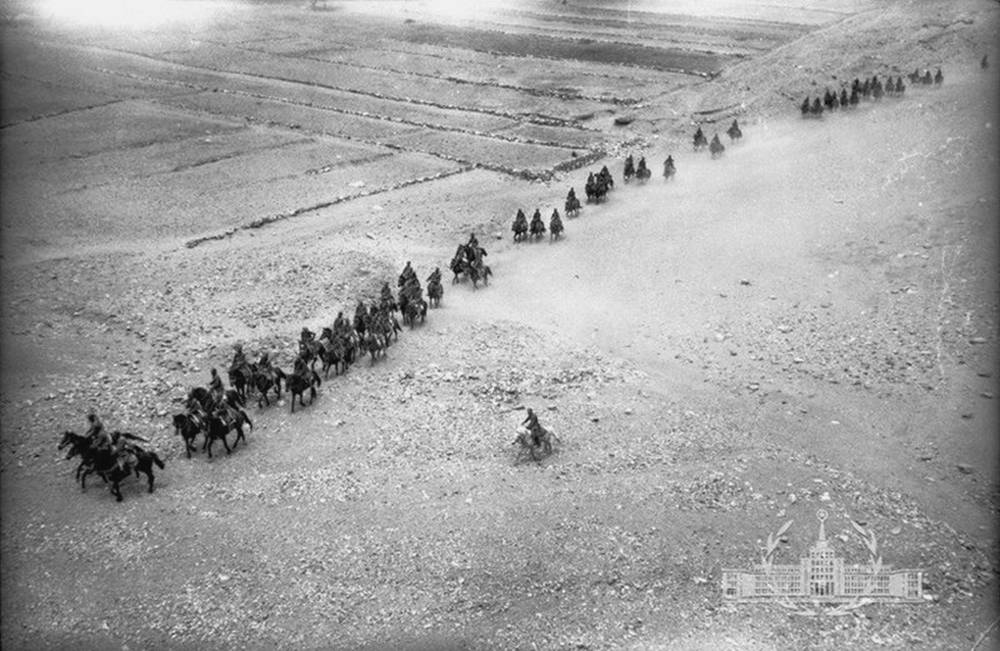 |
| Eighth Route Army cavalry, October 1937. |
 |
| Eighth Route Army cavalry, October 1937. |
 |
| Eighth Route Army taking Chajianling, autumn 1937. |
 |
| Front cover of War supplement of China pictorial, 21 October 1937. |
 |
| Eighth Route Army cheering at Futuyu Great Wall, Laiyuan, Hebei, 1937. |
 |
| Eighth Route Army taking the Zijingguan Great Wall, 1937. |
 |
| Japanese troops parading inside Shanghai's French Concession in 1937. The Japanese only occupied the Chinese part of Shanghai during the Sino-Japanese war of 1937, but they made it clear that the International Settlement and the French Concession were defenseless and at their mercy. |
 |
| Harbor of Shanghai with warship and freighters, 1937. |
 |
| Japanese soldiers on army truck passing through ruins of Shanghai. China, Shanghai, 24 September 1937. |
 |
| Japanese Marines with flags and rifles at the ready, secure a troop transport near Shanghai, China, 23 September 1937. |
 |
| Planes and smoke clouds above the burning city of Shanghai, China, 1937. |
 |
| Monk soldiers in Wutai County, November 1937. |
 |
| Monk soldiers in Wutai County, November 1937. |
 |
| Nantao blazing, 6 November 1937. (DeGolyer Library, Southern Methodist University) |
 |
| Nie Rongzhen en route from Wutai, Shanxi to Fuping, Hebei, 1937. |
 |
| Meeting between Dr. Norman Bethune (left) and Nie Rongzhen (center), Commander-in-Chief of the Chin-Ch'a-Chi Border Region, China, 1938. |
 |
| Sentry at Chajianling Great Wall, autumn 1937. |
 |
| Japanese troops in Nanjing, 1937. |
 |
| The Sihang Warehouse following its capture by the Haji and Hayasaka Naval Landing Force Units. |
 |
| Destroyed deck of the steamship President Hoover after the impact of a rocket fired from the Chinese coast. Shanghai, 16 September 1937. |
 |
| A group of armed American sailors in a boat on the Wangpoo River near Shanghai. After a rocket attack on their ship, the USS Augusta, they head for shore. Shanghai, 20 August 1937. |
 |
| A Japanese soldier stands guard at a section of the railways around Tientsin. In the background is a train transporting Japanese troops. Tientsin, China, 1937. |
 |
| A Type 4 15cm howitzer of the Imperial Japanese Army, China 1937. |
 |
| Yang Chengwu column at the Great Wall, autumn 1937. |
 |
| Japanese Type 94 tankette with armored trailer moves across a bridge. Published 2 December 1937. |
 |
| Yagasaki troops advance to Huzhou, which is burning from the air raids. |
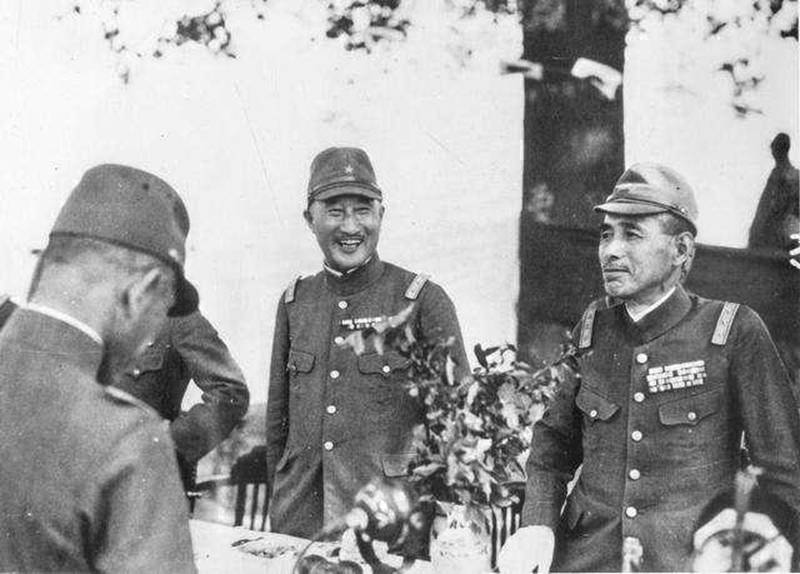 |
| Terauchi Hisaichi and Shunroku Hata celebrating the Japanese victory at Xuzhou, 1938. |
 |
| Cover of the Japanese Pictorial Weekly Magazine, Asahigraph, vol. 31 No. 1, 6 July 1938. |
 |
| Eighth Route Army fighting on the Futuyu Great Wall in Laiyuan, Hebei, China, 1938. |
 |
| Eighth Route Army meeting on the Futuyu Great Wall, spring 1938. |
 |
| Japanese troops fighting with mud in Shou County, An-hui, 17 June 1938. |
 |
| Fuping County government, 1938. |
 |
| Japanese troops occupying a Chinese town in Anhwei province, 1938. |
 |
| Chinese pilots who dropped leaflets over Nagasaki, Japan, in an American plane are honored. China, 1938. |
 |
| On January 10, 1938, the Japanese Army landed in Qingdao. |
 |
| Japanese Army troops occupy Qingdao, China, January 1938. |
 |
| Japanese bombing of a railroad bridge in northwest China, 1938. |
 |
| Chinese bodies in a ditch that were killed by Japanese Army troops, Hsuchow, China, 1938. |
 |
| Japanese naval landing force blasting Chinese pillbox during the Canton Operation, 1938. |
 |
| The bridge in front of the Gate of China in Nanking was destroyed by Japanese shellfire, 13 December 1937. |
 |
| Destruction after Japanese bombing of Nanking, 28 September 1937. |
 |
| The national flag of Japan on the center pole of the Republic of China government main gate in Nanking. |
 |
| Four military leaders of the Imperial Japanese military at the Memorial Ceremony for War Dead at Ku-Kung Airfield after conquering Nanking (18 December 1937). From left to right: Vice Admiral Kiyoshi Hasegawa (Commander-in-chief of 3rd Fleet), General Iwane Matsui (Commander of the Central China Area Army), Lieutenant General Prince Yasuhiko Asaka (Commander of the Shanghai Expeditionary Army), Lieutenant General Heisuke Yanagawa (Commander of 10th Army). |
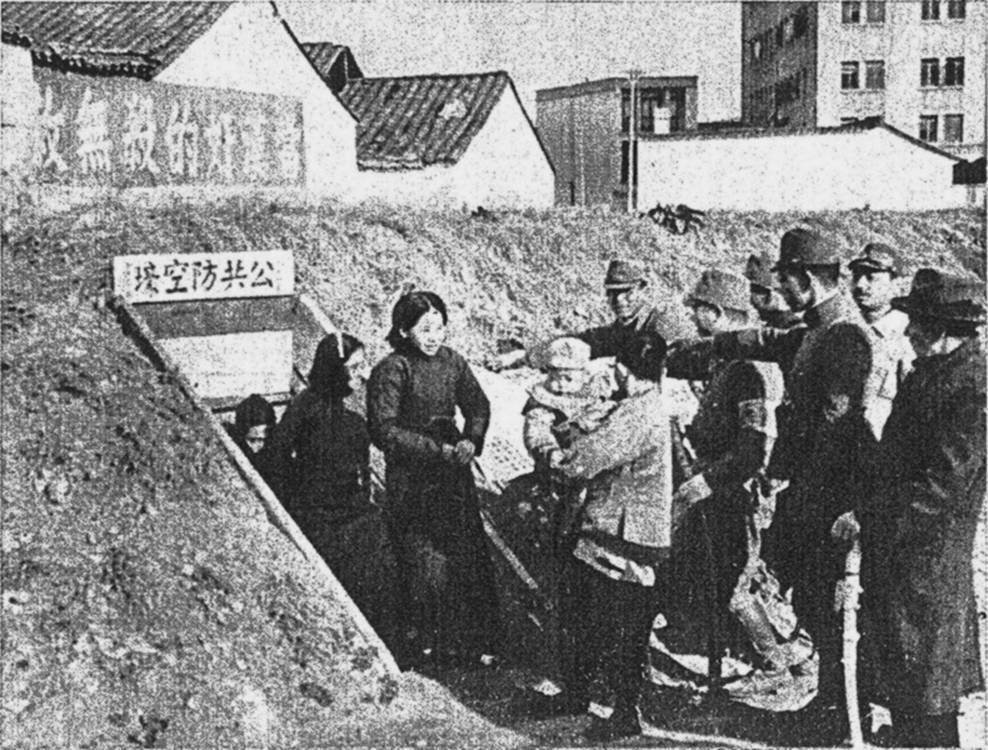 |
| Chinese civilians exit air raid shelter after the Japanese Army occupies Nanking. 14 December 1937. |
 |
| Japanese soldiers and Chinese children play with toy tanks in Nanking, 20 December 1937. The Rising Sun armbands worn by Chinese civilians signal that they are “friendly” towards Japan. |
 |
| The proclamation of the Japanese armed forces which was posted in Nanking says that the objective of the battle is warlords, not ordinary Chinese people. |
 |
| Japanese war correspondent Shinju Sato in front of the Sun Yat-sen Mausoleum in Nanking, 13 December 1938. |
 |
| The Central Hospital in Nanking after being bombed by Japanese aircraft, 1938. |
 |
| The Soviet embassy in Nanking being burned down by arson on January 1, 1938: The Soviet Union Embassy was burned down by a suspicious fire around noon on January 1, 1938. The embassy was a center to expand the communist movement of the Soviet Union in China, and from the beginning of the Second Sino-Japanese War, it was the place where Ambassador Bogomolov, Military Attaché Repin, and such people desperately worked for Soviet-Chinese co-operation for anti-Japanese actions like the Sino-Soviet Non-Aggression Pact. After the fall of Nanking, it was said to have been used as a hideout and a place for radio contact with Hangkow and others by a portion of the Chinese government. There were various rumors about the suspicious fire. It seemed that the Chinese government set fire to the building because they were displeased with the inaugural ceremony of the Nanking Autonomous Commission and tried to make the fire work to the disadvantage of the Autonomous Commission and Japan. A suspicious Chinese was arrested in Nanking on January 5 and interrogated. It was found that the arson was the act of Chinese stragglers. |
 |
| The collapsed Zhongshan Gate in Nanking, December 1937. |
 |
| Chinese troops entered Tai’erzhuang and engaged in street fighting with the Japanese, 1938. |
 |
| General Li Zongren/Li Tsung-jen at Tai’erzhuang, 1938. |
 |
| Chinese soldiers charge against enemy emplacements in the Battle of Tai’erzhuang, 1938. |
 |
| Chinese soldiers in house-to-house fighting in the Battle of Tai’erzhuang, 1938. |
 |
| Chinese troops advancing during the Battle of Wuhan, 1938. |
 |
| Soviet aviators at Hankou airfield. From left to right, B.B. Kamonin, Chinese pilot, Aleksey Andreyevich Lebedev, interpreter, 1938. |
 |
| Chinese machine gun position in action in the outskirts of the Wuhan area during the Battle of Wuhan, 1938. |
 |
| Elite German-trained divisions of the National Revolutionary Army before the Battle of Wuhan, 1938. |
 |
| Chen Cheng with Chiang Kai-shek inspecting troops. |
 |
| Crowd of Chinese refugees of the Yellow River flood who were rescued by Japanese forces, 1938. |
 |
| Near Zhengzhou, the First Yellow River Disaster Relief Team of the Seventh Relief District of the Central Relief Committee of the Nationalist Government of China, 1938. |
 |
| Japanese bombers over Chungking, 1942. |
 |
| Imperial Japanese Navy fighter pilots Masao Asai (left) and Masao Sato (right) in front of a Type 96 Model 4 (Mitsubishi A5M) fighter on the aircraft carrier Akagi during the Sino-Japanese war, c. 1938-39. |
 |
| Japanese armed forces' aircraft engineers study Soviet I-16 fighter used by the Nationalist air force, Nanking, 22 December 1937. |
 |
| Japanese Nakajima Ki-27 Type 97 fighter, 1938. |
 |
| An Imperial Japanese Navy Yokosuka B4Y Type 96 Carrier Attack bomber flies near the aircraft carrier Kaga off China during the Sino-Japanese war, c. 1937-38. |
 |
| A Mitsubishi A5M Type 96 Carrier Fighter, piloted by Sergeant 3rd Class Kashimura Kanichi, lost part of one wing during the attack on Nanchang but returned to Nanjing, 9 December 1937. |
 |
| Mitsubishi A6M2a Model 11 over China to attack Nanzheng from Yichang Air Base. Captain Suzuki Minoru’s machine is in the lead. Sergeant Nakakariya Kunimorizo’s machine is in the foreground. Belonging to the 12th Air Group, 26 May 1941. |
 |
| Japanese Army soldiers during the battle of Changsha, September 1939. |
 |
| Japanese artillery soldiers with gas masks, smoke screen at the Hunan Front near Changsha, 1941. |
 |
| A soldier of the Japanese Army 4th Division firing a Type 92 Heavy Machine Gun during the first stage of the Chángshā operation, near the Miluo River, Húnán Province, China. 22 or 23 September 1941. |
 |
| Japanese soldiers performing railway guard, 1937. |
 |
| Japanese occupation of Peiping (Beijing) in China, on 13 August 1937. Under the banner of the rising sun, Japanese troops are shown passing from the Chinese city of Peiping into the Tartar city through Chen-men, the main gate leading onward to the palaces in the Forbidden City. Just a stone’s throw away is the American Embassy, where American residents of Peiping flocked when Sino-Japanese hostilities were at their worst. |
 |
| Fighting in the Japanese Concession in Tianjin during the North China Incident, July 1937. On 7 July 1937, outside of Beijing, Japanese and Chinese troops clashed, and within a few days, the local conflict had escalated to a full, though undeclared, war between China and Japan. This is considered by some historians as the start of World War II. |
 |
| Chinese soldiers of the Eighth Route Army firing a Type 24 Heavy Machine Gun during an ambush against Japanese troops in the Battle of Pingxingguan, 25 September 1937. |
 |
| Japanese soldiers and trucks camouflaged with local vegetation on the march. |
 |
| Chinese soldiers manning a 3.7cm PaK 36, 1937. |
 |
| Two Nationalist Chinese soldiers firing at Japanese warplanes with a Hotchkiss M1922 machine gun, 1937. |
 |
| Nationalist Chinese soldiers of the 185th Division operating a Czech BRNO ZB26 machine gun, March 1942. |
 |
| Nationalist Chinese T-26 tanks at Hunan. Note the long-barreled guns; similar Vickers 6-Ton tanks also in Chinese service had short gun barrels. 1939. |
 |
| Japanese torpedo boat Hayabusa 9 August 1932. |
 |
| Japanese torpedo boat Hayabusa, Otori class, starboard view, August 1937. (Department of Naval Intelligence, June 1943/Library of Congress) |
 |
| Japanesde torpedo boat Kasasagi on the Yangtze River. |
 |
| Japanese torpedo boat Kasasagi, January 1937. |
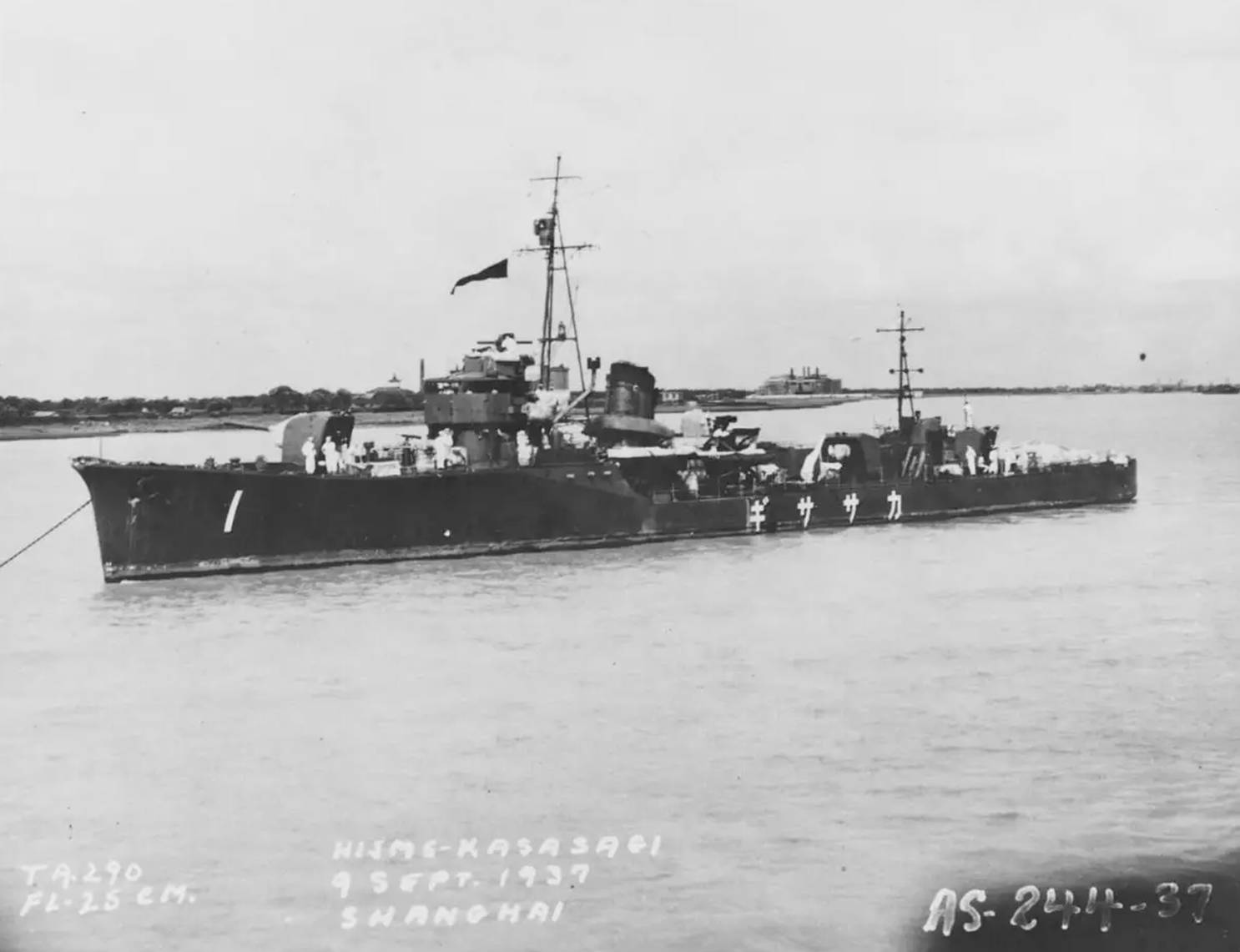 |
| Japanese torpedo boat Kasasagi, Shanghai, 9 September 1937. |
 |
| Kasagi, Imperial Japanese Navy's unfinished aircraft carrier, Sasebo, Japan, November, 1945. |
 |
| Japanese light carrier Kasagi. View of the ship's starboard side, showing her stacks and gun sponsons. Taken at Sasebo, Japan, 19 October 1945. (Naval History & Heritage Command/U.S. National Archives SC 218456) |
 |
| The Japanese carrier Kasagi, seen here in derelict and abandoned condition in September 1945. She was one of six ships of the Unryu class, of which only three were actually completed, these being Unryu herself (sunk December 1944) Amagi (sunk July 1945) and Katsuragi (broken up in 1947). Kasagi was surrendered at war's end when approx 85% completed, and eventually scrapped in 1947. (Colorized photo) |
 |
| French Bougainville class colonial sloop (possibly FR Amiral Charner) in Shanghai Harbor, China, 1937. |
 |
| Japanese destroyer Shigure anchored off Shanghai during the battle of Shanghai, 16 August 1937. (Naval History & Heritage Command) |
 |
| Japanese Type 94 tankettes are transported by train through Northern China. Heavily laden Japanese soldiers walk along the rails. Tientsin, China, November 1937. |
 |
| Japanese Type 89 medium tanks arrive in Shanghai. In the foreground is an armed soldier standing guard. In the background is a troop transport ship. Shanghai, China, October 1937. |
 |
| Aerial view of the steamship Augusta, flagship of the United States of America, being hit by a stray shell. The ship is lying off the Chinese port of Shanghai, China, 20 August 1937. |
 |
| The American gunboat Luzon on the Yangtze River. The American embassy staff was temporarily housed on this ship because of the heavy Japanese bombardments. Nanking, China, 1937. |
 |
| Japanese warship shells Chinese positions near Shanghai, China, 1937. |
 |
| A Japanese plane (possibly a Nakajima A4N Navy Type 95 Carrier Fighter) crashes in flames after being shot down by the Chinese between Shanghai and Hangchow, China, 18 October 1937. |
 |
| Curtiss Hawk III of 4th Squadron Commander Major Gao Zhihang the Chinese air force. In the Jiangqiao air battle on 14 August 1937, he set a record of shooting down three Japanese planes. |
 |
| Japanese Mitsubishi A5M2b, aka Mitsubishi Navy Type 96 Carrier-based Fighter, Mitsubishi Navy Experimental 9-Shi Carrier Fighter, company designation Mitsubishi Ka-14. |
 |
| Curtiss Hawk II in Chinese service, 1937. |
 |
| The Imperial Japanese Navy's G3M from Kisarazu Air Group over Sun Yat-sen Mausoleum, Nanking, 1938. |
 |
| A Polikarpov I-16 fighter of the Soviet Air Force Volunteer Force that came to China to assist in the war of resistance against Japanese aggression. |
 |
| Japanese Mitsubishi Ki-21 bombing the Chinese capital, Chungking, 16 June 1940. |
 |
| Vickers Carden Loyd Light Tanks (M1931). Twenty units were bought by the Nationalist Chinese. |
 |
| Nationalist Chinese T-26 tanks in Hunan province, 1941. |
 |
| China War of Resistance Against Japan Memorial Museum on the site where the Marco Polo Bridge Incident took place. |
 |
| A heavily loaded Japanese supply truck broke down hauling supplies to Japanese troops in the mountains of China, so troops must furnish the horsepower. |