 |
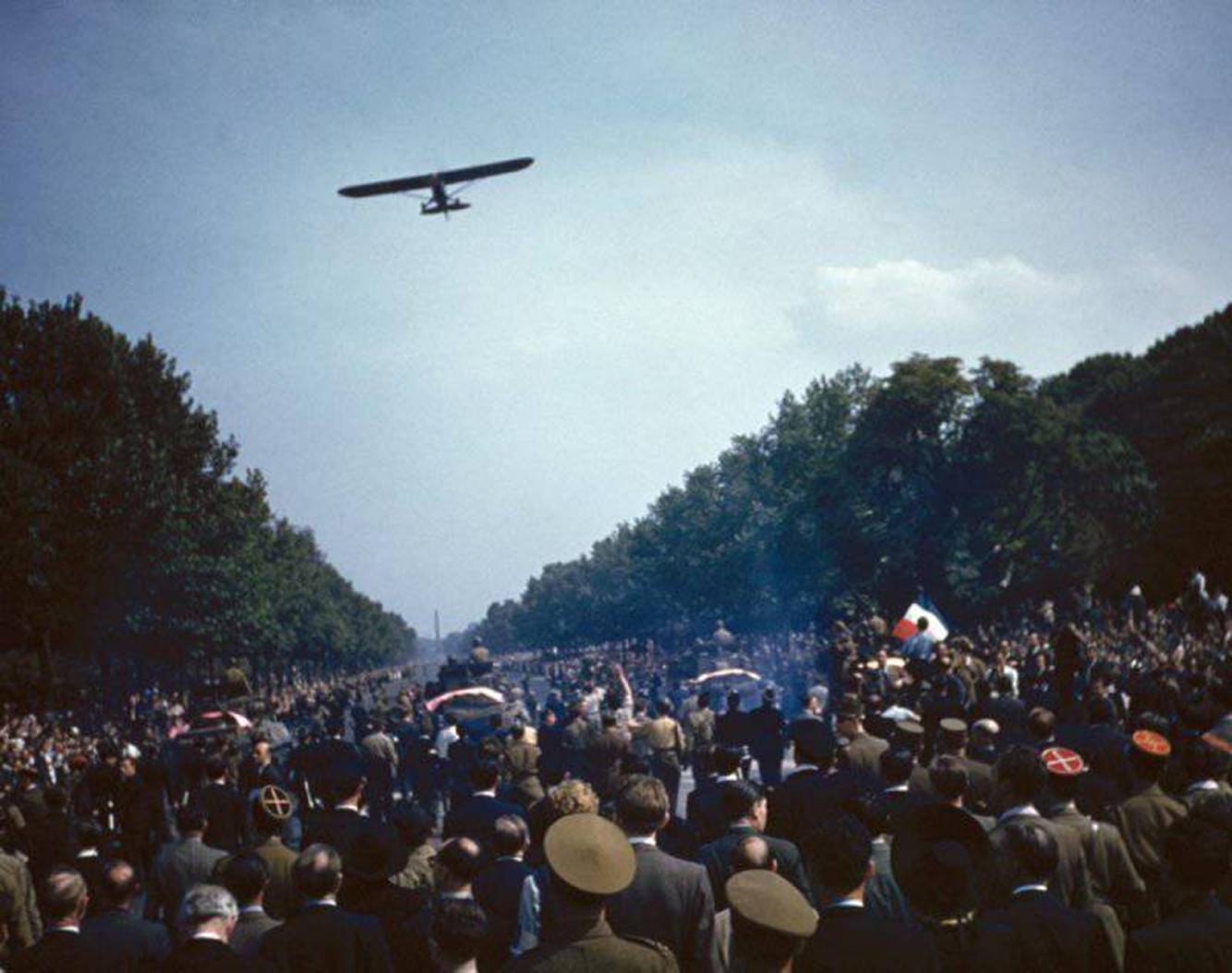
| Crowds of French patriots line the Champs Elysees to view Free French tanks and half tracks of General Leclerc's 2nd Armored Division passes through the Arc du Triomphe, after Paris was liberated on August 26, 1944. Among the crowd can be seen banners in support of Charles de Gaulle. (Library of Congress's Prints and Photographs Division photo fsac.1a55001) |
by Martin Blumenson
The liberation of Paris in World War II illustrated better than most examples the close connection between politics and the military. On the Allied side, specifically for the Americans and the French, the political and operational motivations interacted in harmony as well as in conflict. How they played out is instructive.
Misunderstandings and cross purposes marred the scene. The French believed in the supremacy of politics over the military. The Americans, in accordance with strongly held tradition, concentrated on the clash of arms. The resolution of these national differences affected a long-standing friendship.
The story starts in June 1940, when the Germans entered and occupied Paris. They were a distasteful presence to the French for more than four years. Their ubiquitous street signs were constant reminders of the nuisances, difficulties, and eventual horrors they inflicted. They took and executed hostages. They imposed a curfew. They forbade the playing of jazz. Because of their restraints, petty and otherwise, the inhabitants looked forward with longing to see the Germans go.
The Allies first gave serious thought to Paris when they acceded to the political wish of General Charles de Gaulle, head of the French Provisional Government in London. The invasion planners added the 2d French Armored Division to the list of units scheduled to sail from England to the continent, “primarily so that there may be an important French formation present at the re-occupation of Paris.” General Dwight D. Eisenhower, the Supreme Allied Commander, promised to use the unit to free the capital.
General Jacques Leclerc, the wartime pseudonym of Philippe François Marie de Hautecloque, commanded the division. An aristocrat, he had served as a regular army captain in the disastrous campaign of 1940. After the French surrendered, Leclerc made his way to England and joined De Gaulle.
Leclerc burned with desire to expunge and avenge the French defeat. He was headstrong and impatient, possessed a formidable will, and generated an immense charisma. De Gaulle sent him to Chad, where he raised a column of troops. He took his men to Libya and routed Italian soldiers at Koufra. He then attached his outfit to General Bernard L. Montgomery’s British Eighth Army and fought on its desert flank. Leclerc advanced rapidly in rank and gained a legendary reputation. Having operated more or less independently, he was ill-suited to the discipline of the chain of command.
Toward the end of 1943, De Gaulle instructed Leclerc to form the 2d French Armored Division. Leclerc pulled together a variety of elements, “a mosaic of peoples, races, religions, and political convictions.” Free French from the United Kingdom and Syria, French North Africa and Equatorial Africa, Catholics, Protestants, Jews, Moslems, and animists, communists, reactionaries, socialists, radicals, free thinkers, militant Christians, and Quakers all mingled in friendship. Animating them were hatred of the Germans, love of France, and the spirit of Leclerc, who imparted a sense of adventure. The men exhibited the exuberance of freebooters.
After training in Algeria, the division moved to England. The soldiers knew what they were expected to do. They could hardly wait. Anticipation of their mission made them difficult to control.
The French armored division arrived in Normandy on 1 August 1944, almost two months after D-Day, and was assigned to the Third U.S. Army under General George S. Patton, Jr. A patrician who spoke fluent if ungrammatical French, Patton welcomed Leclerc warmly. He offered Leclerc the opportunity to fight immediately instead of waiting to liberate Paris. Leclerc jumped at the chance.
Patton attached Leclerc’s division to the XV Corps, commanded by General Wade Hampton Haislip. An aristocratic Virginian who had been a student at the Ecole de Guerre in Paris, Haislip spoke French easily. Like Patton, Haislip was especially nice to Leclerc. Both Americans tried to make Leclerc feel at home.
Yet Leclerc was skeptical of Americans. His service with the British in North Africa had given him some anti-American attitudes. Like many British officers, Leclerc thought the Americans to be newcomers to the war and amateurs in execution. He was sure he saw battlefield problems and solutions instantly, whereas Americans required time and paperwork to grasp and work out situations. Part of Leclerc’s outlook came from resentment. The French were the proprietors of France, yet the Americans, who were merely transients, were running the show.
Leclerc would try Haislip’s and Patton’s patience. He would get on the nerves of all his American superior commanders, Generals Omar Bradley at 12th Army Group, Courtney Hodges at First U.S. Army, and Leonard Gerow at V Corps.
With the French on the left and an American armored division, the 5th, on the right, the XV Corps pushed north toward Argentan to close what became known as the Argentan-Falaise pocket, the maneuver to surround the Germans in Normandy. Ahead lay an upland forest, difficult terrain, and Haislip instructed his armored divisions to go around it, the French on the left, the Americans on the right.
In a defiant or thoughtless, yet inexcusable, gesture of disobedience—perhaps because Leclerc had never before commanded a division in combat—Leclerc disregarded Haislip’s order. He sent his elements around the left side, through the forest, and around the right. The latter troops preempted a major road reserved for the Americans and blocked their movement to Argentan, which was undefended.
During the six hours it took Leclerc’s men to complete the maneuver, the remnants of three panzer divisions arrived in Argentan and assumed defensive positions. They turned back the XV Corps and kept the Americans and French out of the town.
On the outskirts of Argentan, the French division found itself on the southern jaw of the Falaise pocket. Paris was 100 miles away. Leaving Leclerc where he was, Patton, on the following day, 14 August, sent half of the XV Corps eastward toward the Seine River. Leclerc was exasperated. Did no one understand the importance of his mission? Asking Patton when the French could go to Paris, he explained, “It is political.”
Patton needed Leclerc to contain the Germans at Argentan, and he bluntly told Leclerc to stay put. Patton’s diary entry for the following day, 15 August, reads as follows: “Leclerc came in very much excited. He said, among other things, that if he were not allowed to advance on Paris, he would resign. I told him in my best French that he was a baby and … that I had left him in the most dangerous place [on the front]. We parted friends.”
Leclerc wrote to Patton on the next day, 16 August. Argentan, he said, was quiet. It was probably time for him to regroup for movement to Paris. Patton wondered in his journal whether Leclerc would obey orders.
At Patton’s headquarters that evening, Leclerc found Bradley there on a visit. Bradley and Patton both assured Leclerc of their respect for his ultimate place in the scheme of things.
Understanding why he had to remain at Argentan, Leclerc worried. American troops were closer to Paris than he was. On 19 August, Haislip’s XV Corps crossed the Seine River, 25 miles below Paris. Walton Walker’s XX Corps at Chartres and Gilbert Cook’s XII Corps at Orleans were 50 and 75 miles from the capital. If Eisenhower had to liberate Paris quickly, would he be able to use Leclerc?
The departure of Haislip’s corps headquarters and the shift of Patton’s army to the east brought Leclerc new superior officers. The headquarters of Hodges’ First Army and of Gerow’s V Corps took charge of Argentan and Leclerc. Neither American spoke French. Neither was concerned with Leclerc’s special role.
To become acquainted with Leclerc, Hodges invited him to lunch on 20 August. All Leclerc could talk about was Paris. Hodges was disgusted. Yet on his own initiative he generously noted in his diary his intention to let Leclerc liberate the capital if the mission fell to Hodges.
On 21 August, the Falaise pocket closed and Leclerc, no longer required at Argentan, decided to fulfill his task. That evening he sent 150 men in ten light tanks, ten armored cars, and ten personnel carriers toward the capital. If the Allies moved into Paris without the French division, this small contingent was to go along as representatives of De Gaulle’s Provisional Government and the French Army.
Writing to De Gaulle, Leclerc regretted his inability to dispatch his entire division. “Unfortunately,” the Americans regulated the fuel they furnished him. And “the rules of military subordination” prohibited him from independent action. Ordering the small group to Paris was already a serious infraction.
On the following morning, 22 August, Leclerc sent an officer to explain to Gerow, his immediate superior. Gerow had by then received a message asking why French troops were outside their authorized boundaries. Was Gerow unable to control them?
Before Leclerc’s emissary could speak, Gerow presented him with a letter for Leclerc. “I desire to make it clear to you,” Gerow had written, “that the 2d French Armored Division is under my command for all purposes and no part of it will be employed by you except in the execution of missions assigned by this headquarters.” He directed Leclerc to recall his detachment.
Unwilling to do so, Leclerc flew in his light plane to Hodges’ First Army headquarters, the echelon above Gerow. Leclerc learned that Bradley was conferring with Eisenhower on Paris. Hodges was awaiting word on the outcome of the meeting. Leclerc decided to wait there too.
Eisenhower had concluded that it was best to defer the liberation. Taking Paris would delay operations against the Germans elsewhere. Seizing the capital might destroy the place and its historic and cultural monuments. Diverting food and coal to the city’s inhabitants on humanitarian grounds would hamper the Allied pursuit of the Germans fleeing toward their homeland. The possibility of ending the war quickly might vanish. Bypassing Paris, going around the city, and waiting for the isolated German garrison to surrender made military sense.
The Supreme Allied Commander appreciated the political nature of Paris, but very early in his tenure of his position he had made it known that he would lead the Allied forces operationally and conduct the war without regard to politics. If he committed troops to Paris, he would be breaking his word, for he would make it possible for De Gaulle to enter the city. Eisenhower might thereby impose De Gaulle and his Provisional Government on the French people before elections could be held.
Outside Eisenhower’s frame of reference, Paris in August 1944 was the prize of a contest for power among various factions of the French Resistance. The overall aim of the Resistance, to get rid of the Germans, bound together men and women of conflicting philosophies and interests. De Gaulle had organized the Resistance outside France to support his Provisional Government. Inside France, several contingents jockeyed for control. The approach of Allied forces sharpened the political differences. A large and vociferous group on the left competed with De Gaulle for overall leadership.
Governing France was possible only from Paris. The city was the hub of national administration, the center of the transportation system, the focal point of communications. The ancient dictum was right: he who holds Paris rules France. No wonder De Gaulle was so anxious to get to Paris and Leclerc was so frustrated.
Rumors of unrest in the city and talk of a general uprising were additional dangers to De Gaulle, who wanted no social and political upheaval. A revolt in Paris might place his opponents in the seat of political power. Civil disorder might flame into full-scale revolution and anarchy. An insurrection might provoke the Germans into a bloody repression.
Adolf Hitler had ordered his military forces to defend Paris fiercely. He wished the 70-odd bridges in the city prepared for demolition. He expected his troops to battle outside as well as inside the capital. Paris, Hitler instructed, must not fall into Allied hands except as, he said, “a field of ruins.”
The commander of Greater Paris, General Dieter von Choltitz, had about 20,000 troops in strong defenses outside the city. No one minded fighting there. He had about 5000 men inside the city. No one wanted to fight there.
Sarcastically, Choltitz explained to his immediate superior how he planned to conform with Hitler’s desire. He had put three tons of explosive in the Cathedral of Notre Dame, two tons in the Invalides, one in the Palais Bourbon. He was ready to level the Arch of Triumph to clear a field of fire. He was going to blow up the Opera and the Madeleine church. He expected to dynamite the Eiffel Tower, have it fall across the Seine River, and use it as a wire entanglement to block the waterway. At dinner with his personal staff one evening, he said, “Ever since our enemies have refused to listen to and obey our Fuehrer, the whole war has gone badly.”
About 20,000 Resistance members were in Paris, but few were armed. They had routinely destroyed road signs, punctured the tires of German vehicles, cut communication lines, bombed gasoline depots, and attacked isolated Germans. But they had never waged open warfare.
As American forces approached, patriotic excitement flared. By 18 August, more than half of the railroad workers in the city were on strike, and virtually all of the policemen had disappeared from the streets. Several armed Resistance members appeared in public, and a few anti-German demonstrations took place. Lack of a German reaction led small, local Resistance groups, without central direction, to take possession on the very next day, 19 August, of police stations, town halls, national ministries, newspaper buildings, and the Hotel de Ville, city hall. The seizures challenged the Germans.
To avoid an outright clash, Resistance leaders persuaded the Swedish Counsel General in Paris to negotiate with Choltitz. That evening of 19 August, the two men agreed to a truce. No expiration date was stated.
The arrangement was quite nebulous. Choltitz promised to regard certain parts of Paris as Resistance territory. The Resistance consented to leave certain sections of Paris free for the passage of German troops. No boundaries were drawn, and neither side was exactly sure of its area.
The truce was advantageous to both parties. The Resistance was aware of its weakness, uncertain when Allied troops would arrive, hopeful of preserving the capital from harm, and anxious to prevent repressive measures by the Germans. Choltitz, by maintaining order in the city, could devote his attention to engaging the Allies on the approaches to Paris. He could hardly operate outside the city if widespread civilian disorder occurred within.
During the negotiations, Choltitz had made an offhand remark. He was of course unable, he said, to surrender to the irregular troops of the French Resistance. Would he then capitulate to the regular Allied forces? No one knew.
Resistance emissaries departed Paris to seek and urge Allied commanders and De Gaulle to take immediate action. Some brought exaggerated reports of unrest in the capital. Others emphasized Choltitz’s apparent desire to give up as soon as Allied troops seized his headquarters in the Hotel Meurice on the rue de Rivoli. The solution to everyone’s problem, it seemed, was to get Allied troops into the capital.
On 21 August, De Gaulle met with Eisenhower, who talked of bypassing Paris and who reiterated his acceptance of Leclerc as the eventual liberator. De Gaulle wanted Leclerc in the capital at once. Later that day, De Gaulle sent Eisenhower a letter by messenger. As head of the Provisional Government, he threatened politely to order Leclerc to Paris himself.
Eisenhower read the letter and jotted a note on the margin. He would probably, he wrote, “be compelled to go into Paris.”
Five days earlier, on 16 August, the Combined Chiefs of Staff had informed Eisenhower of a change in policy. They now had no objection to De Gaulle’s entry into the capital. Most Frenchmen, it was becoming increasingly clear, approved of De Gaulle, and the Allies were ready to recognize his provisional organization as the de facto government of France.
Eisenhower telephoned Bradley, his closest American subordinate commander, and asked for a conference on the following morning, 22 August. Eisenhower wished to discuss a reconsideration of his plans. That evening, Eisenhower set out his dilemma in these words. Although it was desirable to postpone the capture of Paris, it no longer seemed possible. If the Germans held Paris in strength, they would menace the flanks of the Allied troops bypassing the capital. If they conceded the place, “it falls into our hands whether we like it or not.”
The problem for Eisenhower was the intrusion of the political into the operational. He could cut Leclerc loose to liberate the capital any way the French desired. But he disliked losing control of Leclerc’s men. So long as the division was part of his force, he was loath to approve a political mission for it. Yet the Allies ought to enter to satisfy French aspirations, to maintain order in the capital, to secure important Seine River crossings, and to gain public relations prestige. What Eisenhower needed was a military reason for committing Leclerc to the city.
As Eisenhower and Bradley talked on the morning of 22 August, conflicting news continued to come in. Whether Choltitz was ready to surrender or to fight was unclear. The Resistance apparently controlled most of the city and all of the bridges. The bulk of the Germans had already gone. The defenses outside Paris were inconsequential. Because the truce expired at noon on the following day, 23 August, Allied troops must arrive in Paris at that time to avoid fighting and bloodshed.
Eisenhower finally found a way to resolve the situation. He would send reinforcements to the Resistance who had seized the city and who needed help to hold it. By making available support, Eisenhower would repay the Resistance forces what he called “their great assistance in the campaign.”
Reinforcement was a military action. Therefore, Eisenhower could order Leclerc to Paris. The Allies could participate in the movement. The liberation was to be Allied rather than French. Leclerc was to penetrate into Paris first, as Bradley said, “to help the French recapture their pride after four years of occupation.” But Allied troops were to accompany the French on their ostensibly military mission to bolster the Resistance in the capital.
Early in the afternoon, the conference terminated, Bradley flew to Hodges’ First Army headquarters in order to start the proceedings. He discovered Leclerc waiting at the First Army airstrip. Bradley told him to move immediately to Paris. Leclerc gave a joyous shout and hastened back to his division, while Bradley and Hodges conferred on how to shape the activity. Hodges suggested having Gerow direct the operation. It would be fair, Hodges said. Gerow and General J. Lawton Collins had been the D-Day commanders, and Collins had had the honor of liberating Cherbourg. Now Gerow was to have his moment of glory.
Under Gerow’s V Corps headquarters would be Leclerc and, as backup, General Raymond O. Barton’s 4th U.S. Infantry Division. American reconnaissance and engineer units and whatever British troops turned up would accompany them. Eisenhower had telephoned Montgomery and asked him to send a British contingent. All who entered the city were to display their national flags. They were to arrive in Paris as soon after noon of 25 August as possible. There was to be no sustained combat in the city.
That evening of 22 August, Gerow telephoned Leclerc and told him no serious opposition was expected to hinder his movement to the capital. Leclerc was to start at once, that night. Despite Gerow’s wish, Leclerc waited until the morning of 23 August.
The eastward displacement to Paris occurred on two routes in conformance with Gerow’s direction. The northern column, expected to be the main effort, consisted of the bulk of the French division in the lead, some American reconnaissance and engineer troops, and four firing battalions of the V Corps Artillery. The southern column had a French combat command, U.S. reconnaissance elements, the V Corps headquarters, and Barton’s 4th Infantry Division in that order of march. British troops failed to show up.
The force made good progress on 23 August, reaching points less than 20 miles from the capital by nightfall. There the heads of both columns met solid German opposition. Without consulting or telling Gerow, Leclerc changed his formation by transferring a combat command from the northern to the southern column. Probably he was trying to speed his advance. Perhaps he was favoring the commander of the southern group who was close to De Gaulle. Possibly he was reluctant to attack through Versailles. Maybe he was attracted to the wide Orleans-Paris highway. Was he displaying his resentment of American control in a matter he considered to be strictly French?
His decision was unfortunate in three respects. He inadvertently concentrated his force where the German defenses were the strongest and in the greatest depth. He put his southern column out of range of the V Corps Artillery. He impinged on the route reserved for the 4th U.S. Infantry Division.
Leclerc’s men attacked at dawn of 24 August. The northern column fought fiercely and gained about 15 miles. By evening the troops had reached the Pont de Sevres, a wide highway bridge across the Seine River and a principal entry into the city. The bridge was still intact, and a few tanks crossed into the suburb of Boulogne-Billancourt. Paris proper was less than two miles away at the Porte de St. Cloud. But the men stayed where they were as enthusiastic civilians swarmed over them in eager welcome, pressing flowers, kisses, and wine on them.
The main effort in the south advanced about 13 miles with great difficulty. By nightfall, the head of the column was still about five miles from the closest entrance, the Porte d’Orleans. The Pantheon, the objective, was seven miles away. Notre Dame, the center of the capital, was eight miles distant.
The supposed expiration of the truce was very much on the minds of the Americans following French progress. To Bradley, who had taken unofficial charge of the operation, it was incredible that the French were making such little headway. They seemed to be procrastinating. They “stumbled reluctantly through a Gallic wall” Bradley later said, “as townfolk … slowed the French advance with wine and celebration.” Gerow substantiated the impression. The German opposition appeared to be slight, Leclerc’s attack halfhearted.
Hoping to shame the French into greater effort, Gerow asked Bradley whether he could order the 4th U.S. Division into the city. An angry Bradley wondered how long after the truce Choltitz would wait for regular troops before destroying the capital. Bradley could hardly let the French “dance their way to Paris.” He told Gerow, “To hell with prestige. Tell the 4th to slam on in and take the liberation.” Precedence in favor of the French, Gerow informed Barton and Leclerc, no longer applied.
This information prompted Leclerc to make one more attempt that night. It was impossible for him to order the northern column to continue beyond the Sevres bridge because, as the French reported, “liaison between the columns for all practical purposes no longer exists.” Leclerc’s mistake or oversight was perhaps due to inexperience.
So Leclerc, who was with the main effort in the south, sent a small detachment of tanks and half-tracks forward. This force rolled along side roads and back streets, crossed the Seine River by the Pont d’Austerlitz, drove along the quays on the right bank, and reached the Hotel de Ville, the city hall, just before midnight, 24 August.
The bells of nearby Notre Dame began to ring joyously. Another church took up the refrain. A third joined. Soon all the churches in Paris were pealing in celebration. A cascade of sound washed over the city.
Few Parisians had gone to bed that night. The telephones were functioning, and everyone knew of the Allied soldiers in the suburbs. The church bells could mean only that the liberators had arrived.
On the following morning, 25 August, the official day of liberation, enormous crowds of excited Parisians welcomed the 2d French Armored Division, which swept the western part of Paris, and the 4th U.S. Infantry Division, which cleared the eastern part. Everywhere were joy, delight, tears of happiness. Unbounded elation took hold of Parisians and the French and the whole civilized world.
Most of the Germans had melted away during the night. Two thousand remained in the Bois de Boulogne, seven hundred more in Luxembourg Gardens. A few small and scattered groups awaited capture.
In the early afternoon of 25 August, under the arcades of the rue de Rivoli, a young French officer sprang into the Hotel Meurice. He burst into Choltitz’s suite of rooms. To Choltitz, who sat at his desk, he shouted in his excitement, “Do you speak German?” Choltitz replied coolly. “Probably better than you.” He allowed himself to be taken prisoner.
In the presence of Leclerc and the French Resistance commander in Paris, Choltitz signed a formal act of capitulation. Teams of French and German officers circulated copies to the Germans still in the city.
As for the internal political situation, the Gaullists proved to be better organized and disciplined than their opponents. Taking advantage of the uprising on 19 August, they had seized and occupied the seat of government. They held the buildings and the facilities and thus the means of political control.
On 26 August, De Gaulle wrote and thanked Eisenhower for letting Leclerc liberate Paris. With cheering crowds present, De Gaulle, Leclerc, and members of the Provisional Government walked from the Etoile, now named the Place du General de Gaulle, down the Champs Elysees to the Place de la Concorde. De Gaulle then proceeded to the Cathedral of Notre Dame where an overflow congregation celebrated a mass of thanksgiving.
When Hitler learned that Allied troops were in Paris, he asked whether the capital was burning. “Brennt Paris?” Enraged by the negative response, he ordered artillery, V-weapons, and planes to destroy the city. His military commanders were busy with other matters. Getting their forces back to Germany, rearming the Siegfried Line, and preparing to keep the Allies out of their homeland were their priorities.
To make clear the participation of Allied troops in the liberation, Eisenhower marched the 28th U.S. Infantry Division through the city to the front on 29 August. Eisenhower, Bradley, Gerow, De Gaulle, and Leclerc reviewed the parade. Eisenhower had invited Montgomery to attend, but he said he was too busy to come.
After a week of maintaining order in Paris, Leclerc took his men to the eastern part of France. There he rejoined Haislip’s XV Corps. Leclerc had changed his opinion of American competence, he had learned to run his division effectively, and he gained great respect from his American commanders in the ensuing campaigns.
Gerow, the senior military commander in Paris, had sought to exercise control, but the French blocked his efforts. They immediately took over civil affairs without checking with Gerow as a matter of courtesy. Several days later, when Gerow formally turned the area over to them, they flatly said, “French authorities alone have handled the administration of the city of Paris since its liberation.” They avoided giving the slightest sign of admitting their dependence on the Americans.
To the French, the Americans spoiled the occasion by intruding. The Americans felt their participation was small repayment for the dead soldiers lost between the Normandy beaches and the gates of the capital. They expected gratitude, but instead garnered resentment. Eisenhower was charitable. “We shouldn’t blame them,” he later wrote, “for being a bit hysterical.”
The British refrained from taking part. Perhaps they regarded the event as a French affair. More likely, they were aware of anti-British feeling among the French, the result mainly of their destruction of the French fleet in 1940.
Eisenhower’s reinforcement contributed to a legend which emerged immediately after the liberation and endured for many years. The 2d French Armored Division and the French Resistance, the story went, had, together and without outside help, expelled the Germans from the city.
This belief has changed over the past half-century. As the French commemorated and celebrated the arrival of Allied forces over the Normandy beaches on D-Day, they gradually became aware of the Allied role in liberating their country. They eventually acknowledged the American presence in freeing their capital. Only good friends like the Americans, the French have now decided, could share the privilege, the splendid moment. It was all right for the Americans to be there.
The Author
Educated at Bucknell and Harvard universities, Martin Blumenson served in Europe during World War II and in Korea during the Korean War and is a retired lieutenant colonel, USAR. He has held the Admiral Ernest J. King Chair at the Naval War College, the General Harold K. Johnson Chair at the Army War College, and the General Mark Clark Chair at The Citadel. He has been Visiting Professor of Military and Strategic Studies at Acadia University, Visiting Professor at Bucknell University, at the University of North Texas, and at the University of Texas (Austin), Professor at the National War College, and Professorial Lecturer in International Affairs at George Washington University. Professor Blumenson is the author of 16 books, including Breakout and Pursuit in the official history series United States Army in World War II, The Patton Papers, Mark Clark, and The Battle of the Generals: The Untold Story of the Falaise Pocket.
 |
| An M8 armored scout car of the U.S. Army passes under the Arc de Triomphe after the liberation of Paris in August 1944. The identifying numbers of the vehicle were censored for security reasons, making it difficult to identify the unit. They appear to read “20X 20R-1” or “28X 28R-1,” which would indicate a vehicle of the reconnaissance troop of the 20th or 28th Infantry Divisions. However, the image is captioned here as showing a vehicle of Troop B, 102nd Cavalry Reconnaissance Squadron, which was attached to the French 2nd Armored Division. Both the 102nd Cavalry and 20th Infantry were present at the liberation and in the parade that followed on the 29th. |
 |
| Infantry and an M10 tank destroyer unit advancing into the Paris suburbs, August 1944. Note the varying styles of wearing the trousers over the canvas leggings, and the discarded combat jackets tucked through their belts. M1941 combat dress. |
 |
| Parisians fighting during the liberation of Paris. August 1944. Note the man with the double-barreled shotgun in the foreground. |

 |
| 18-year-old French Résistance fighter, Simone Segouin, during the liberation of Paris. She was a member of a patrol to root out Germans snipers. The girl reportedly had killed two Germans in Paris two days previously. She adopted the war name Nicole Minet. She had come from Chartres to help liberate the capital. Paris, August 19, 1944. |
 |
| Another shot of Simone, brandishing her German MP-40. |

 |
| Captured German soldier, Paris, August 1944. |
 |
| French Resistance fighters roll down a Paris street in their truck, nicknamed “Le Terrible.” |

 |
| Member of the FFI (French Forces of the Interior), hiding behind a truck, during Battle for Paris. August 1944. |
 |
| French resistance fighters firing in a skirmish during the battle for Paris. One skirmisher is wearing an Adrian helmet. 19 August 1944. Still from “La Liberation de Paris,” 1 September 1944, an underground propaganda work produced by the Le Comite de Liberation du Cinema Francais which disbanded shortly after. |
 |
| Urban warfare scene during the battle for Paris. German Hotchkiss H35 tanks captured by the French resistance fires against a sniper’s position. Still from “La Liberation de Paris,” 1 September 1944. |
 |
| German Hotchkiss H35 tanks captured by the French resistance, moving in downtown Paris on 19 August 1944 during the battle for Paris. Still from “La Liberation de Paris,” 1 September 1944. |
 |
| Two Parisians (possibly FFI forces) disarming a recently killed German soldier. Still from “La Liberation de Paris,” 1 September 1944.In the frames before this, the soldier is seen being shot, as Parisian snipers directly overlooking Notre Dame Cathedral watch him die. In the next few scenes, the woman and the man will remove his rifle, a pistol and other objects. |
 |
| M10 tank destroyer of the 2nd French Armored Division, on Boulevard Raspail, Paris. 23 August 1944. |


 |
| In the shadow of the Arc de Triomphe, two soldiers of the 2nd French Armored Division shoot at German snipers and pro-German French militia who were making an abortive attempt to free German prisoners. The latter lie dead on the Champs Elysees. |
 |
| General De Gaulle with General Leclerc and other French officers at Montparnasse railway station in Paris, 25 August 1944. |
 |
| Captured Germans are marched through the streets of Paris. 25 August 1944. |
 |
| “For the first time in four years, a French microphone speaks French!” De Gaulle speaks to the media upon liberating Paris. 25 August 1944. |
 |
| American soldiers look at the French tricolor flying from the Eiffel Tower. 25 August 1944. |
 |
| General Charles de Gaulle laying a wreath at the Tomb of the Unknown Warrior at the Arc de Triomphe in Paris, 26 August 1944. |

 |
| Parisians express their feelings towards a defaced portrait of German leader Adolf Hitler the day after the surrender of the German garrison in the city, 26 August 1944. They had spent four years having to refrain from anything of the sort. |

 |
| French generals De Gaulle (third from right) and Leclerc (right) preparing to march down the Champs Elysees the day after the liberation of Paris. In the background: General Pierre Koenig and Colonel Louis Dio. |
 |
| General Charles de Gaulle marches down the Champs Elysee in Paris during the city’s liberation. |
 |
| General Charles de Gaulle marches down the Champs Elysee in Paris during the city’s liberation. |


 |
| The crowd, flanked by firemen, greets a M5 light tank of the 2nd French Armored Division during the military parade, on August 26, 1944, at Place de la Concorde, the day after the Liberation of Paris. |
 |
| General Charles de Gaulle and his entourage set off from the Arc de Triumphe down the Champs Elysees to Notre Dame for a service of thanksgiving following the city’s liberation on 25 August 1944. |

 |
| General Charles de Gaulle and his entourage walk down the Champs Elysees to Notre Dame for a service of thanksgiving following the city’s liberation on 25 August 1944. |
 |
| General De Gaulle walking through the streets of Paris following the city’s liberation, 24 August 1944. |


 |
| Crowds of Parisians celebrating the entry of Allied troops into Paris scatter for cover as a sniper fires from a building on the place De La Concorde. Although the Germans surrendered the city, small bands of snipers still remained. August 26, 1944. |
 |
| Crowd on the pavement after snipers in buildings overlooking the Place de l’Hotel de Ville opened fire on the celebrations. 26 August 1944. |
 |
| 105mm self-propelled guns of the French 2nd Armored Division in front of Notre Dame in Paris, 26 August 1944. |
 |
| Another 105mm self-propelled gun of the French 2nd Armored Division in front of Notre Dame in Paris, 26 August 1944. |
 |
| Civilians shelter behind 105mm self-propelled guns of the French 2nd Armored Division as German snipers open fire from buildings in Paris, 26 August 1944. |
 |
| An AFPU (Army Film and Photographic Unit) jeep displaying a large union flag drives down the Champs Elysees in Paris, 26 August 1944. |
 |
| An AFPU photographer kisses a small child before cheering crowds in Paris, 26 August 1944. |
 |
| High ranking German officers seized by Free French troops which liberated their country’s capital are lodged in the Hôtel Majestic, headquarters for the Wehrmacht in the days of the Nazi occupation, Paris, France. 26 August 1944. |
 |
| Parisian girls greet a GI. |
 |
| Parisians line the Champs-Elysees to cheer the massed infantry units of the American army as they march in review towards the Arc de Triomphe, celebrating the liberation of the capital of France from Nazi occupation. 29 August 1944. |

 |
| American troops of the 28th Infantry Division march down the Avenue des Champs-Élysées, Paris, in the “Victory Day” Parade. 29 August 1944. |
 |
| 1945 3-cent stamp picturing the Arc de Triumph in Paris France with marching U.S. Army soldiers and an overflight by U.S. Army Air Force. Note that the image on the stamp is not the same as seen above. Also, no planes flew overhead during the parade. The stamp was issued 8 September 1945. |
 |
| The actual photo used for the stamp. Note that there are no planes overhead. |
 |
| Celebration of the liberation of Paris in France with Ahmadiyya Jabrayilov (on the end of the table). August 1944. |
 |
| Front row left to right: General Omar Bradley, Dwight D. Eisenhower, General Marie-Pierre Kœnig and Air Marshal Arthur Tedder in Paris, August 1944 |
 |
| Pvt. Gordon Conrey, one of the first Americans to visit Versailles after its liberation, standing in the Hall of Mirrors. |
 |
| French Forces of the Interior and Paris policemen inspect the execution chamber in the cellars of the former Ministry of Aviation building in Paris. August 1944. |
 |
| Free French Army trucks parade down the Champs-Elysées the day after the liberation of Paris by French and Allied troops, August 1944. |

 |
| Parisians welcoming Free French troops. |

 |
| Parisians hang American and French flags out of the windows on the Champs Elysees. |

 |
| Free French M4 medium tank under the Arc de Triomphe. |




 |
| A French sailor and two U.S. Army soldiers looking at the Eiffel Tower after the liberation of Paris. 1944. |
 |
| Truck of the FFI (French Forces of the Interior), painted with the marks of the FFI and the V for Victory, exhibited during the 60th anniversary of the liberation of Paris. |
 |
| M4 medium tank “Romilly” used in the liberation of Paris, August 1944, in Romilly-sur-Seine, Aube, France. |


