 |
| Japanese war art entitled “Night Operations of the Battle of Savo Island” (8-9 August 1942). Burning American warships, illuminated by searchlights, take additional fire. |
The Battle of Savo
Island, also known as the First Battle of Savo Island and, in Japanese sources,
as the First Battle of the Solomon Sea, and colloquially among Allied
Guadalcanal veterans as The Battle of the Five Sitting Ducks, was a naval
battle of the Pacific Campaign of World War II between the Imperial Japanese
Navy and Allied naval forces. The battle took place on August 8–9, 1942 and was
the first major naval engagement of the Guadalcanal campaign, and the first of
several naval battles in the straits later named Ironbottom Sound, near the
island of Guadalcanal.
The Imperial Japanese
Navy, in response to Allied amphibious landings in the eastern Solomon Islands,
mobilized a task force of seven cruisers and one destroyer under the command of
Vice Admiral Gunichi Mikawa. The task forces sailed from Japanese bases in New
Britain and New Ireland down New Georgia Sound (also known as “the Slot”), with
the intention of interrupting the Allied landings by attacking the supporting
amphibious fleet and its screening force. The Allied screen consisted of eight
cruisers and fifteen destroyers under British Rear Admiral Victor Crutchley VC,
but only five cruisers and seven destroyers were involved in the battle. In a
night action, Mikawa thoroughly surprised and routed the Allied force, sinking
one Australian and three American cruisers, while suffering only light damage
in return. The battle has often been cited as the worst defeat in a fair fight
in the history of the United States Navy.
After the initial
engagement, Mikawa, fearing Allied carrier strikes against his fleet upon
daybreak, decided to withdraw under cover of night rather than attempt to locate
and destroy the Allied invasion transports. The Japanese attacks prompted the
remaining Allied warships and the amphibious force to withdraw earlier than
planned (prior to the unloading of all supplies), temporarily ceding control of
the seas around Guadalcanal to the Japanese. This early withdrawal of the fleet
left the Allied ground forces (primarily United States Marines), which had
landed on Guadalcanal and nearby islands only two days before, in a precarious
situation, with limited supplies, equipment, and food to hold their beachhead.
Mikawa’s decision to
withdraw under cover of night rather than attempt to destroy the Allied
invasion transports was primarily founded on the high risk of Allied carrier
strikes against his fleet upon daybreak. In reality, the Allied carrier fleet,
similarly fearing Japanese attack, had already withdrawn beyond operational
range. This missed opportunity to cripple (rather than interrupt) the supply of
Allied forces on Guadalcanal contributed to Japan’s inability to later
recapture the island. At this early critical stage of the campaign, it allowed
the Allied forces to entrench and fortify themselves in sufficient strength to
successfully defend the area around Henderson Field until additional Allied
reinforcements arrived later in the year.
The battle was the
first of five costly, large scale sea and air-sea actions fought in support of
the ground battles on Guadalcanal itself, as the Japanese sought to counter the
American offensive in the Pacific. These sea battles took place every few days,
with increasing delays on each side to regroup and refit, until the November
30, 1942 Battle of Tassafaronga (sometimes referred to as the Fourth Battle of
Savo Island or, in Japanese sources, as the Battle of Lunga Point—after which
the Japanese, eschewing the costly losses, attempted resupplying by submarine
and barges. The final naval battle, the Battle of Rennell Island, took place
months later on January 29–30, 1943, by which time the Japanese were preparing
to evacuate their remaining land forces and withdraw.
Background
Operations at
Guadalcanal
On August 7, 1942,
Allied forces (primarily U.S. Marines) landed on Guadalcanal, Tulagi, and
Florida Island in the eastern Solomon Islands. The landings were meant to deny
their use to the Japanese as bases, especially the nearly completed airfield at
Henderson Field that was being constructed on Guadalcanal. If Japanese air and
sea forces were allowed to establish forward operating bases in the Eastern
Solomons they would be in a position to threaten the supply shipping routes
between the U.S. and Australia. The Allies also wanted to use the islands as
launching points for a campaign to recapture the Solomons, isolate or capture
the major Japanese base at Rabaul, and support the Allied New Guinea campaign,
which was then building strength under General Douglas MacArthur. The landings
initiated the six-month-long Guadalcanal campaign.
The overall commander
of Allied naval forces in the Guadalcanal and Tulagi operation was U.S. Vice
Admiral Frank Jack Fletcher. He also commanded the carrier task groups
providing air cover. U.S. Rear Admiral Richmond K. Turner commanded the
amphibious fleet that delivered the 16,000 Allied troops to Guadalcanal and
Tulagi. Also under Turner was British Admiral Victor Crutchley’s screening
force of eight cruisers, fifteen destroyers, and five minesweepers. This force
was to protect Turner’s ships and provide gunfire support for the landings.
Crutchley commanded his force of mostly American ships from his flagship, the
Australian heavy cruiser HMAS Australia.
The Allied landings
took the Japanese by surprise. The Allies secured Tulagi, nearby islets Gavutu
and Tanambogo, and the airfield under construction on Guadalcanal by nightfall
on August 8. On August 7 and August 8, Japanese aircraft based at Rabaul
attacked the Allied amphibious forces several times, setting afire the U.S.
transport ship George F. Elliott (which sank later) and heavily damaging the
destroyer USS Jarvis. In these air attacks, the Japanese lost 36 aircraft,
while the U.S. lost 19 aircraft, including 14 carrier fighter aircraft.
Concerned over the
losses to his carrier fighter aircraft strength, anxious about the threat to
his carriers from further Japanese air attacks, and worried about his ships’
fuel levels, Fletcher announced that he would be withdrawing his carrier task
forces on the evening of August 8.
Some historians contend
that Fletcher’s fuel situation was not at all critical but that Fletcher used
it to justify his withdrawal from the battle area. Fletcher’s biographer notes
that Fletcher concluded that the landing was a success and that no important
targets for close air support were at hand. Being concerned over the loss of 21
of his carrier fighters, he assessed that his carriers were threatened by
torpedo-bomber strikes, and, wanting to refuel before Japanese naval forces
arrived, withdrew as he had previously forewarned Turner and Vandegrift.
Turner, however, believed that Fletcher understood that he was to provide air
cover until all the transports were unloaded on August 9.
Even though the
unloading was going slower than planned, Turner decided that without carrier
air cover he would have to withdraw his ships from Guadalcanal. He planned to
unload as much as possible during the night and depart the next day.
Japanese Response
Unprepared for the
Allied operation at Guadalcanal, the initial Japanese response included
airstrikes and an attempted reinforcement. Mikawa, commander of the newly
formed Japanese Eighth Fleet headquartered at Rabaul, loaded 519 naval troops
on two transports and sent them towards Guadalcanal on August 7. However, when
the Japanese learned that Allied forces at Guadalcanal were stronger than
originally reported, the transports were recalled.
Mikawa also assembled
all the available warships in the area to attack the Allied forces at
Guadalcanal. At Rabaul were the heavy cruiser Chōkai (Mikawa’s flagship), the
light cruisers Tenryū and Yūbari and the destroyer Yūnagi. En route from
Kavieng were four heavy cruisers of Cruiser Division 6 under Rear Admiral
Aritomo Goto: Aoba, Furutaka, Kako, and Kinugasa.
The Japanese Navy had
trained extensively in night-fighting tactics before the war, a fact of which
the Allies were unaware. Mikawa hoped to engage the Allied naval forces off
Guadalcanal and Tulagi on the night of August 8 and August 9, when he could
employ his night-battle expertise while avoiding attacks from Allied aircraft,
which could not operate effectively at night. Mikawa’s warships rendezvoused at
sea near Cape St. George in the evening of August 7 and then headed
east-southeast.
Battle
Prelude
Mikawa decided to take
his fleet north of Buka Island and then down the east coast of Bougainville.
The fleet would pause east of Kieta for six hours on the morning of August 8.
(This would avoid daytime air attacks during their final approach to
Guadalcanal.) They would then proceed along the dangerous channel known as “The
Slot,” hoping that no Allied plane would see them in the fading light. The Japanese
fleet was in fact sighted in St George Channel, where their column almost ran
into USS S-38, lying in ambush. She was too close to fire torpedoes, but her
captain, Lieutenant Commander H.G. Munson, radioed: “Two destroyers and three
larger ships of unknown type heading one four zero true at high speed eight
miles west of Cape St George” The warnings, however, were considered vague and
the size of the force reported did not suggest an attack was pending.
Once at Bougainville,
Mikawa spread his ships out over a wide area to mask the composition of his
force and launched four floatplanes from his cruisers to scout for Allied ships
in the southern Solomons.
At 10:20 and 11:10, his
ships were spotted by Royal Australian Air Force Hudson reconnaissance aircraft
based at Milne Bay in New Guinea. The first Hudson misidentified them as “three
cruisers, three destroyers, and two seaplane tenders.” (Note: Some accounts
state that the first Hudson’s crew identified the enemy ships correctly, but
the composition of enemy forces was changed from the aircraft crews’ report by
intelligence officers in Milne Bay.) The Hudson’s crew tried to report the
sighting to the Allied radio station at Fall River, New Guinea. Receiving no
acknowledgment, they returned to Milne Bay at 12:42 to ensure that the report
was received as soon as possible. The second Hudson also failed to report its
sighting by radio, but completed its patrol and landed at Milne Bay at 15:00.
It reported sighting “two heavy cruisers, two light cruisers, and one unknown
type.” For unknown reasons, these reports were not relayed to the Allied fleet
off Guadalcanal until 18:45 and 21:30, respectively, on August 8. U.S. official
historian Samuel Morison wrote in his 1949 account that the RAAF Hudson’s crew
failed to report the sighting until after they had landed and even had tea.
This claim made international headlines and was repeated by many subsequent
historians. Later research has discredited this version of events, and in 2014,
the U.S. Navy’s Naval History and Heritage Command acknowledged in a letter to
the Hudson’s radio operator, who had lobbied for decades to clear his
crewmates’ name, that Morison’s criticisms were “unwarranted.”
Mikawa’s floatplanes
returned by 12:00 and reported two groups of Allied ships, one off Guadalcanal
and the other off Tulagi. He reassembled his warships and began his run towards
Guadalcanal, entering the Slot near Choiseul by 16:00 on August 8. Mikawa
communicated the following battle plan to his warships: “On the rush-in we will
go from S. (south) of Savo Island and torpedo the enemy main force in front of
Guadalcanal anchorage; after which we will turn toward the Tulagi forward area
to shell and torpedo the enemy. We will then withdraw north of Savo Island.”
Mikawa’s run down the
Slot was not detected by Allied forces. Turner had requested that U.S. Admiral
John S. McCain, Sr., commander of Allied air forces for the South Pacific area,
conduct extra reconnaissance missions over the Slot in the afternoon of August
8. But, for unexplained reasons, McCain did not order the missions, nor did he
tell Turner that they were not carried out. Thus, Turner mistakenly believed
that the Slot was under Allied observation throughout the day.
To protect the
unloading transports during the night, Crutchley divided the Allied warship
forces into three groups. A “southern” group, consisting of the Australian
cruisers HMAS Australia and HMAS Canberra, cruiser USS Chicago, and destroyers
USS Patterson and USS Bagley, patrolled between Lunga Point and Savo Island to
block the entrance between Savo Island and Cape Esperance on Guadalcanal. A
“northern” group, consisting of the cruisers USS Vincennes, USS Astoria and USS
Quincy, and destroyers USS Helm and USS Wilson, conducted a box-shaped patrol
between the Tulagi anchorage and Savo Island to defend the passage between Savo
and Florida Islands. An “eastern” group consisting of the cruisers USS San Juan
and HMAS Hobart and two U.S. destroyers guarded the eastern entrances to the
sound between Florida and Guadalcanal Islands. Crutchley placed two
radar-equipped U.S. destroyers to the west of Savo Island to provide early
warning for any approaching Japanese ships. The destroyer USS Ralph Talbot
patrolled the northern passage and the destroyer USS Blue patrolled the
southern passage, with a gap of 12–30 kilometers (8–20 mi) between their
uncoordinated patrol patterns. At this time, the Allies were unaware of all of
the limitations of their primitive ship-borne radars, such as the effectiveness
of the radar could be greatly degraded by the presence of nearby landmasses.
Chicago’s Captain Bode ordered his ship’s radar to be turned off in the
mistaken belief it would reveal his position. He allowed a single sweep every
half hour with the fire control radar, but the timing of the last
pre-engagement sweep was too early to detect the approaching Japanese cruisers.
Wary of the potential threat from Japanese submarines to the transport ships,
Crutchley placed his remaining seven destroyers as close-in protection around
the two transport anchorages.
The crews of the Allied
ships were fatigued after two days of constant alert and action in supporting
the landings. Also, the weather was extremely hot and humid, inducing further
fatigue and, in Morison’s words, “inviting weary sailors to slackness.” In
response, most of Crutchley’s warships went to “Condition II” the night of
August 8, which meant that half the crews were on duty while the other half
rested, either in their bunks or near their battle stations.
In the evening, Turner
called a conference on his command ship off Guadalcanal with Crutchley and
Marine commander Major General Alexander A. Vandegrift to discuss the departure
of Fletcher’s carriers and the resulting withdrawal schedule for the transport
ships. At 20:55, Crutchley left the southern group in Australia to attend the
conference, leaving Captain Howard D. Bode of Chicago in charge of the southern
group. Crutchley did not inform the commanders of the other cruiser groups of
his absence, contributing further to the dissolution of command arrangements.
Bode, awakened from sleep in his cabin, decided not to place his ship in the
lead of the southern group of ships, the customary place for the senior ship,
and went back to sleep. At the conference, Turner, Crutchley, and Vandegrift
discussed the reports of the “seaplane tender” force reported by the Australian
Hudson crew earlier that day. They decided it would not be a threat that night,
because seaplane tenders did not normally engage in a surface action. Vandegrift
said that he would need to inspect the transport unloading situation at Tulagi
before recommending a withdrawal time for the transport ships, and he departed
at midnight to conduct the inspection. Crutchley elected not to return with
Australia to the southern force but instead stationed his ship just outside the
Guadalcanal transport anchorage, without informing the other Allied ship
commanders of his intentions or location.
As Mikawa’s force
neared the Guadalcanal area, the Japanese ships launched three floatplanes for
one final reconnaissance of the Allied ships, and to provide illumination by
dropping flares during the upcoming battle. Although several of the Allied
ships heard and/or observed one or more of these floatplanes, starting at 23:45
on August 8, none of them interpreted the presence of unknown aircraft in the
area as an actionable threat, and no one reported the sightings to Crutchley or
Turner.
Mikawa’s force
approached in a single 3-kilometer (1.9 mi) column led by Chōkai, with Aoba, Kako,
Kinugasa, Furutaka, Tenryū, Yūbari, and Yūnagi following. Sometime between
00:44 and 00:54 on August 9, lookouts in Mikawa’s ships spotted Blue about 9
kilometers (5.6 mi) ahead of the Japanese column.
Action South of Savo
To avoid Blue, Mikawa
changed course to pass north of Savo Island. He also ordered his ships to slow
to 22 knots (41 km/h), to reduce wakes that might make his ships more visible.
Four minutes later, Mikawa’s lookouts spied either Ralph Talbot about 16
kilometers (10 mi) away or a small schooner of unknown nationality. The
Japanese ships held their course while pointing more than 50 guns at Blue,
ready to open fire at the first indication that Blue had sighted them. When
Blue was less than 2 kilometers (1 mi) away from Mikawa’s force, she suddenly
reversed course, having reached the end of her patrol track, and steamed away,
apparently oblivious to the long column of large Japanese ships sailing by her.
Seeing that his ships were still undetected, Mikawa turned back to a course
south of Savo Island and increased speed, first to 26 knots (48 km/h), and then
to 30 knots (56 km/h). At 01:25, Mikawa released his ships to operate independently
of his flagship, and at 01:31, he ordered, “Every ship attack.”
At about this time,
Yūnagi detached from the Japanese column and reversed direction, perhaps
because she lost sight of the other Japanese ships ahead of her, or perhaps she
was ordered to provide a rearguard for Mikawa’s force. One minute later,
Japanese lookouts sighted a warship to port. This ship was the destroyer
Jarvis, heavily damaged the day before and now departing Guadalcanal
independently for repairs in Australia. Whether Jarvis sighted the Japanese
ships is unknown, since her radios had been destroyed. Furutaka launched
torpedoes at Jarvis, which all missed. The Japanese ships passed as close to
Jarvis as 1,100 meters, close enough for officers on Tenryū to look down onto
the destroyer’s decks without seeing any of her crew moving about. If Jarvis
was aware of the Japanese ships passing by, she did not respond in any
noticeable way.
Two minutes after
sighting Jarvis, the Japanese lookouts sighted the Allied destroyers and
cruisers of the southern force about 12,500 meters away, silhouetted by the
glow from the burning George F. Elliott. Several minutes later, at about 01:38,
the Japanese cruisers began launching salvos of torpedoes at the Allied
southern force ships. At this same time, lookouts on Chōkai spotted the ships
of the Allied northern force at a range of 16 kilometers (10 mi). Chōkai turned
to face this new threat, and the rest of the Japanese column followed, while
still preparing to engage the Allied southern force ships with gunfire.
Patterson’s crew was
alert because the destroyer’s captain had taken seriously the earlier daytime
sightings of Japanese warships and evening sightings of unknown aircraft, and
told his crew to be ready for action. At 01:43, Patterson spotted a ship,
probably Kinugasa, 5,000 meters dead ahead and immediately sent a warning by
radio and signal lamp: “Warning! Warning! Strange ships entering the harbor!”
Patterson increased speed to full, and fired star shells towards the Japanese
column. Her captain ordered a torpedo attack, but his order was not heard over
the noise from the destroyer’s guns.
At about the same
moment that Patterson sighted the Japanese ships and went into action, the
Japanese floatplanes overhead, on orders from Mikawa, dropped aerial flares
directly over Canberra and Chicago. Canberra responded immediately, with
Captain Frank Getting ordering an increase in speed, a reversal of an initial
turn to port, which kept Canberra between the Japanese and the Allied
transports, and for her guns to train out and fire at any targets that could be
sighted. Less than one minute later, as Canberra’s guns took aim at the
Japanese, Chōkai and Furutaka opened fire on her, scoring numerous hits within
a few seconds. Aoba and Kako joined in with gunfire, and within the next three
minutes Canberra took up to 24 large caliber hits. Early hits killed her
gunnery officer, mortally wounded Getting, and destroyed both boiler rooms,
knocking out power to the entire ship before Canberra could fire any of her
guns or communicate a warning to other Allied ships. The cruiser glided to a
stop, on fire, with a 5- to 10-degree list to starboard, and unable to fight
the fires or pump out flooded compartments because of lack of power. Since all
of the Japanese ships were on the port side of Canberra, the damage to the
ship’s starboard side occurred either from shells entering low on the port side
and exiting below the waterline on the starboard side, or from one or two
torpedo hits on the starboard side. If torpedoes did hit Canberra on the
starboard side, then they may have come from a nearby Allied ship, and at this
time the U.S. destroyer Bagley was the only ship on that side of the Australian
cruiser and had fired torpedoes moments earlier.
The crew of Chicago,
observing the illumination of their ship by air-dropped flares and the sudden
turn by Canberra in front of them, came alert and awakened Captain Bode from “a
sound sleep.” Bode ordered his 5 in (127.0 mm) guns to fire star shells towards
the Japanese column, but the shells did not function. At 01:47, a torpedo,
probably from Kako, hit Chicago’s bow, sending a shock wave throughout the ship
that damaged the main battery director. A second torpedo hit but failed to
explode, and a shell hit the cruiser’s mainmast, killing two crewmen. Chicago
steamed west for 40 minutes, leaving behind the transports she was assigned to
protect. The cruiser fired her secondary batteries at the trailing ships in the
Japanese column and may have hit Tenryū, causing slight damage. Bode did not
try to assert control over any of the other Allied ships in the southern force,
of which he was still technically in command. More significantly, Bode made no
attempt to warn any of the other Allied ships or personnel in the Guadalcanal
area as his ship headed away from the battle area.
During this time,
Patterson engaged in a gun duel with the Japanese column. Patterson received a
shell hit aft, causing moderate damage and killing 10 crew members. Patterson
continued to pursue and fire at the Japanese ships and may have hit Kinugasa,
causing moderate damage. Patterson then lost sight of the Japanese column as it
headed northeast along the eastern shore of Savo Island. Bagley, whose crew
sighted the Japanese shortly after Patterson and Canberra, circled completely
around to port before firing torpedoes in the general direction of the rapidly
disappearing Japanese column; one or two of which may have hit Canberra. Bagley
played no further role in the battle. Yūnagi exchanged non-damaging gunfire
with Jarvis before exiting the battle area to the west with the intention of
eventually rejoining the Japanese column north and west of Savo Island.
At 01:44, as Mikawa’s
ships headed towards the Allied northern force, Tenryū and Yūbari split from
the rest of the Japanese column and took a more westward course. Furutaka,
either because of a steering problem, or to avoid a possible collision with
Canberra, followed Yūbari and Tenryū. Thus, the Allied northern force was about
to be enveloped and attacked from two sides.
Action North of Savo
When Mikawa’s ships
attacked the Allied southern force, the captains of all three U.S. northern
force cruisers were asleep, with their ships steaming quietly at 10 knots (19
km/h). Although crewmen on all three ships observed flares or gunfire from the
battle south of Savo or else received Patterson’s warning of threatening ships
entering the area, it took some time for the crews to go from Condition II to
full alert. At 01:44, the Japanese cruisers began firing torpedoes at the
northern force. At 01:50, they aimed powerful searchlights at the three
northern cruisers and opened fire with their guns.
Astoria’s bridge crew
called general quarters upon sighting the flares south of Savo, around 01:49.
At 01:52, shortly after the Japanese searchlights came on and shells began
falling around the ship, Astoria’s main gun director crews spotted the Japanese
cruisers and opened fire. Astoria’s captain, awakened to find his ship in
action, rushed to the bridge and ordered a ceasefire, fearful that his ship
might be firing on friendly forces. As shells continued to cascade around his ship,
the captain ordered firing resumed less than a minute later. Chōkai, however,
had found the range, and Astoria was quickly hit by numerous shells and set
afire. Between 02:00 and 02:15, Aoba, Kinugasa, and Kako joined Chōkai in
pounding Astoria, destroying the cruiser’s engine room and bringing the flaming
ship to a halt. At 02:16, one of Astoria’s remaining operational main gun
turrets fired at Kinugasa’s searchlight, but missed and hit Chōkai’s forward
turret, putting the turret out of action and causing moderate damage to the
ship.
Quincy had also seen
the aircraft flares over the southern ships, received Patterson’s warning, and
had just sounded general quarters and was coming alert when the searchlights
from the Japanese column came on. Quincy’s captain gave the order to commence
firing, but the gun crews were not ready. Within a few minutes, Quincy was
caught in a crossfire between Aoba, Furutaka, and Tenryū, and was hit heavily
and set afire. Quincy’s captain ordered his cruiser to charge towards the
eastern Japanese column, but as she turned to do so Quincy was hit by two
torpedoes from Tenryū, causing severe damage. Quincy managed to fire a few main
gun salvos, one of which hit Chōkai’s chart room 6 meters (20 ft) from Admiral
Mikawa and killed or wounded 36 men, although Mikawa was not injured. At 02:10,
incoming shells killed or wounded almost all of Quincy’s bridge crew, including
the captain. At 02:16, the cruiser was hit by a torpedo from Aoba, and the
ship’s remaining guns were silenced. Quincy’s assistant gunnery officer, sent
to the bridge to ask for instructions, reported on what he found:
When
I reached the bridge level, I found it a shambles of dead bodies with only
three or four people still standing. In the Pilot House itself the only person
standing was the signalman at the wheel who was vainly endeavoring to check the
ship’s swing to starboard to bring her to port. On questioning him I found out
that the Captain, who at that time was laying [sic] near the wheel, had
instructed him to beach the ship and he was trying to head for Savo Island,
distant some four miles (6 km) on the port quarter. I stepped to the port side
of the Pilot House, and looked out to find the island and noted that the ship
was heeling rapidly to port, sinking by the bow. At that instant the Captain
straightened up and fell back, apparently dead, without having uttered any
sound other than a moan.
Quincy sank, bow first,
at 02:38.
Like Quincy and
Astoria, Vincennes also sighted the aerial flares to the south, and furthermore,
actually sighted gunfire from the southern engagement. At 01:50, when the U.S.
cruisers were illuminated by the Japanese searchlights, Vincennes hesitated to
open fire, believing that the searchlight’s source might be friendly ships.
Shortly thereafter, Kako opened fire on Vincennes which responded with her own
gunfire at 01:53. As Vincennes began to receive damaging shell hits, her
commander, U.S. Captain Frederick L. Riefkohl, ordered an increase of speed to
25 knots (46 km/h), but shortly thereafter, at 01:55, two torpedoes from Chōkai
hit, causing heavy damage. Kinugasa now joined Kako in pounding Vincennes.
Vincennes scored one hit on Kinugasa causing moderate damage to her steering
engines. The rest of the Japanese ships also fired and hit Vincennes up to 74
times, and, at 02:03, another torpedo hit her, this time from Yūbari. With all
boiler rooms destroyed, Vincennes came to a halt, burning “everywhere” and
listing to port. At 02:16, Riefkohl ordered the crew to abandon ship, and
Vincennes sank at 02:50.
During the engagement,
the U.S. destroyers Helm and Wilson struggled to see the Japanese ships. Both destroyers
briefly fired at Mikawa’s cruisers but caused no damage and received no damage
to themselves.
At 02:16, the Japanese
columns ceased fire on the northern Allied force as they moved out of range
around the north side of Savo Island. Ralph Talbot encountered Furutaka,
Tenryū, and Yūbari as they cleared Savo Island. The Japanese ships fixed the
U.S. destroyer with searchlights and hit her several times with gunfire,
causing heavy damage, but Ralph Talbot escaped into a nearby rain squall, and
the Japanese ships left her behind.
Mikawa’s Decision
At 02:16 Mikawa
conferred with his staff about whether they should turn to continue the battle
with the surviving Allied warships and try to sink the Allied transports in the
two anchorages. Several factors influenced his ultimate decision. His ships
were scattered and would take some time to regroup. His ships would need to
reload their torpedo tubes, a labor-intensive task that would take some time.
Mikawa also did not know the number and locations of any remaining Allied
warships and his ships had expended much of their ammunition.
More importantly,
Mikawa had no air cover and believed that U.S. aircraft carriers were in the
area. Mikawa was probably aware that the Japanese Navy had no more heavy
cruisers in production, and thus would be unable to replace any he might lose
to air attack the next day if he remained near Guadalcanal. He was unaware that
the U.S. carriers had withdrawn from the battle area and would not be a threat
the next day. Although several of Mikawa’s staff urged an attack on the Allied
transports, the consensus was to withdraw from the battle area. Therefore, at
02:20, Mikawa ordered his ships to retire.
Aftermath
Allied
At 04:00 on August 9
Patterson came alongside Canberra to assist the cruiser in fighting her fires.
By 05:00, it appeared that the fires were almost under control, but Turner, who
at this time intended to withdraw all Allied ships by 06:30, ordered the ship
to be scuttled if she was not able to accompany the fleet. After the survivors
were removed, the destroyers USS Selfridge and USS Ellet sank Canberra which
took some 300 shells and five torpedoes.
Later in the morning of
August 9, General Vandegrift advised Admiral Turner that he needed more
supplies unloaded from the transports before they withdrew. Therefore, Turner
postponed the withdrawal of his ships until mid-afternoon. In the meantime,
Astoria’s crew tried to save their sinking ship. Astoria’s fires, however,
eventually became completely out of control, and the ship sank at 12:15.
On the morning of
August 9, an Australian coastwatcher on Bougainville radioed a warning of a
Japanese airstrike on the way from Rabaul. The Allied transport crews ceased
unloading for a time but were puzzled when the airstrike did not materialize.
Allied forces did not discover until after the war was over that this Japanese
airstrike instead concentrated on USS Jarvis south of Guadalcanal, sinking her
with all hands. The Allied transports and warships all departed the Guadalcanal
area by nightfall on August 9.
Japanese
In the late evening of
August 9, Mikawa on Chōkai released the four cruisers of Cruiser Division 6 to
return to their home base at Kavieng. At 08:10 on August 10, Kako was torpedoed
and sunk by the submarine USS S-44 110 kilometers (70 mi) from her destination.
The other three Japanese cruisers picked up all but 71 of her crew and went on
to Kavieng.
Admiral Yamamoto
signaled a congratulatory note to Mikawa on his victory, stating, “Appreciate
the courageous and hard fighting of every man of your organization. I expect
you to expand your exploits and you will make every effort to support the land
forces of the Imperial army which are now engaged in a desperate struggle.”
Later on, though, when it became apparent that Mikawa had missed an opportunity
to destroy the Allied transports, he was intensely criticized by his comrades.
Tactical Result
From the time of the battle
until several months later, almost all Allied supplies and reinforcements sent
to Guadalcanal came by transports in small convoys, mainly during daylight
hours, while Allied aircraft from the New Hebrides and Henderson Field and any
available aircraft carriers flew covering missions. During this time, Allied
forces on Guadalcanal received barely enough ammunition and provisions to
withstand the several Japanese drives to retake the islands.
Despite their defeat in
this battle, the Allies eventually won the battle for Guadalcanal, an important
step in the eventual defeat of Japan. In hindsight, if Mikawa had elected to
risk his ships to go after the Allied transports on the morning of August 9, he
could have improved the chances of Japanese victory in the Guadalcanal campaign
at its inception, and the course of the war in the southern Pacific could have
gone much differently. Although the Allied warships at Guadalcanal that night
were completely routed, the transports were unaffected. Many of these same transports
were used many times to bring crucial supplies and reinforcements to Allied
forces on Guadalcanal over succeeding months. Mikawa’s decision not to destroy
the Allied transport ships when he had the opportunity would prove to be a
crucial strategic mistake for the Japanese.
U.S. Naval Inquiry
A formal United States
Navy board of inquiry, known as the Hepburn Investigation, prepared a report of
the battle. The board interviewed most of the major Allied officers involved
over several months, beginning in December 1942. The report recommended official
censure for only one officer, Captain Howard D. Bode of the Chicago, for
failing to broadcast a warning to the fleet of encroaching enemy ships. The
report stopped short of recommending formal action against other Allied
officers, including Admirals Fletcher, Turner, McCain, and Crutchley, and
Captain Riefkohl. But Vice Admiral Ghormley, Vice Admiral Fletcher, and Rear
Admiral Noyes were relieved of their commands. The careers of Turner,
Crutchley, and McCain do not appear to have been affected by the defeat or the
mistakes they made in contributing to it. Riefkohl, however, never commanded
ships again. Captain Bode, upon learning that the report was going to be
especially critical of his actions, shot himself in his quarters at Balboa,
Panama Canal Zone, on April 19, 1943, and died the next day. Crutchley was
gazetted with the Legion of Merit (Chief Commander) in September 1944.
Admiral Turner assessed
why his forces were so soundly defeated in the battle:
The
Navy was still obsessed with a strong feeling of technical and mental
superiority over the enemy. In spite of ample evidence as to enemy
capabilities, most of our officers and men despised the enemy and felt
themselves sure victors in all encounters under any circumstances. The net
result of all this was a fatal lethargy of mind which induced a confidence
without readiness, and a routine acceptance of outworn peacetime standards of
conduct. I believe that this psychological factor, as a cause of our defeat,
was even more important than the element of surprise.”
Historian Richard B.
Frank adds that “This lethargy of mind would not be completely shaken off
without some more hard blows to (U.S.) Navy pride around Guadalcanal, but after
Savo, the United States picked itself up off the deck and prepared for the most
savage combat in its history.”
Operational Changes
The report of the
inquiry caused the US Navy to make many operational, and structural, changes.
Virtually every US Navy
cruiser was retrofitted with emergency diesel electric generators. The fire
mains of the ships were changed to a vertical loop design that could be broken
many times and still function.
During the battle at
Savo, many ship fires were attributed to aviation facilities filled with gas,
oil, and planes. Motorboats were filled with gasoline, and also caught fire. In
some cases, these facilities were dead amidships, presenting a perfect target
for enemy ships at night. Ready-service lockers added to the destruction, and
it was noted that these lockers were never close to being depleted, i.e. they
contained much more dangerous ammunition than they needed to.
The Naval Commander in
Chief Admiral King would order sweeping changes be made before ships entered
surface combat in the future.
 |
| The U.S. Navy destroyer USS Ralph Talbot (DD-390) escorting the Guadalcanal-Tulagi invasion convoy, circa 7-8 August 1942. The heavy cruiser HMAS Australia (D84) is dimly visible in the far right distance, beyond the three destroyers maneuvering there. |
 |
| The U.S. Navy heavy cruiser USS Astoria (CA-34) joins Task Force 16 as it approaches Tulagi, about 6 August 1942. |
 |
| A U.S. destroyer steams up what later became known as Ironbottom Sound, the body of water between Guadalcanal and Tulagi, during landings on both islands, 7 August 1942. Savo Island is in the center distance and Cape Esperance, on Guadalcanal, is at the left. Photographed from USS San Juan (CL-54) from a location approximately due east from the northern tip of Savo Island. |
 |
| View from the Japanese cruiser Chokai of the battle with the Allied “southern” force as aerial flares illuminate the Allied cruisers HMAS Canberra (D33) and USS Chicago (CA-29) on 9 August 1942. |
 |
| Japanese, Type 93, “Long Lance” torpedo, on display outside U.S. Navy headquarters in Washington, DC, during World War II. This torpedo was recovered from Point Cruz on Guadalcanal. |
 |
| The Japanese cruiser Yubari shines searchlights towards the northern force of Allied warships during the Battle of Savo Island on 9 August 1942. |
 |
| The U.S. Navy heavy cruiser USS Quincy (CA-39) photographed from a Japanese cruiser during the Battle of Savo Island, off Guadalcanal, 9 August 1942. Quincy, seen here burning and illuminated by Japanese searchlights, was sunk in this action. The flames at the far left of the picture are probably from the USS Vincennes (CA-44), also on fire from gunfire and torpedo damage. |
 |
| U.S. Navy destroyers remove the crew from the sinking Royal Australian Navy heavy cruiser HMAS Canberra (D33) after the Battle of Savo Island, 9 August 1942. USS Blue (DD-387) is alongside Canberra´s port bow, as USS Patterson (DD-392) approaches from astern. |
 |
| U.S. Navy destroyers remove the crew from the sinking Royal Australian Navy heavy cruiser HMAS Canberra (D33) after the Battle of Savo Island, August 9, 1942. USS Blue (DD-387) is alongside Canberra´s port bow, as USS Patterson (DD-392) approaches from astern. |
 |
| The Royal Australian Navy heavy cruiser HMAS Canberra (D33) burning and sinking on 9 August 1942, following the Battle of Savo Island. Savo Island is in the background. |
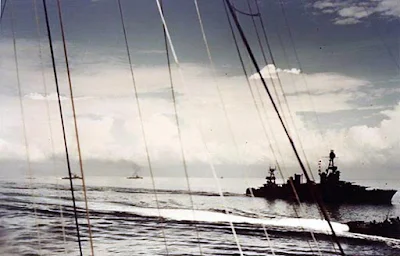 |
| Allied ships maneuvering off Tulagi, Solomon Islands, on 9 August 1942. The U.S. Navy heavy cruiser USS Chicago (CA-29) is at right, with a destroyer’s stern and wake in the foreground. The column of smoke in the left center distance, beyond the two destroyers, may be from the burning troop transport USS George F. Elliott (AP-13). |
 |
| The U.S. Navy heavy cruiser USS Chicago (CA-29) off Guadalcanal the day after the Battle of Savo Island, showing crewmen cutting away damaged plating to enable the ship to get underway. She had been torpedoed at her extreme bow during the night action of 9 August 1942. The view looks forward along her port side, with the No. 1 eight-inch gun turret in the upper right. Note the life rafts hung on the turret side and the destroyers in the distance. |
 |
| “Men wounded in the Battle of Tulagi Island being removed from the USS Blue (DD-387) to the USS Neville (AP-16), 7-8-9 August 1942.” Quoted from the original caption. This photograph was probably taken on 9 August, as Blue was transferring survivors of the Battle of Savo Island, which had taken place during the previous night. |
 |
| Map showing the disposition of the Imperial Japanese and U.S. forces at the beginning of the Battle of Savo Island, circa 0100-0120 hrs on 9 August 1942. |
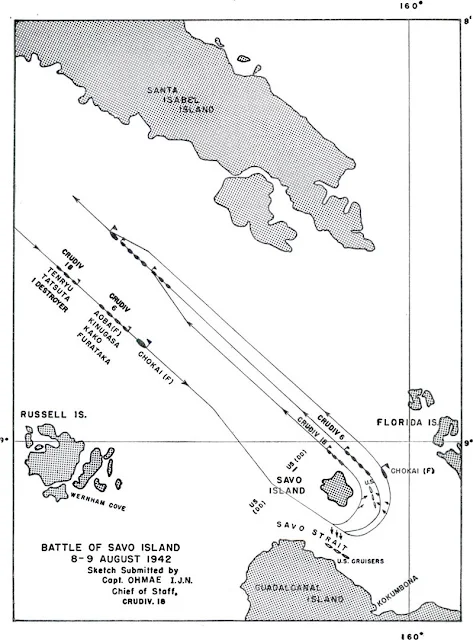 |
| Battle of Savo Island showing Japanese movements based on testimony from a surviving Japanese participant. |
 |
| U.S. Navy map from 1943 of engagement between Japanese ships and southern force of Allied ships in battle on August 8-9, 1942. |
 |
| U.S. Navy map from 1943 showing battle between Japanese ships and Allied northern force ships near Savo Island on August 9, 1942. Modified in 2006 to show that the Japanese force split into two groups. |


